UK Defence: an Introduction
Just One Damn Thing after Another
Judging by media reporting, UK defence confronts an endless litany of problems: procurement of vehicles and equipment; recruitment and retention of service men and women; the quality of housing; cases of sexual assault and bullying; the lack of effective air defence around the UK; the Royal Fleet Auxiliary taking commercial strike action; all services working under strength; and a glacially slow pace of budget increase combined, extraordinarily, with continued demands for in-year cuts in spending.
A net assessment might say that UK defence lacks strength and organisation, largely because it is politically, and therefore strategically, directionless. Yet there seems no lack of political rhetoric that seeks to give the opposite impression – one of political commitment and leadership. Defence is often described, in ringing tones, as the ‘first duty’ of government; an assertion that would appear to have been lifted verbatim from Adam Smith’s lucid observation in The Wealth of Nations: ‘The first duty of the sovereign is that of protecting the society from the violence and invasion of other independent societies’.
Rhetorical flourishes accompany most, if not all statements of political intent. But national security and defence require its accompanying rhetoric to be sober and sincere rather than casual and disingenuous. When Prime Minister Keir Starmer refers to his government’s ‘first duty’ his audience in the UK hear him making what they think must be a serious, substantive commitment. And when the leaders of allied European governments hear the same words, they suppose, not unreasonably, that Prime Minister Starmer must mean it.
Less than credible
UK defence has always been a working compromise between declaratory policy or rhetoric, military strategy, and fiscal constraints, with the character of that compromise determined by a fourth variable – the military stability of the UK’s areas of concern. However, while the fourth variable seems clear enough (there is a land war being fought in Europe and a crisis in the Gulf), the ‘working compromise’ measured in terms of the capability and credibility of the UK’s defence posture, is less than convincing.
Various explanations – some stronger than others – might be offered for this situation. One view is that it results from a collision between closely contested electoral politics and tightly constrained public finances: ‘There are no votes in defence’, so the aphorism goes, while there are plenty of votes in other, more appealing areas of public spending such as health, welfare, decarbonisation and so on. Others see the problem as a triumph of publicity over substance; the most recent UK defence reviews have been colourfully illustrated and this has given them an appearance of superficiality: lacking gravitas, changing little and too soon becoming politically disposable.
Inter-service rivalry or tribalism is also widely considered to have a corrosive effect on the development and maintenance of a balanced and capable UK national defence posture as each of the armed services fights – often in public – for the largest possible slice of a declining defence budget, to the detriment of the whole. One consequence of this tribalism is the notion that what the UK really needs is something described – albeit without much clarity of definition – as a ‘grand strategy’ that will set out, unequivocally, what sort of defence posture the UK should have. A related claim is that large-scale defence spending on any sort of ‘legacy’ ideas and equipment could be avoided altogether as rapidly evolving weapons and communications technology provide all that defence will need, and more cheaply.
One final explanation for the apparently unhappy state of UK defence concerns the language in which it is too frequently expressed. The language of UK defence policy should be characterised by sophistication, diplomacy, nuance, risk awareness, determination and so forth. But these characteristics have largely been replaced by equivocation and prevarication (largely cost-driven) such that the UK’s declared defence policy has become unconvincing and unpersuasive and at times has bordered on the risible and deluded (e.g., the ‘Global Britain’ refrain of recent memory). The language of UK defence practice, on the other hand, should be clear, decisive and goal-oriented but it has too often become a theatre for pretentious intellectualisation and pseudo-philosophising such that its outpourings have become unintelligible. In his seminal work On War, published in the 1830s, the Prussian General Carl von Clausewitz saw the importance of clear expression in matters of strategy: “We will […] avoid using an arcane and obscure language, and express ourselves in plain speech, with a sequence of clear, lucid concepts. […] If concepts are to be clear and fruitful, things must be called by their right names.”
Hope for the future
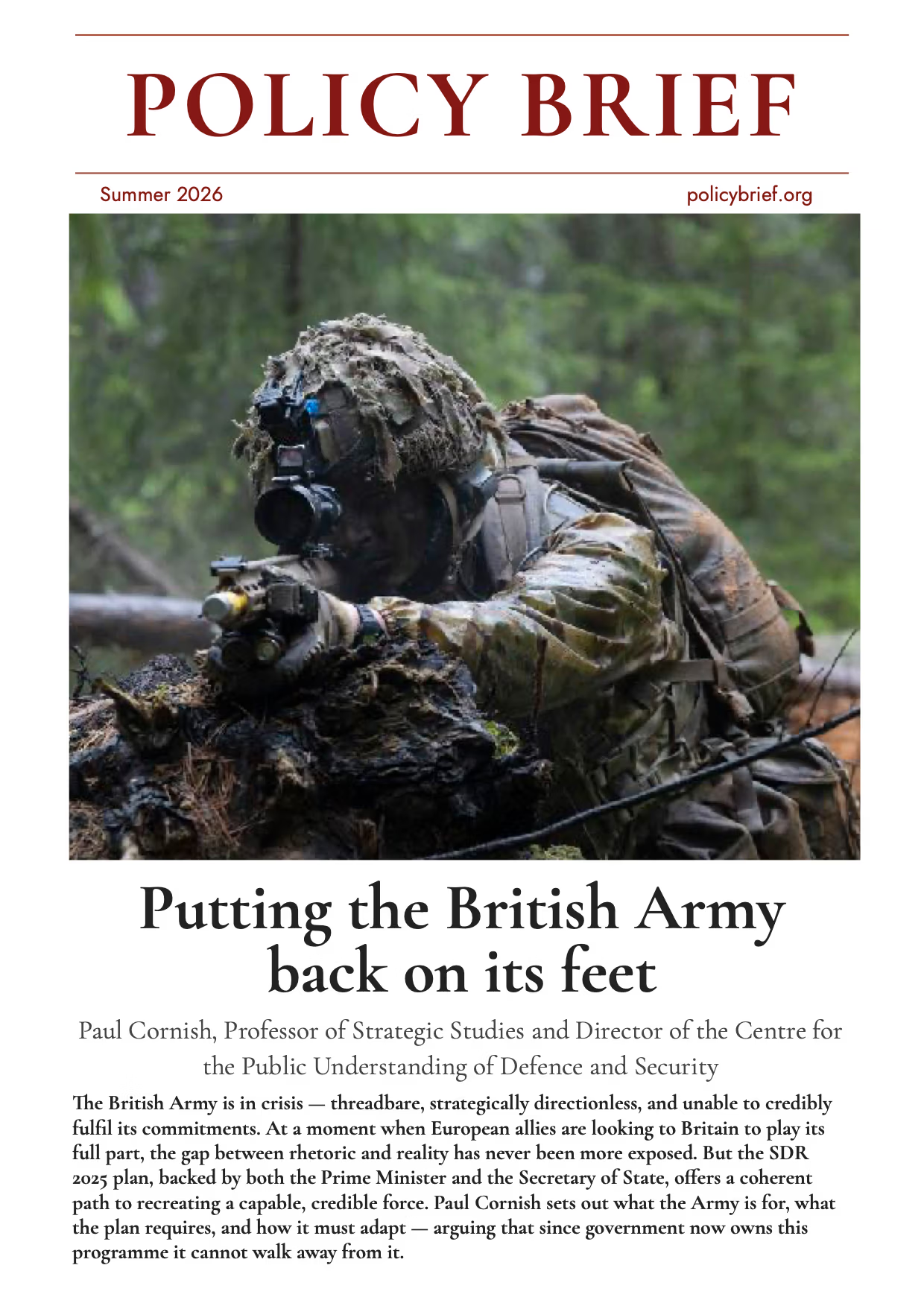
In general, UK defence is afflicted by a mood of widespread and seemingly inescapable gloom, with serious concerns being raised as to the government’s commitment to reversing decades of retrenchment in defence spending and preparation; a trend that has left the UK with a collapsing reputation, both for its military capability and even for its seriousness in matters of strategy and defence. There are, however, encouraging signs that a corrective might soon be administered (at least within the current political cycle) and it is with this possibility in mind that this essay asks how the British Army might be re-energised and rebuilt. The British Army is not, of course, the sole or complete expression of UK defence policy, but it is the largest and, arguably, the most visible component of UK defence. And while allowing for obvious technical and operational differences between the armed services, it is also fair to say that many of the most significant problems currently facing the British Army (e.g., funding, equipment acquisition, recruitment and retention) are also being faced by the Royal Navy and the Royal Air Force. But the problems with which the British Army is confronted are immense. It is now embarrassingly, even painfully apparent that the British Army is fast becoming so threadbare that its ability to carry out and maintain the tasks traditionally expected of an army are in question.
Grounded in what is admittedly a traditional understanding of the UK defence environment, this essay asks how the British Army might emerge from a period of reconstruction, based upon responses to three sets of questions:
- Purpose: what is the British Army – indeed any army – actually for? What, in general terms, should an army be required to do? Who or what determines these requirements?
- Plan: what is the vision for the British Army out to 2035? What is its proposed strength and structure and what is it expected to achieve in this configuration? Does it have the procedures, personnel and equipment it will need?
- Future: how should the British Army meet expected and plausible strategic challenges in 2035 and beyond?
The Purpose of the British Army
The British Army’s purpose in the early 21st century is little different from that of most organised armies throughout history: an army has conventionally existed for the task of inflicting the threat or fact of organised violence on an adversary. That task is undertaken to defend or capture territory when it is judged necessary to do so, for whatever reason. The emphasis on territory invites further analysis: how much territory, of what type, where, for how long should it be held and against what type and scale of adversary? Does the task of capturing territory differ substantively, in e.g., equipment, tactics and logistics, from the task of defending it?
The threat to use armed force is arguably as important as the fact of its use, if not more so. If an army is capable of carrying out the threats it makes and can communicate that capability to an adversary, such that the adversary believes the threat to be credible and decides against aggression, then an army can be said to have achieved a deterrent effect. Territory might be protected and the costs of open conflict might have been avoided altogether. As Sun Tzu wrote some 2,500 years ago, “The skilful leader subdues the enemy’s troops without any fighting.” Were deterrence to fail, however, and were armed conflict to break out, then a capable and credible army would find itself able to move, relatively straightforwardly albeit probably with reinforcement, from the threat to the use of armed force. Effective deterrence is best understood not as an alternative to effective defence, but as its enabler.
An army can be expected to train for and draw upon a broad range of tactical and operational practices to achieve its purpose. Tactical practices (from the Greek taktikós, meaning to organise and deploy troops) might include such things as interlocking arcs of fire, patrolling, cordons, advance to contact, logistics and positional assault. And at the operational level commanders might consider containment, the indirect approach, manoeuvre warfare, all-arms co-operation, multi-domain operations and so on. An army might also be expected to undertake such operational tasks as home defence, to contribute to and collaborate with alliances and partners such as, in the UK case, NATO and the Joint Expeditionary Force, and to conduct peacekeeping duties such as those mandated by the United Nations.
An army cannot expect to have an open, unfettered licence to operate. In the first place, an army must carry out its function within the budget set for it. Adam Smith, mentioned above, explained this necessary constraint in these terms: “In a civilized society, as the soldiers are maintained altogether by the labour of those who are not soldiers, the number of the former can never exceed what the latter can maintain…” In other words, Smith argued not for a wilful denial of the cost of defence, but for a very close awareness of that cost. But there is an implicit trade-off to be made here, in that government should not expect more defence capability than it is able and willing to pay for. It also follows that if the ‘first duty’ argument is to be anything more than hollow rhetoric, then civil government must accept that its unrivalled responsibility as the ‘sovereign’ comes at a cost that only it can (and should) meet. The matter of financial provision is, in other words, very closely connected to the final determinant of an army’s purpose. At least in liberal democratic societies, it is not for armies to decide their purpose on their own terms. Clausewitz, so widely venerated in western military staff colleges, described this restraint on military authority in the following terms: ‘The political object is the goal, war is the means of reaching it, and means can never be considered in isolation from their purpose.’ [Emphasis added].
The Army’s Commitments and Plans
The current strength (mid 2026) of the British Army is based largely upon some 74,000 ‘regular’ (i.e., permanent, full-time) troops. This force is supplemented by a further 4,000 Gurkha troops, making a regular force of about 78,000, supplemented by a volunteer reserve (trained, part-time and often ex-regular) of about 26,000, as well as 5,000 others. The size of the regular force often leads commentators to complain that the British Army is now significantly smaller than one or another historical reference point; Fairfax and Cromwell’s army of the mid-seventeenth century Civil War; the War of the Spanish Succession at the beginning of the eighteenth century; or the Napoleonic Wars. These historical comparisons, colourful and interesting though they might be, are of questionable value; after all, rather a lot has happened in military terms in the almost four centuries since Cromwell and there can surely be no serious argument that the British Army of 2035 should emulate the New Model Army of 1645. A more serious criticism is that quantitative comparisons such as these miss the crucial point and add very little to the contemporary debate on British defence policy. What is needed, instead, is a qualitative assessment asking whether the British Army, however it is constituted, can meet the tasks that could be expected of it in the strategic environment of the mid-twenty-first century.
The current plan for the British Army involves an extensive reorganisation of commands, formations and functions. According to its website, the UK Field Army (since March 2026 to be known, once again, as UK Land Forces) is “responsible for generating and preparing forces for current and contingency operations.” The Field Army/Land Forces has under direct command various functions (e.g., surveillance, intelligence, electro-magnetic activities and the Army’s Land Warfare Centre) as well as ‘Field Army Troops’ including several specialist brigades: special operations, information operations, recce-strike and medical. UK Land Forces also commands the UK’s two divisions:
- 1st UK Division: a light forces division of about 30,000 personnel, describing itself as the UK’s ‘Global Response Division’ with seven brigades deploying units of light armour, infantry, air assault, artillery, engineers, logistics and medical support;
- 3rd UK Division: a heavy division of up to 20,000 personnel, describing itself as the ‘Iron Division’ with deep recce-strike and armoured manoeuvre brigades deploying armour, infantry, artillery, engineer and logistics units, as well as air defence and signals.
The language of army organisation – ‘field army’, ‘division’, ‘brigade’, ‘regiment’, ‘company’ and so on – might sound quaintly historic. But there is method in it. These specialised terms are easily comprehensible (the Royal Navy still has ‘frigates’ and ‘destroyers’, after all) and have the great virtue of being reconfigurable. The organisation of 1st UK Division, for example, shows how familiar structures can be used to adapt to the new and unfamiliar. In addition to the formations and units listed above, the British Army commits units and sub-units to the UK Special Forces Directorate, part of the UK Cyber and Specialist Operations Command.
The overarching vision for the British Army is to support the three UK defence roles set out in the 2025 Strategic Defence Review: defend, protect, and enhance the resilience of the UK, its Overseas Territories, and Crown Dependencies; deter and defend in the Euro-Atlantic; and shape the global security environment. These commitments are not born of reminiscence of the British Army’s past glories (and failures); they are the considered summary of the range of ‘real world’ tasks the British Army will be expected to undertake for the foreseeable future.
While the first and third of these roles are general in character, albeit no less vital to UK defence, the task of deterrence and defence in the Euro-Atlantic is more specific. The UK is committed to provide NATO with a functioning corps headquarters in the form of the Allied Rapid Reaction Corps (ARRC) commanded by a British general and based in Gloucestershire. With command of the UK’s 1st and 3rd Divisions, together with troops from elsewhere in NATO, the Allied Rapid Reaction Corps will form one of two NATO Strategic Reserve Corps. The second Strategic Reserve Corps is to be based on France’s 1st Army Corps, to which the UK will also contribute troops. As noted earlier, these commitments to allied security and defence are taken seriously by the UK’s allies, particularly those in Europe for whom the involvement of the British Army is and will be considered indispensable.
To satisfy this list of tasks and requirements, the British Army is planned to have a minimum troop strength of 100,000 (full-time and reserve), with the ability to “rapidly expand and mobilise Reserve forces”. As outlined, the Army will require a range of armoured platforms (reconnaissance vehicles, main battle tanks, armoured infantry vehicles, artillery, armoured engineers), attack helicopters, field engineers, intelligence, communications and medical support, and a logistics chain (fuel, ammunition, rations, repair) that is responsive and deployable. The Army will also require a comprehensive, repeatable training programme, with access to high quality training areas and facilities, to maintain its capability and credibility. It is important to note that this is not merely a ‘shopping list’ of ‘nice to have’ vehicles and capabilities that senior Army officers have had their eye on; the plan to reconstruct the British Army will depend on the acquisition and sustainment of everything listed here. As discussed above, the British Army has a considerable list of essential commitments with which its capabilities must be fully reconciled.
The reorganisation and re-equipment of the British Army is currently underway, with an approximate target date of 2035. The plan is as clear, coherent, expert and versatile as might be expected of a medium-sized, economically recovering, internationally oriented country with a strong reputation for military capability. It is also a plan that positions the UK and its Army at the highest joint and combined operational level (i.e., corps level) within NATO, in Europe and internationally. All that said, the plan will require a strong commitment of effort and expenditure before it can be said to be fully implemented. There will, almost certainly, be procurement delays and errors, setbacks in the public finances, and even international crises that will divert attention and funds and increase the likelihood that difficult (i.e., costly) questions will simply be hedged: Will commitments to invest in the Army’s vehicle and equipment plan be met? Will sufficient personnel (particularly reserves) be recruited and retained? Will the Royal Navy and Royal Air Force be able to provide the Army with the enablers it will need?
The Army’s Future
Military strategy is informed by the past and enacted in the present as deterrence of, or response to, calculable risks of conflict. But strategy’s greatest challenge is, arguably, with the future and its uncertainty: with strategic possibilities that are plausible albeit not (yet) calculable. However comprehensively and intelligently articulated, military strategy can be derailed rapidly if the future arrives sooner than thought plausible, in an unexpected shape (Nassim Taleb’s ‘Black Swan’) or in a way that overwhelms prevailing assumptions. In Liquid times: living in an age of uncertainty, the sociologist Zygmunt Bauman summarises the problem as a “liquid phase of modernity”: “Social forms … can no longer … keep their shape for long, because they decompose and melt faster than the time it takes to cast them…” If that description is accurate then how can the plan for the British Army be future-proofed, and for how long? How can the Army manage this ‘strategic liquidity’; being effective in the present while adapting to the future as it begins to emerge, and continuing to adapt thereafter?
Subject to its complete and successful implementation, the 2025 theory of change for the British Army could be as ‘liquid’ a plan as might be hoped for: responsive in ideas, military doctrine and organisation, with an element of latency built into the design, manufacture and deployment of vehicles and equipment. With what SDR 2025 describes as a “dynamic ‘high-low’ mix of capability”, the British Army will seek a ‘20-40-40’ mix between crewed platforms (20%) controlling reusable platforms such as drones (40%) and consumables such as conventional munitions (40%). The attraction of this approach is that it provides a conceptual bridge between legacy and emergent systems and challenges, while remaining open to the unfamiliar and unknown.
The 2025 plan for the British Army has also provided a response to another long-running debate: whether the British Army should be concerned primarily with mass (of armour, infantry and artillery) as in its twentieth century past and more recently or should embrace the advantages offered by new and evolving technology. The 2025 plan appears to suggest that a balance can be found between mass and technology: a balance that can evolve as circumstances change, with new technology multiplying the effect of (reduced) mass, rather than replacing it altogether. As recent and current conflicts show, war has not changed conclusively from the legacy model of mass, heavy warfare to a new model of technological advantage. War is certainly changing – as it always has – but it is important to understand the properties of military innovation without being seduced by it.
All military technology is obsolescent as soon as it emerges from the factory, but that does not mean it is obsolete. In all but the rarest of examples, the replacement of the old by the new tends to be a gradual and very cautious process. It is also important to bear in mind that military innovation usually, if not inevitably, provokes countermeasures, whether technical or procedural, as explained by JFC Fuller’s ‘constant tactical factor’.1 For example, the ‘drone’ (or, more specifically, the uncrewed combat aerial vehicle – UCAV) is widely cited as evidence of a fundamental shift in the nature of warfare. Yet technical countermeasures are already beginning to emerge that question this proposition. And if it is the case that the effect of UCAVs (e.g., in Ukraine) has been to immobilise the modern battlefield, turning it into a ‘no-go, no-man’s land’ in which manoeuvre warfare has become close to impossible, then it seems certain that land forces will find new ways to pursue their traditional tasks of taking and holding territory. Unless, of course, ‘post-modern’ warfare has also become ‘post-territorial’, with conflict being decided in some way other than by the gain or loss of territory, and perhaps even ‘post-human’ through the use of automated systems and robotics.
Conclusion
This assessment of the prospects for a reconstructed and reinvigorated British Army prompts various summary and wider conclusions. First: the British Army plan, as set out in the 2025 SDR, has the endorsement not just of the Secretary of State for Defence but also of the Prime Minister. In other words, the UK government ‘owns’ the plan for the British Army. Second: there is no other plan. This is what the British Army is intended to become; there is not an easier, cheaper ‘lite’ version on offer and nor could there be, given the scope of the UK’s strategic commitments. It follows that a cost-saving proposal to, say, cut the number of recce-strike armoured vehicles or delay the purchase of artillery ammunition by five years, would be an implicit, but militarily and strategically inexpert argument for a different, as yet undefined, plan. Third: for an army to qualify as such, it must be a ground force that produces ground effects. Other organisations and devices might achieve ground effects, but they are not known as armies and are unlikely to be as versatile as armies. Fourth: if the programme to reorganise and re-equip the British Army, as scheduled, demands more from the public finances than current projections of defence spending envisage, then it also follows that the UK government must either revise those financial provisions so the UK can have the Army for which it has planned, or revise the plan (again) while reconsidering how, where and at what intensity the UK should be strategically and militarily committed, and be honest about this with both the public and the UK’s allies.
No discussion of UK defence can expect to have much traction if it is predicated on the belief that the UK’s public finances are a metaphorical bottomless pit, or that scarce public finances can be spent casually and even incompetently. It is, of course, possible to make a general argument that ‘more should be spent on defence’, but that would simply repeat a claim that for many decades has been depressingly easy for government to ignore. Instead, the plan for the British Army, as set out in SDR 2025, makes a very different, more constructive and convincing argument that ‘no less can be spent’; the UK government has an inescapable responsibility for the British Army that should be regarded with as much gravity as, say, the provision of hospitals and schools. This in turn will require a cultural shift in the way the financing of defence has traditionally been managed.
There seems to be something about UK defence spending that encourages government ministers and officials (notably those associated with the Treasury) to believe they have sufficient knowledge and understanding of defence to make authoritative judgements on the size, shape and capability of UK armed forces. This excess of confidence is manifested in the only form of decision-making in which these ministers and officials actually do have authority – input decisions concerning the level and schedule of funding allocations to defence. What is urgently required, instead, is a cultural shift which acknowledges that while input decisions must of course be within the scope of expertise of the Treasury, the main purpose of these spending decisions lies in the output they can purchase, providing the country’s experts in military power with the equipment and capabilities they require. A more rounded understanding of defence spending would also acknowledge that much of what is required is for the indirect purpose of deterring aggression and armed conflict. If the purposes of defence spending, direct and indirect, can be fully understood then not only will the armed forces receive the funding they require and for which they have planned, but government will have honoured in full the task set for it by Adam Smith, ensuring that the ‘primary duty’ is substantive rather than merely rhetorical. Furthermore, those responsible for the expenditure of public finances will have demonstrated their keen appreciation of the value of deterrence to the UK economy and the considerable costs that can be associated with its failure.
Finally, the UK government, the Ministry of Defence and the UK armed forces need to go much further in improving the UK public’s understanding of, and engagement with defence. It is, after all, the public who must endure the costs of defence (financial and personal) in order to enjoy its benefits. The problems that UK defence must confront are certainly historic and, without doubt, economic. But they are also political and cultural and are becoming ever more so. The UK public’s understanding of defence needs to be that of a public benefit that cannot be deferred on the grounds that it imposes too many costs and inconveniences in the present.
1. JFC Fuller, Memoirs of an Unconventional Soldier (London, I. Nicholson and Watson, 1936), p.453.