The UK government’s September 2025 Defence Industrial Strategy is subtitled “Making Defence an Engine for Growth”. This seems a misplaced priority, it should have been subtitled “Making the Weapons We Need”. A consequence of defence policy — economic spill-overs — has become an objective, distorting decision-making about the primary function of the policy: efficient acquisition of the armaments that the UK requires. The Defence Industrial Strategy contains much about the defence dividend and how the Ministry of Defence (MoD) should maximise its potential to drive economic growth, but less about determining what weapons are needed and how they should be procured and financed.
Financing is a particular problem. Introducing the 2025 Strategic Defence Review (SDR25), the Prime Minister said “We are delivering our commitment to spend 2.5% of GDP on defence, accelerating it to 2027, and we have set the ambition to reach 3% in the next Parliament, subject to economic and fiscal conditions.”1 But this will not provide enough money to do what was promised in either SDR25 or the Defence Industrial Strategy, and in consequence publication of the Defence Investment Plan (DIP), promised for Autumn 2025 was postponed. Press reports say that in December 2025 the Prime Minister asked for the Defence Investment Plan to be reworked because of questions about affordability and that it is not now expected till March 2026. These changes in the defence budget are quite marginal relative to some previous rearmaments. The Korean War rearmament raised defence from 7.3% of GDP in 1950 to 11.1% in 1953.
This policy brief explains why letting the growth and prosperity agenda drive defence policy is a mistake. It then looks at the threat, the money, the industrial policy and the procurement process, and concludes with examples of good and bad practice.
Growth?
The current emphasis on growth in defence planning has its origins in a tendency to goal displacement that began in the 1990s. With the end of the Cold War, governments felt unable to justify defence spending in military terms so shifted to justifying it in economic terms. The problematic nature of this shift prompted metaphors like trying to hit two birds — security and prosperity — with one stone, and letting the economic tail wag the military dog. The government is also accused of taking its eye off the many balls in the air, including the increasing security threat, US unreliability and the technological transformation of the nature of war.
The shift to an emphasis on economic consequences is explicit in the 2015 Defence Review, which set three national security objectives: protect our people; project our global influence; and promote our prosperity. Defence Ministries know about protection and power projection, they have neither the expertise nor the instruments to promote prosperity, this is the job of other Departments. It is hard enough trying to buy the right weapons, without complicating the process with other concerns. The prosperity agenda also gives a powerful lever to domestic monopolists to argue against imports.
The Defence Industrial Strategy says we will strengthen our national security through the strong deterrence provided by a strong industrial base whilst supporting economic prosperity so that every region and nation of the UK benefits from the defence dividend. This suggests that you can have both security and prosperity, that there is no trade-off. But trade-offs are inevitable. Central Banks set interest rates by balancing less inflation against more unemployment. Finance Ministries set defence budgets by balancing more security against its opportunity cost, less money for other things. These are macro trade-offs. The micro trade-offs in acquiring a tank involve finding the cost-effective balance between protection, mobility and firepower, not how the tank can contribute to prosperity. Not only is there a lot that can go wrong when trying to balance multiple poorly defined objectives, it slows everything down.
“The shift to an emphasis on economic consequences is explicit in the 2015 Defence Review, which set three national security objectives: protect our people; project our global influence; and promote our prosperity.”
The negative effects of the emphasis on a prosperity agenda at the expense of defence considerations are now widely recognised. In A RUSI Journal article on the security prosperity paradox2, William Parker argues that the merger of national security and national prosperity has caused the UK’s strategic decision-making and prioritisation efforts to have grown increasingly vague and indecisive. Similarly, in a RUSI commentary on the false promise of defence as prosperity3 Noah Sylvia and Khem Rogaly argue that “Framing defence spending as a path to prosperity ignores its poor economic returns, limited job creation, and the opportunity costs of not making alternative public investments.”
In a Wavell Room article4 Laurence Thomson argues that there are three areas of concerns regarding the Defence Industrial Strategy. First, it risks confusing economic policy with strategic and military deterrence so that the emphasis on jobs and regional regeneration could dilute the much-needed focus on lethality, readiness and operational capability. Second, it is not clear that British industry has the capacity and ability to deliver it. Third, its delivery lacks fiscal credibility.
In the Defence Industrial Strategy’s section “Fixing Defence Procurement”, the secondary objectives are given prominence, with the primary objective tagged on at the end. “By introducing a consistent approach to commissioning new programmes, we will ensure decisions on procurement are informed by the full range of government policy drivers, including export potential, growth and other strategic factors, at the earliest stage in the acquisition process, in addition to the fundamental objective of equipping our service personnel.”5
The UK uses the VSTOL F35B on its aircraft carriers but has announced the purchase of 12 F35A6 aircraft that can be used to deliver US nuclear weapons. The UK would join the nuclear sharing program in which Belgium, Germany, Italy, the Netherlands, and Turkey host US nuclear weapons and have aircraft that can deliver them. The US controls these weapons. This is a major strategic change, but the announcement emphasised the economic benefits: “Order will support 20,000 jobs across the UK, with over 100 UK-based suppliers contributing to the F35 programme.”
These secondary objectives are embodied in defence contracts through a minimum of 10% of the total tender evaluation weighting being given for social value7. The MoD’s social value priorities include tackling economic inequality; fighting climate change; equal opportunity: enhancing mental and physical health for communities impacted by defence activities; community cohesion: building stronger relationships between military and civilian populations. These are all desirable outcomes and, in some cases, may bring military benefits: skills creation and supply chain resilience are directly related to the strength of the defence industrial base. But it should be the military benefits that matter, particularly given the nature of the security threat the UK now faces.
In the Defence Industrial Strategy the secondary objectives of economic growth and exports are given prominence, with the primary objective of delivering the equipment the armed forces needs tagged on at the end.
Threat?
In her first speech in December 2025 Blaise Metreweli Chief of the Secret Intelligence Service argued that the rules of conflict are now being rewritten and that “Our world is more dangerous and contested now than it has been for decades. …. We are now operating in a space between peace and war.”8 In this space the Russians are exporting chaos by cyberattacks on critical infrastructure; drones buzzing airports and bases; aggressive activity in our seas, above and below the waves; state-sponsored arson and sabotage; propaganda and influence operations that crack open and exploit fractures within societies. In a speech at the same time the Chief of the Defence Staff, also argued “that the situation is more dangerous than I have known during my career and the price of peace is rising.”9
Ukraine showed how fast traditional munitions are exhausted and how fast technology is changing the character of war. The US National Security Strategy noted “The huge gap, demonstrated in recent conflicts, between low-cost drones and missiles versus the expensive systems required to defend against them has laid bare our need to change and adapt.”10
Designing a response to the threat is made more difficult by the unpredictability of the US. Much of the language of its National Security Strategy, is critical of Europe including “activities of the European Union and other transnational bodies that undermine political liberty and sovereignty … and loss of national identities and self-confidence.”11 Later, it says “This lack of self-confidence is most evident in Europe’s relationship with Russia. European allies enjoy a significant hard power advantage over Russia by almost every measure, save nuclear weapons. As a result of Russia’s war in Ukraine, European relations with Russia are now deeply attenuated, and many Europeans regard Russia as an existential threat. Managing European relations with Russia will require significant U.S. diplomatic engagement, both to re-establish conditions of strategic stability across the Eurasian landmass, and to mitigate the risk of conflict between Russia and European states.”12
The Chief of the Defence Staff, Air Chief Marshal Sir Richard Knighton, has stated that “that the situation is more dangerous than I have known during my career and the price of peace is rising”.
The National Security Strategy is not all negative, later it says “America is, understandably, sentimentally attached to the European continent — and, of course, to Britain and Ireland.”13 However, a sentimental attachment is probably not enough given the dependence of the UK on the US for its nuclear missiles, intelligence cooperation through Five-Eyes, space-based assets, and much equipment including F35s. But rather than diversify or hedge, the Defence and Industrial Strategy seeks to “Maximise and expand industrial and technological collaboration with the USA.”14
If the UK cannot rely on the US, its industrial policy needs to build more links with Europe. The European defence industry is substantial. In the Stockholm International Peace Research Institute list of 100 largest arms companies15 about a quarter of the firms are European and they account for about a fifth of the total spending. But Europe is too fragmented to exercise hard power or produce efficiently. Where the US produces a single type of tank or aircraft, Europe produces many. European arms companies are too small because national governments defend national champions and as a result lose the benefits of a division of labour, economies of scale, and learning curves.
Money?
One of the authors of SDR25, General Sir Richard Barrons, has pointed out that the money for it was arriving more slowly than the risks, and that SDR25 was set two requirements which were always at odds. The first was to determine what needed to be done for deterrence and, if necessary, fighting in the new strategic reality. The second was to establish what could be done to deliver this outcome within a 10-year financial profile.
Public expenditure is normally planned with a five-year horizon. The 2025 Spending Review set figures till 2028-9 for current spending, and 2029-30 for capital spending. However, big defence projects have decades long horizons. This is provided by the equipment plan, now renamed the Defence Investment Plan (DIP). The Defence Industrial Strategy says that to improve our signalling of defence requirements to industry we will deliver the Defence Investment Plan by Autumn 2025. Not only was it not delivered, there was a six-month delay in appointing the new National Armaments Director, Rupert Pearce.16

Photographer: Cpl Tim Hammond. Copyright: UK MOD © Crown copyright 2023.
Both MoD and the National Audit Office (NAO) agreed that the last equipment plan in 2023 was unaffordable. In March 2023 MoD forecast total equipment costs of £305.5bn over the next ten years against a budget of £288.6bn. The ring-fenced nuclear deterrent costs of £117.8bn exceeded budget by £7.9 billion. The whole defence budget showed a ten-year deficit of £42.5bn. These relate to the previous government — we await the figures for this government. Press reports suggest that the gap in the Defence Investment Plan between the cost of implementing SDR25 and the proposed budget is £28bn.
Sir Richard Barrons thought that the combined effects of inflation, foreign exchange movement, shortcomings in programme delivery, and the re-costing of recommendations meant that perhaps £2bn has to be saved in-year to balance the books. The savings could come from training, routine activity and maintenance, which reduce readiness, but it also means not much money is available for the new requirements identified in SDR25.
Laurence Thomson also reported that industry voiced concerns about bureaucratic inertia and the slow translation of strategic ambition into executable contracts, with some firms publicly citing delays in purchases as emblematic of systemic issues.17 Leonardo who had been waiting for over a year for an order for AW149 helicopters, where it is the only bidder, is threatening to leave the UK and close the Westland plant in Yeovil.
“MoD and the National Audit Office (NAO) agreed that the last equipment plan in 2023 was unaffordable. MoD forecast total equipment costs of £305.5bn over the next ten years against a budget of £288.6bn. The whole defence budget showed a ten-year deficit of £42.5bn.”
Overambitious plans, for which there is not enough money, cause waste and mismanagement. Britain spent £72m on a mid-life upgrade of the amphibious assault ship HMS Bulwark, then sold it to Brazil for a reported $26m. Bulwark’s sister ship HMS Albion has been withdrawn from service due to manning and budgetary problems.
Industrial policy
The objectives of the Defence Industrial Strategy — “we will reform procurement, innovate at wartime pace, and grow our industrial base” — are laudable, but there is no evidence that the Government is willing to make the hard choices required to implement them. As it states, “Previous defence industrial strategies have failed where ideas are prioritised over implementation,”18 yet the current strategy seems likely to fail for the same reason.
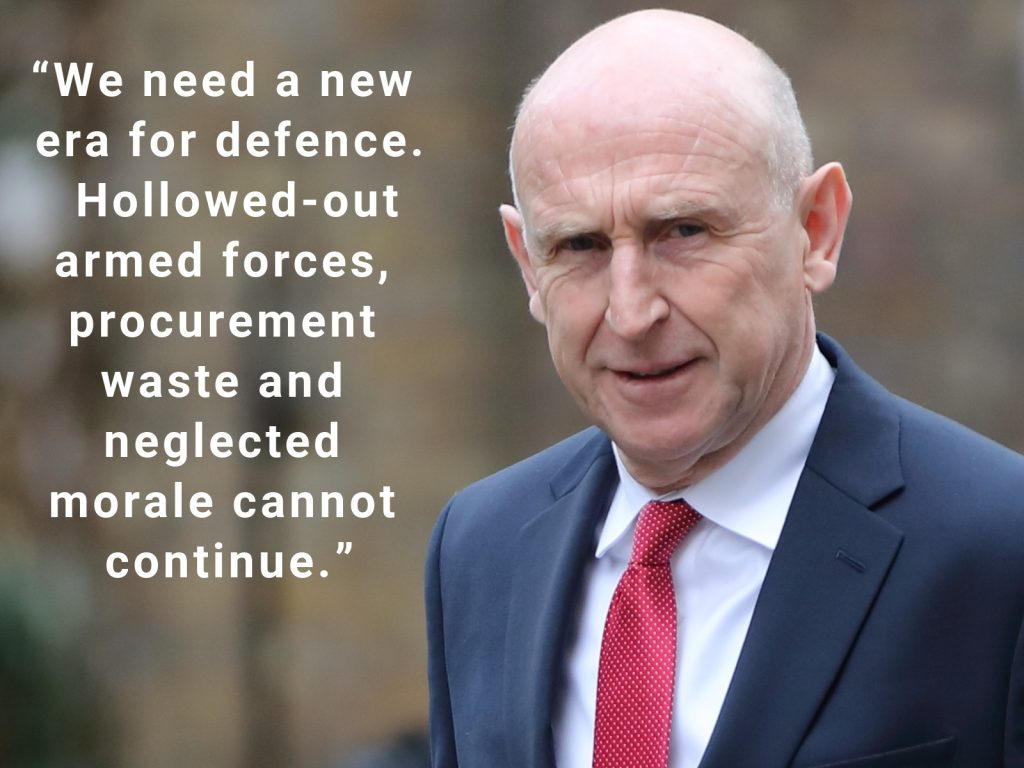
Since the 1950s British Defence Policy has been described in terms of a persistent imbalance between resources, capabilities and commitments. At regular intervals that imbalance becomes unsustainable and prompts a defence review that does not resolve the contradictions. Ben Wallace, then Defence Secretary said, in the foreword to the 2021 Defence Command Paper published alongside the Integrated Review: “Previous reviews have been over-ambitious and under-funded, leaving forces that were overstretched and under-equipped.”19 The 2021 Defence Command Paper and Integrated Review had to be rapidly refreshed with an update in 2023.20 The Labour Defence Secretary, John Healey, announcing the terms of reference for the SDR25 said “we need a new era for defence. Hollowed-out armed forces, procurement waste and neglected morale cannot continue.”21
Given the unpredictability of threats and the impossibility of optimising against unknowns, a common analogy is to treat defence policy as an insurance policy. You do not know what may occur, so you pay a premium, a defence budget of some percentage of GDP, which is invested in such a way that it pays off by reducing damage if an adverse event, such as a threat, materialises, and possibly deterring the threat. What the optimisation approach may regard as inefficient redundancy, the insurance approach regards as useful given the uncertainty: just in case rather than just in time. But you cannot afford everything, so you have to choose.
One choice is between specialisation and diversification. Specialisation involves acquiring relatively few, “exquisite” platforms, like aircraft carriers, optimised for particular roles. These platforms have to be provided with arms, personnel, support, logistics, and protection, with the danger that, because there are so few of them, each platform is too valuable and vulnerable to use. Many of these platforms are probably better seen as symbols of geo-political aspirations rather than as useable weapons. But they are true Black Holes, as they run over budget their gravitational field sucks in money from all the small useful projects that get sacrificed to construct them.
Diversification suggests many “cheap and cheerful” general-purpose systems that can be used for a variety of roles. UK wars — the Falklands, the 1991 Gulf War, Iraq and Afghanistan — were largely “come-as-you-are-wars” using whatever equipment was available at the time, not equipment optimised for that type of conflict. Were there enough money one might buy both. The US was once able to develop both the cheap F16, which has been mass produced, and the expensive F15. But there is now rarely enough money to do both, even in the US. Instead, there are calls for a combination of the “exquisite” and “expendable”.
SDR25 was conducted within a set of “parameters”. These were a total commitment to the nuclear deterrent; enhancing the UK’s contribution to NATO; reinforcing homeland security; supporting Ukraine; maintaining defence ties to the Indo Pacific region, the Gulf and the Middle East and delivering on the AUKUS partnership with the US and Australia. The government said “Within these parameters, the Review will consider the need for prioritisation of objectives”22. But these parameters themselves are unaffordable and unachievable. Trying to do everything means doing nothing effectively.
“The 2025 Strategic Defence Review was conducted within a set of “parameters”. But these parameters themselves are unaffordable and unachievable. Trying to do everything means doing nothing effectively.”
Buying weapons
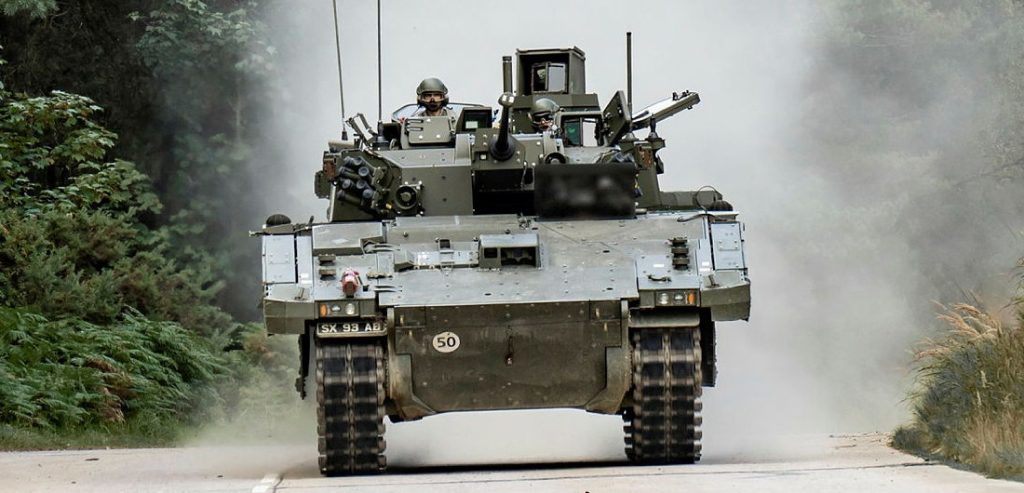
There is a long history of weapons being delivered late, over budget and failing to meet requirements. A recent example is the Ajax armoured cavalry programme whose entry into service was halted in December 2025 because of danger to soldiers using the vehicle.
The Defence Industrial Strategy says the Government is clear that business as usual in defence procurement is not an option. Emerging technologies are changing the character of warfare and military power depends on how quickly the Armed Forces and industry can innovate and operationalise rapidly developing technology. But it says we are stuck in Cold War-era procurement cycles and relationships with industry and “To meet the SDR vision for Defence by 2035, and maximise the economic growth potential of Defence, both government and industry must transform.”23 But it does not say how this will be done.
Buying weapons is hard, partly because of the uncertainty about technology and threat, and partly because of the perverse incentives that get built into the contracting system, whether cost-plus or fixed price. My book on defence acquisition and procurement24 was subtitled “how (not) to buy weapons” because of these perverse incentives. Every review of procurement since Solly Zuckerman in the 1960s makes very similar recommendations, which are never implemented and appear in the next review. A common recommendation is to keep procurement staff in post for longer than the usual two years to enhance their skill. SDR25 says Senior Responsible Owners should remain in post for at least five years, without disadvantage to promotion25. It does not say how this will be done. Promotion in the military depends on operational command, not sitting in a procurement office.
Other repeated recommendations are: to invest in technology demonstrators to show that the systems work before committing to the project, fly before you buy; avoid simultaneous development and production and changing specifications; cancel projects that do not meet time cost and performance targets to offset the conspiracy of optimism between buyers and sellers; and avoid varying production and quantities procured to fit into fluctuating budgets for short term affordability reasons.
People talk about a conspiracy of optimism, but there is no need to conspire. All the actors — politicians, military, civil servants and industry — have good reasons to under-estimate the cost and time required for the project and under-state the difficulties it faces. It is in their joint and individual interests to make the project look sufficiently attractive to get it into the plan and is an example of “motivated beliefs”; believing what is in your interests to believe. If salary and promotion depend on believing that “this time will be different” then that is a good reason to believe it. Since all the principal actors share this optimism, they reinforce each other’s belief. The effect is strengthened if these beliefs will only be proved wrong many years later, when they have other jobs. This is partly the reason that so many reports complain that there is too little institutional learning from experience.
Conclusion
Finding examples of failure is easy. Of the 47 MoD projects in the 2025 Government Major Projects Portfolio, 12 were rated Red (successful delivery of the project appears unachievable), 27 as Amber (significant issues already exist) and only 3 as Green. Five were exempt from rating for security reasons. Finding examples of success is more difficult, partly because the failures on these “exquisite” major projects gets more attention than the successes on thousands of smaller contracts.
One area of success is procurement for urgent operational requirements (UORs), where the urgency of these purchases prevents the normal acquisition process from being followed. Instead, time gets priority, rapid procurement is possible, and often costs are lower because there is less “gold plating”. UORs have been widely used to support Ukraine. A dedicated unit, Taskforce Kindred, was established in 2022 to coordinate and rapidly deliver significant military aid, equipment, and training to Ukraine’s Armed Forces, focusing on fast-tracking supplies from UK stockpiles and procurement, including drones, anti-air systems like Raven, and ammunition, while also fostering long-term defence industrial ties.
One area of success is procurement for urgent operational requirements (UORs). The urgency of these purchases prevents the normal acquisition process from being followed. Instead, time gets priority, rapid procurement is possible, and often costs are lower because there is less “gold plating”.
A factor in the success of support for Ukraine is that it is financed out of the Treasury Reserve rather than the MoD budget, reducing the inter-service rivalry that has plagued formulation of the Defence Investment Plan. Successes include Project Octopus a joint UK-Ukrainian rapid development of a cheap drone interceptor and the procurement in record time from Sweden of the 14 Archer artillery systems to replace the 32 AS90 guns gifted to Ukraine26. A longer-term solution for the British Army’s Mobile Fires Platform requirement is the RCH 155, mounted on to a Boxer armoured vehicle, being procured jointly with Germany. The Defence Industrial Strategy gives the example of how a flexible portfolio management agreement with MBDA, a pan European missile consortium, enabled MoD to rapidly meet UORs from Ukraine.27
While Support for Ukraine does generate employment28, it is a success because the choices are driven by military needs rather than the growth agenda. The defence industrial strategy is more likely to be a success if it is also driven by military needs rather than the growth agenda.
1. ‘Strategic Defence Review Making Britain Safer: secure at home,strong abroad’, Ministry of Defence, 2 June 2025, page 2.
2. ‘The UK’s Security–Prosperity Paradox: Is it Strategically Sound?’, William Parker, RUSI, 14 August 2025.
3. ‘The False Promise of Defence as Prosperity’, Noah Sylvia and Khem Rogaly, RUSI, 18 August 2025.
4. ‘Defence’s New Industrial Strategy’, Laurence Thomson, Wavell Room, 12 November 2025.
5. ‘The Defence Industrial Strategy: Making Defence an Engine for Growth’, Ministry of Defence, September 2025, paragraph 7.2.3.2, page 88.
6. ‘UK to purchase F-35As and join NATO nuclear mission as Government steps up national security and delivers defence dividend’, Press Release, No. 10 and MoD, 24 June 2025.
7. ‘Guidance: Social Value in MoD Procurement’, UK Space Agency, 30 September 2025.
8. Speech by Blaise Metreweli, Chief of SIS, 15 December 2025 on how SIS is keeping the UK safe in a world where the rules of conflict are being re-written, 15 December 2025.
9. Chief of the Defence Staff annual lecture at RUSI, 15 December 2025.
10. ‘National Security Strategy of the United States of America’, President of the United States, November 2025, page 14.
11. Ibid. page 25.
12. Ibid.
13. Ibid. page 26.
14. ‘Defence Industrial Strategy: Making Defence an Engine for Growth’ 2025, CP1388, paragraph 8.2.3.2.
15. SIPRI Arms Industry Database.
16. ‘The UK and Germany should combine their strengths to address weaknesses in European defence’, General Sir Richard Barrons KCB CBE, Chatham House, 19 November 2025.
17. ‘Defence’s New Industrial Strategy’, Laurence Thomson, Wavell Room, 12 November 2025.
18. ‘Defence Industrial Strategy: Making Defence an Engine for Growth’, CP1388, 2025, Summary, page 26.
19. ‘Defence in a Competitive Age’, Ministry of Defence, March 2021, page 2.
20. ‘Defence’s response to a more contested and volatile world’, CP901, Ministry of Defence, July 2023.
21. Press release ‘New era for defence: government launches root and branch review of UK Armed Forces’, Ministry of Defence, 16 July 2024.
22. Guidance, ‘Strategic Defence Review 2024-2025: Terms of reference’, Ministry of Defence, 17 July 2024.
23. ‘Defence Industrial Strategy: Making Defence an Engine for Growth’, CP1388, 2025, paragraph 7.1, page 84.
24. ‘Defence Acquisition and Procurement: How (Not) to Buy Weapons’, Ron P. Smith, published online by Cambridge University Press, 21 June 2022.
25. ‘Strategic Defence Review Making Britain Safer: secure at home,strong abroad’, Ministry of Defence, 2 June 2025, page 62.
26. ‘Octopus Adds an Additional Layer to Ukraine’s Air Defences’, Dr Jack Watling, RUSI, 27 November 2025.
27. ‘Defence Industrial Strategy: Making Defence an Engine for Growth’, CP1388, 2025, page 95.
28. ‘Britain’s Economic and Military Dividend from Supporting Ukraine’, Major Laurence Thomson, RUSI, 5 December 2025.