Independent Analysis.
Practical Solutions.

Policy Brief

Policy Brief connects expertise with decision makers and their advisers — delivering in-depth specialist advice that is politically informed. Our aim is to support better policy making and outcomes for everyone. Solutions are there — we are here to promote them and support their delivery.

Trending News

Water,Pipeline,To,Hydro-electric,Power,Station,At,Tarraleah,,Tasmania
Ofgem's cap and floor: a good first step for Long Duration Energy Storage – but much more will be needed
10 Min Read
Pete Roche
At the end of June 2026, Ofgem's decision on government support for Long Duration Energy Storage backed 16 projects (7.6GW), nearly tripling Britain's storable electricity — but stuck largely to large-scale pumped hydro and lithium-ion batteries. With battery costs falling fast and nuclear growing costlier and more delayed, there is a strong case for even more energy storage using a wider range of emerging technologies and hydrogen in the near future.
Royal Navy F-35B fighters of HMS Prince of Wales intercept a Russian military aircraft
Securing effective deterrence for peace and prosperity
13 Min Read
Matthew Heaslip
| University of Portsmouth
Britain's conventional deterrence has failed. Hostile actors — Russian aircraft and submarines and Iranian drones, street-level subversion — are testing UK resolve with growing confidence. Decades of deferred spending have left the Royal Navy and RAF critically overstretched, with maintenance backlogs meaning only a handful of warships and combat aircraft are operationally ready. The planned uplift to 2.7% of GDP is insufficient. The Treasury seems to have failed to realise that deterrence is cheaper than war; it must recognise that front-loaded capital investment can prevent vastly greater costs later.
Girl,With,Autism,Identification,Necklace
Autism risks becoming invisible in England’s policy agenda
12 Min Read
Jolanta Lasota
| Ambitious for Autism
Seventeen years after the Autism Act, England's autism strategy is due to expire this month with no replacement, autism is increasingly sidelined across education, health and employment reforms. SEND reforms risk narrowing specialist support through standardised "complexity" thresholds, while rising diagnoses are being reframed as overdiagnosis rather than unmet need. Autistic people continue to face high absence, exclusion and unemployment rates, yet their barriers go unrecognised in the Young People and Work Review and Get Britain Working. The article calls on the government to embed autism recognition into reform design from the outset, ensuring policy is built around autistic people's needs.
How the UK should now deploy its overseas aid
15 Min Read
Mikaela Gavas
| Center for Global Development
Sara Casadevall Bellés
| Center for Global Development
The UK's development reset signals a shift toward investment, partnerships and systemic change. But with ODA at its lowest in years, the government must be clear about how aid resources are deployed. Three principles should guide that deployment: matching instruments to context, maintaining a clear link to poverty reduction, and adopting partner-country-led strategies. Applying this discipline is essential if the UK is to retain development credibility.
René,Magritte-inspired,Artwork,,Modern,Civil,Servant,,Sharp,Pin-striped,Suit,,Bowler
Derisking, Industrial Strategy and the British Economy
9 Min Read
James Silverwood
| Leeds Beckett University
Britain's growth model has relied on "derisking" — using privatisation, outsourcing and PFI to create investable assets for international capital. But the strategy has failed to deliver: productivity has stagnated, real wages have flatlined, and regional inequality remains entrenched. The alternative is an industrial strategy targeting the foundational economy — care, housing, utilities and local services — embedding ownership in communities and prioritising living standards over asset markets.
Nursery,Teacher,With,Children,Boy,And,Girl,Learn,Color,And
What is the point of nursery provision for 0–2-year-olds in England?
7 Min Read
Dr Mona Sakr
| Middlesex University
Dr Sara Bonetti
Kayla Halls
| Middlesex University
England has expanded the funded childcare entitlement to include babies from just nine months old, but policy has yet to answer a fundamental question: what is the purpose of nursery provision for 0-2-year-olds? Drawing on new research, this article calls on the Department for Education to articulate and embed that purpose within the Early Years Foundation Stage, providing a foundation for future decisions about quality, workforce development and wider family support.
Roderick Crawford

An Editorial Welcome

At Policy Brief, we explore key policy issues as well as social and economic affairs in-depth, bringing insight and commentary from leading experts to policy makers and opinion formers in order to inform public debates and to shape policy.

Alongside general policy and current affairs, we focus on a number of key policy themes to enhance understanding of the issues surrounding them and we run
focused campaigns to deliver change in policy and to affect changes for in the lives of people.

Our coverage is focused geographically on policy in the UK, the North, and on conflict resolution and aid globally.

We look to educate and inform, but chiefly to impact policy and political and investment decisions across the public and the public-facing private sector. We look to create bridges for experts to reach advisers and decision makers with the aim of
facilitating better policy outcomes and realising change that benefits all.

Editor, Policy Brief

Explore Our Focus Areas

Policy Brief brings together analysis and commentary across key issues shaping the UK and the world. You can expect to see a consistent focus on the issues of public policy and finances; on the economy, industrial strategy, energy and trade; the UK regions — especially the North; on housing and cities; and on foreign, aid, security and defence policy.

icon

Public Policy & Public Services

Rethinking policy across public services
 

New demands on public services and the professionals who deliver them are straining budgets and staff in ways that are unsustainable and leaving significant gaps in delivery. Aligning policy and practice to better meet the needs and expectations of professionals and the public is key to delivering the public services that the UK needs and can afford to sustain.


Money icon

Public Finances & Taxation

Understanding the fundamental crisis facing the UK state

Unsustainable public deficits and debt levels, consistently below-trend GDP growth, a diminished tax base, high public spending and continued growth in demand for public services have placed the UK into an unsustainable position. Understanding how we got here and recognising the scale of the challenge is essential to inform policy makers, legislators, opinion formers and the public debate.

Factory icon

ECONOMY, ENERGY & TRADE

Finding the keys to economic growth
 

UK economic growth collapsed in 2008, and its trend rate of growth has not recovered, contributing to the fiscal crisis, social stagnation, public dissatisfaction and political instability. Raising growth rates is the common aim across the West yet
almost twenty years on the solution still evades the major European economies. Can current policies meet the challenge? Is a more fundamental reappraisal
required?

UK Icon

UK Regions: Focus on the North
 

The North: Red wall or Powerhouse
 

Realising the economic potential of the North isn’t about Westminster political calculations to win back the red wall, it is about creating productive economies in the North and enhancing opportunities for employment and investors alike. With public funds under strain, the North needs to attract far more private capital for productive purposes if it is to realise its potential.


House icon

HOUSING, LAND & CITIES
 

Radical solutions to the most stubborn policy problem of all

Overall, housing in the UK represents one of the most consistent areas of policy.
Asset price inflation has created wealth for older generations and reduced
opportunity for younger ones. It lies at the heart of numerous social, political and economic problems. Transforming the UK’s housing market requires more competition, an opening up of the land, and the expansion of existing cities.

Shield icon

FOREIGN, DEVELOPMENT & DEFENCE POLICY

Rethinking the UK’s place in Europe and the World

UK foreign policy has been clear and decisive on Ukraine, but elsewhere it has been less sure of itself. The loss of DfID has blunted its policy to Africa, conflict resolution and the SDGs; its reset with the EU could blunt its ability to find its own voice. Good analysis and the freedom to speak it are key to a successful foreign policy.


Featured Publications

In-depth research and bold perspectives from leading voices in policy, governance, and public affairs.

Why France is lukewarm towards a major EU-UK reset
Why France is lukewarm towards a major UK-EU reset
10 Min Read
Pauline Schnapper
| Université Sorbonne Nouvelle, Paris
The UK–EU 'reset' faces persistent French scepticism. Paris supports closer cooperation, particularly on defence and Ukraine, but suspects Britain of cherry-picking single market benefits while rejecting free movement. France insists on financial contributions to EU programmes, rejects a Swiss-style model, and — with any new settlement potentially undone by a future Reform- or Conservative-led government — sees little point in a major reset while British domestic politics remains so unsettled.
London-,September,,18,,2023:,The,Ministry,Of,Defence,Main,Building
The MOD’s perpetual procurement crisis and what should be done about it
20 Min Read
Steve Prest
The MOD's procurement failures stem not from flawed organisation charts but from deeper systemic problems: chronic overcommitment, optimism bias, dysfunctional incentives, and the diffusion of accountability. Structural reform without behavioural change will simply recycle familiar problems. The solution lies in empowered programme leads, realistic resourcing, and a culture that favours timely ‘good enough’ delivery over procedurally perfect failure.
The Nuclear Regulatory Taskforce- The wrong questions, the wrong team, the wrong answers
The Nuclear Regulatory Taskforce: The wrong questions, the wrong team, the wrong answers
30 Min Read
Stephen Thomas
| Greenwich University
The UK government's 2025 Nuclear Regulatory Taskforce, established to cut "red tape" blocking nuclear expansion, is fundamentally misconceived. Historical evidence shows that failed nuclear projects collapsed due to financial risk, not regulatory failure. The Taskforce lacked expertise in radiation science, environment, and economics, its recommendations threaten regulator independence, and its reforms will consume government resources without delivering new capacity before the mid-2040s.
London,,United,Kingdom,-,July,23,,2024:,Ed,Miliband,,Britain's
Long Duration Energy Storage: the key to a 100% renewable energy grid
12 Min Read
Pete Roche
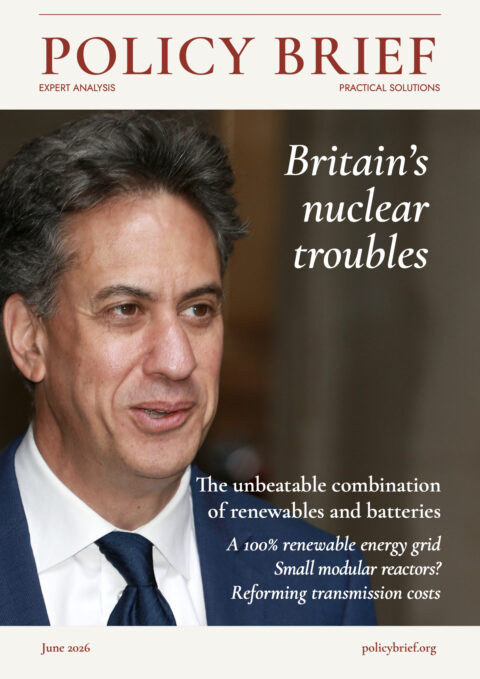
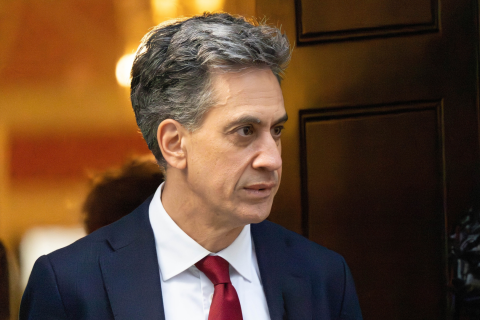
Long Duration Energy Storage (LDES) is emerging as the critical missing piece in UK energy policy, with energy group Iberdrola calling it the "key enabler for a 100% renewable electricity grid". New long-duration battery technologies as well as a diverse range of other energy storage technology is coming forward, but UK Government plans for only 4-6GW of capacity are not ambitious enough.
this-shock-to-the-western-alliance-should-send-a-shock-wave-through-whitehall:greenlandandnato
This shock to the Western Alliance should send a shock wave through Whitehall
5 Min Read
Roderick Crawford
| Policy Brief
The lesson from the near crisis over Greenland is that the UK will need to step up its role in securing the Transatlantic alliance, not least in taking the lead role in securing the High North. Providing security for the US may now be more important than contributing to the security of the continent. It is certainly a mission the UK is uniquely equipped and positioned to fulfil. A credible UK defence policy will require substantial additional investment that can only be met by raising funds from the markets.
IMG_1069
High-quality play-based practice in reception year leads to improved outcomes for all
9 Min Read
Kym Scott
Early childhood is at the heart of the government’s Opportunity Mission, including a focus on improving outcomes at the end of Reception. Without explicit protection of high‑quality play‑based pedagogy in Reception, there is a danger that many schools’ well-meaning attempts to improve outcomes are leading to approaches that work against what we know about the way young children learn. If the aim is to close gaps and improve overall outcomes in all areas of learning and development, then Reception provision must be rooted in what we know enables young children to thrive. This article sets out a model that highlights four requirements for learning that must be in place for young children to learn deeply, securely and with joy.

If you want to understand the issues, be better informed on policy, and make better decisions —then Policy Brief is for you.

Policy Brief is designed to provide decision makers and advisers across governments, parliaments, public services, business, industry and finance with informed analysis on the major issues and policy decisions facing the UK.

It’s for Government Advisers and Decision Makers

black and white photo of people at a meeting

Providing sharper insight, for smarter policy, for stronger outcomes.

Getting the right policy outcomes requires better analysis — as well as fresh ideas. Policy Brief does both. It provides additional analysis from experts to help you make the right decisions and new ideas for policy and initiatives that will deliver better outcomes for all. This is needed at every level of Government, whether UK, devolved or local.


For Northern Political and Business Leaders

black and white photo of people

Turning Northern challenges into opportunities through analysis and insight.

If there is a crisis of delivery at the national level, that is true regionally too — and
exacerbated by lack of resources. Policy Brief’s Northern focus is designed to help you to develop and implement policies to transform northern city regions while our regional reports will identify regional policy issues for Whitehall. Policy Brief is designed for decision makers in the regions, not just Whitehall and Westminster.

For Leaders in Business, Industry, Finance and Academia

black and white photo of people at a meeting

Informing stakeholders outside Government; bringing their insights to Government.

Getting the UK back in business — across all its regions — is a necessity. What that looks like is something that needs spelling out, sector by sector, issue by issue —
and often region by region, by business as well as by external analysts. Policy Brief is a place to do that. It is your bridge to Government.

And it’s for general readers interested in understanding policy and politics

black and white photo of people in a crowd

Equipping you with the analyses needed to better understand the issues.

This site makes available all our publications on specialist areas to anyone who is
interested in understanding the issues we cover. Articles are written at sufficient length to allow for depth, yet short enough to remain accessible to the general reader. Informing the general reader is equally important as engaging with policy makers. Policy Brief is for you too.

Anyone is welcome to engage with the editorial team: just drop us a line with your comments, thoughts and ideas: contact@policybrief.org

Our Campaigns

Shaping policy through focused action.

Why France is lukewarm towards a major EU-UK reset
Why France is lukewarm towards a major UK-EU reset
10 Min Read
Pauline Schnapper
| Université Sorbonne Nouvelle, Paris
The UK–EU 'reset' faces persistent French scepticism. Paris supports closer cooperation, particularly on defence and Ukraine, but suspects Britain of cherry-picking single market benefits while rejecting free movement. France insists on financial contributions to EU programmes, rejects a Swiss-style model, and — with any new settlement potentially undone by a future Reform- or Conservative-led government — sees little point in a major reset while British domestic politics remains so unsettled.
London-,September,,18,,2023:,The,Ministry,Of,Defence,Main,Building
The MOD’s perpetual procurement crisis and what should be done about it
20 Min Read
Steve Prest
The MOD's procurement failures stem not from flawed organisation charts but from deeper systemic problems: chronic overcommitment, optimism bias, dysfunctional incentives, and the diffusion of accountability. Structural reform without behavioural change will simply recycle familiar problems. The solution lies in empowered programme leads, realistic resourcing, and a culture that favours timely ‘good enough’ delivery over procedurally perfect failure.
The Nuclear Regulatory Taskforce- The wrong questions, the wrong team, the wrong answers
The Nuclear Regulatory Taskforce: The wrong questions, the wrong team, the wrong answers
30 Min Read
Stephen Thomas
| Greenwich University
The UK government's 2025 Nuclear Regulatory Taskforce, established to cut "red tape" blocking nuclear expansion, is fundamentally misconceived. Historical evidence shows that failed nuclear projects collapsed due to financial risk, not regulatory failure. The Taskforce lacked expertise in radiation science, environment, and economics, its recommendations threaten regulator independence, and its reforms will consume government resources without delivering new capacity before the mid-2040s.
London,,United,Kingdom,-,July,23,,2024:,Ed,Miliband,,Britain's
Long Duration Energy Storage: the key to a 100% renewable energy grid
12 Min Read
Pete Roche
Long Duration Energy Storage (LDES) is emerging as the critical missing piece in UK energy policy, with energy group Iberdrola calling it the "key enabler for a 100% renewable electricity grid". New long-duration battery technologies as well as a diverse range of other energy storage technology is coming forward, but UK Government plans for only 4-6GW of capacity are not ambitious enough.
this-shock-to-the-western-alliance-should-send-a-shock-wave-through-whitehall:greenlandandnato
This shock to the Western Alliance should send a shock wave through Whitehall
5 Min Read
Roderick Crawford
| Policy Brief
The lesson from the near crisis over Greenland is that the UK will need to step up its role in securing the Transatlantic alliance, not least in taking the lead role in securing the High North. Providing security for the US may now be more important than contributing to the security of the continent. It is certainly a mission the UK is uniquely equipped and positioned to fulfil. A credible UK defence policy will require substantial additional investment that can only be met by raising funds from the markets.
IMG_1069
High-quality play-based practice in reception year leads to improved outcomes for all
9 Min Read
Kym Scott
Early childhood is at the heart of the government’s Opportunity Mission, including a focus on improving outcomes at the end of Reception. Without explicit protection of high‑quality play‑based pedagogy in Reception, there is a danger that many schools’ well-meaning attempts to improve outcomes are leading to approaches that work against what we know about the way young children learn. If the aim is to close gaps and improve overall outcomes in all areas of learning and development, then Reception provision must be rooted in what we know enables young children to thrive. This article sets out a model that highlights four requirements for learning that must be in place for young children to learn deeply, securely and with joy.

Latest Campaign

Early Years - Foundations for Every Future

The earliest years of life shape every outcome that follows. Yet too often, investment in early years education, health, and family support is fragmented, underfunded, or overlooked. This campaign makes the case for bold, joined-up action: putting the first years of life at the heart of policy, finance, and delivery.

Latest Campaign

Putting Development back on the agenda

Development has slipped from the front pages — crowded out by crisis management, security tensions, and short-term politics. But the stakes are too high to ignore. The world cannot afford a lost decade for growth, opportunity, and poverty reduction

Editorial Advisors

Get to know the contributors driving our conversations

What they see, what they challenge, and why it matters…

black and white photo of a woman

Dr. Amina Clarke

Senior Fellow in Public Policy

Former advisor to the Cabinet Office and award-winning author of Reimagining Public Trust in Government.

black and white photo of a man

Tomás Llewellyn

Economic Analyst & Regional Development Specialist

Led regeneration projects across the North of England and served on the UK Economic Recovery Taskforce.

black and white photo of a lady

Prof. Lucia Moretti

Director of European Affairs, Institute for Strategic Dialogue

Regular commentator for BBC World News and architect of several EU resilience frameworks.

black and white photo of a man

Zain Malik

Senior Advisor on Security & International Relations

UN Peacebuilding consultant and lead researcher on post-conflict governance in the Middle East.

Our Printed Publications

Our most enduring ideas

policy brief template
policy brief
policy brief

Join Our Newsletter

Stay informed with sharp, timely insights - subscribe to the Policy Brief newsletter and get new thinking delivered straight to your inbox.

From 1992-2012 Roderick Crawford directed Parliamentary Brief with great style and effect.  Policy Brief has the capacity to illuminate the issues in British politics in a decisive way

Lord Bew

Lord Bew is a Crossbench member of the House of Lords. He is a member of Committee A (Sovereign Matters) of the British-Irish Parliamentary Assembly.

Policy Brief offers reliable and carefully researched policy analysis in a marketplace dominated by narrow Westminster interests. In Roderick Crawford clients work with the former editor of Parliamentary Brief and benefit from his expertise on economic policy, social policy, the North, and UK-EU relations. 

Matt Beech

Dr Matt Beech is Director of the Centre for British Politics at the University of Hull and IES Senior Fellow at UC Berkeley.

When I was trying to draw attention to the potential ill-effects of children’s changing lifestyles on their physical and mental health, it was difficult to interest either press or politicians. Roderick Crawford saw the merit in my work and not only gave me a platform but published a series of articles on childhood issues.

Sue Palmer

Sue Palmer, childhood campaigner and author of ‘Toxic Childhood’, ‘21st Century Boys’, ‘21st Century Girls’ and ‘Foundations of Literacy’.

Scroll to Top
Thank you

We'll keep you updated on all our news. You can subscribe anytime. Just email editor@policybrief.org