Expert Analysis. Practical Solutions.

Policy Brief Reports

Policy Brief Reports provide in-depth expert analysis of the challenges facing the UK, with clear recommendations for action. Grounded in hard evidence, our reports make the case for policy solutions and show how they can be delivered.

POLICY BRIEF REPORTS

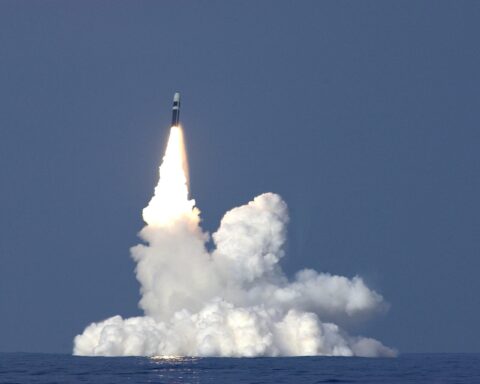
A Trident 2 D5 Missile breaking the surface.
22 Min Read
Dr Charlotte Levy
Timothy Levy
SDR 2025 and the Defence Investment Plan recognise the priorities, but investment is not readiness. Timothy Levy and Dr Charlotte Levy test whether Britain’s programmes add up to an integrated deterrent across five layers: cyberspace, air and missile defence, command and control, conventional forces and nuclear posture. A shock in one layer can spread inward, narrowing the “decision corridor” in which leaders can make controlled choices short of nuclear use. They find a vulnerability gap: legacy capabilities are declining faster than their replacements, crews and doctrine can mature. The MOD should publish a delivery roadmap, make cyber assurance a gateway to integration, match every capability plan to a workforce plan, exercise under compound degradation, and report readiness rather than spending.
London,,United,Kingdom,-,September,09,2026.,British,Prime,Minister
20 Min Read
Stephen Thomas
| Greenwich University
Britain’s three new nuclear projects – Hinkley Point C, Sizewell C and Wylfa – now depend on public money, above all from the National Wealth Fund, which has committed up to £36.6bn to Sizewell C alone: about twice what it can lend to all its other projects. Abandoning all three would save consumers £93–133bn and free the NWF to back renewables, energy storage and the government’s regional and industrial priorities.
UK ARMED FORCES STEPPING UP FOR NATO ACROSS LAND SEA AND AIR
15 Min Read
Paul Cornish
| University of Exeter
The British Army is threadbare and strategically directionless, its credibility eroded by talk of a “first duty” that goes unfunded. Paul Cornish asks what an army is for: taking and holding territory, and deterring aggression by being demonstrably able to do so. He finds a coherent answer in SDR 2025: a force of at least 100,000, two divisions at the heart of a NATO strategic reserve corps, and a “high-low” mix in which technology multiplies rather than replaces mass. Endorsed by the Prime Minister and Defence Secretary, it is the government’s own plan. If the money falls short, ministers must fund it or honestly revise Britain’s commitments, and the Treasury must judge defence spending by what it buys.
London-,September,,18,,2023:,The,Ministry,Of,Defence,Main,Building
20 Min Read
Steve Prest
The MOD is reorganising its procurement system again, but Steve Prest argues the organisation chart was never the problem. The failure is systemic. The department commits to more than it can afford, masks shortfalls with promised “efficiencies”, lowballs costs to win approval and imposes in-year savings that slow delivery. Optimism bias and risk models blind to tail risks make it worse. So do functions that can veto programme leaders, producing compliant failure rather than imperfect success. The remedy is known: earlier, harder choices about what not to do, costs tested against comparable programmes, full funding with risk provision, and Senior Responsible Owners empowered like military commanders. The failure is behavioural, not intellectual; “good enough” must be good enough.
The Nuclear Regulatory Taskforce- The wrong questions, the wrong team, the wrong answers
30 Min Read
Stephen Thomas
| Greenwich University
The 2025 Nuclear Regulatory Taskforce was set up to cut “red tape”, with terms of reference that signalled the answers wanted. Stephen Thomas finds the diagnosis wrong. Five of the six projects launched after 2006 failed for want of investors and finance, not planning or regulation, and Hinkley Point C’s overruns owe more to the EPR design. None of the five members had expertise in radiation science or the environment, or had built or operated a nuclear plant. Yet the government accepted all 47 recommendations within two days. They would weaken radiation protection, allow reactors near towns, loosen habitat rules and compromise the regulator’s independence, while adding no capacity before the mid-2040s. Parliament must scrutinise them first.
How the sun went down on UK nuclear
Stephen Thomas
| Greenwich University
The UK governments have been keen to pursue nuclear power projects since 2006, but it has been stop and go.  In 2016, the government moved forward on small modular reactors, only to shelve plans before starting again in 2021.  Since then, one Small Modular Reactor has been chosen and the final investment decision is expected by government in 2029. This is unlikely given delays in process and the fact that it is yet to be determined who will own the plant, how it will be financed or how the power will be sold.  It is likely that there will be no new nuclear power in the UK before 2040, by which time the UK will have been operating with less nuclear power than now for over a decade.  Meanwhile, by 2030, renewables will have delivered 48GW of…
Scroll to Top