The OECD’s Development Assistance Committee (DAC) is 70 years old in 2031. The DAC remains a symbol of inequality between countries: donors in the Global North provide resources and recipients in the Global South receive them. Today, the DAC is under major review. Official development assistance (ODA) has suffered its largest recorded fall with all major donors cutting ODA in 2024 and 2025, while the largest contributor to the OECD itself, the US, has threatened to defund the organisation. In this context, the old idea of development cooperation as solidarity is giving way to a new one: ‘mutual interest’. Our piece takes that idea and asks one question: if the DAC survives to 2031, which face of mutual interest will it represent? We argue four faces are possible and each produces a different kind of DAC and implies a different fate for the 0.7% development cooperation target. Our argument also concerns the future of development cooperation as a whole, not only the DAC.
Introduction
It is 2031. Marco Rubio is US President (it just didn’t pan out for J.D. Vance). At the OECD, the Development Assistance Committee (DAC) celebrates 70 years, and the letters DAC still hang on a door in Paris. However, what they stand for is now highly contested. The donors’ club has less money and development cooperation more broadly has been redefined by the idea of ‘mutual interest’.
Rewind to 2026. Change was already in the air. The DAC sat at the centre of a system it no longer controlled. Its members had just posted the worst fall in aid figures in the institution’s history. DAC aid fell by almost a quarter in 2025. The United States drove three-quarters of the fall.
The DAC’s founding instrument, official development assistance, was losing ground to alternative forms of financing including commercial finance, South-South cooperation and to commercial lending from China and the Gulf states. The DAC’s founding patron, the United States, had switched from patron to disruptor under the second Trump administration. The clearest sign of this was outlined by Marco Rubio in a new vision for foreign aid in July 2025 – ‘Making Foreign Aid Great Again’. The centrepiece of this is the promotion of ‘trade over aid’ or business deals as a rival development cooperation doctrine. The approach is not currently part of the OECD discourse. It sits closer to the UN, where the US administration is using its mission in New York to organise a voluntary ‘Group of Friends’.
The initiative is not just the US. At its launch 35 countries had joined the ‘trade over aid’ initiative, and this has grown to 47 countries plus the US. That list includes five of the 34 full DAC members and Associates (namely, Czechia, Poland, Estonia, Lithuania, and associate, Romania) and four of the six countries that hold ‘Participant’ status at the DAC meaning they attend meetings but are not members (Kuwait, Qatar, Saudi Arabia and UAE).
So, what happened? The DAC was formally constituted as the DAC in 1961, building on the 1960 Development Assistance Group. In the same year USAID and the West German development ministry (BMZ) were also established as part of the institutional aid architecture of the Cold War. The DAC created the concept of Official Development Assistance (ODA). It ran the peer reviews that disciplined Western donors against agreed norms and standards. That world is very different to the one of 2026. Only about 40 developing countries with populations above one million still depend heavily on aid (meaning net ODA greater than 5% of GNI). However, most developing countries have outgrown traditional grant aid. That said, many still borrow at high market rates and would gain from concessional lending. This post-ODA world for much of the developing world is awkward for the DAC in the sense that the DAC now speaks for an instrument (ODA) that fewer countries need in its classic form and that most of the DAC’s own members are cutting.
The rise and rise of mutual interest
A new idea has risen to the fore in the current period. That idea is ‘mutual interest’. The concept has proved to be attractive because it speaks to domestic audiences and it is also very malleable. The idea is not new. South-South cooperation has claimed the principle for decades. China speaks of win-win. Even some DAC members agree. For example, Japan and South Korea built their aid programmes on it and the EU increasingly frames cooperation as mutual benefit.
The idea sounds simple at one level. It evokes the sense that cooperation rests not on altruism but on reciprocal gains or an implicit contract between parties. The more complicated questions arise when one asks: Whose mutual interests are to be served?
The issue is that ‘mutual interest’ raises two questions. The first is the distribution of benefits between parties. Are the gains symmetric, or does one side capture much of the material benefit — say 66 per cent or more — such that it becomes a hierarchical relationship rather than a genuinely mutual one? The second question concerns distribution of benefits within parties. Whose preferences count when a provider of development cooperation or recipient government declares something to be in their ‘national interest’? Is it largely elite interests or a broader set of the population’s interests?
If we cross these two dimensions, we get four potential faces of mutual interest (see Figure 1). Each of these we give a name to. So, Type 1 is symmetric gains, broadly shared or what we call a ‘developmental partnership’. Type 2 is symmetric gains, narrowly captured or an ‘elite pact’. Type 3 is asymmetric gains, broadly shared; we label this ‘strategic concession’. Finally, Type 4 is asymmetric gains, narrowly captured or what can be called ‘extractive cooperation’.
Figure 1: Four Futures for the OECD-DAC: The faces of mutual interest.
| Distribution of benefits between parties | |||
|---|---|---|---|
| Symmetric | Asymmetric | ||
| Distribution of benefits within parties | Broadly shared | Type 1 The DAC and mutual interest as developmental partnership | Type 3 The DAC and mutual interest as strategic concession |
| Narrowly shared | Type 2 The DAC and mutual interest as elite pact | Type 4 The DAC and mutual interest as extractive cooperation | |
It is worth stressing that this is not about a North-South distinction. Elite capture of cooperation operates in advanced countries too. Take, for example, tied aid to a specific sector or even a single company, or commercial diplomacy dressed as development cooperation. Further, in a Northern donor with populist parties in the governing coalition or influential from outside government, as is the case in many European DAC members, the national interest can be defined narrowly and in the short term. The ‘mutual interest’ between such a nationalist/populist government in the North and an autocracy, even an electoral autocracy in the Global South, is a different thing from the mutual interest between two accountable democracies.
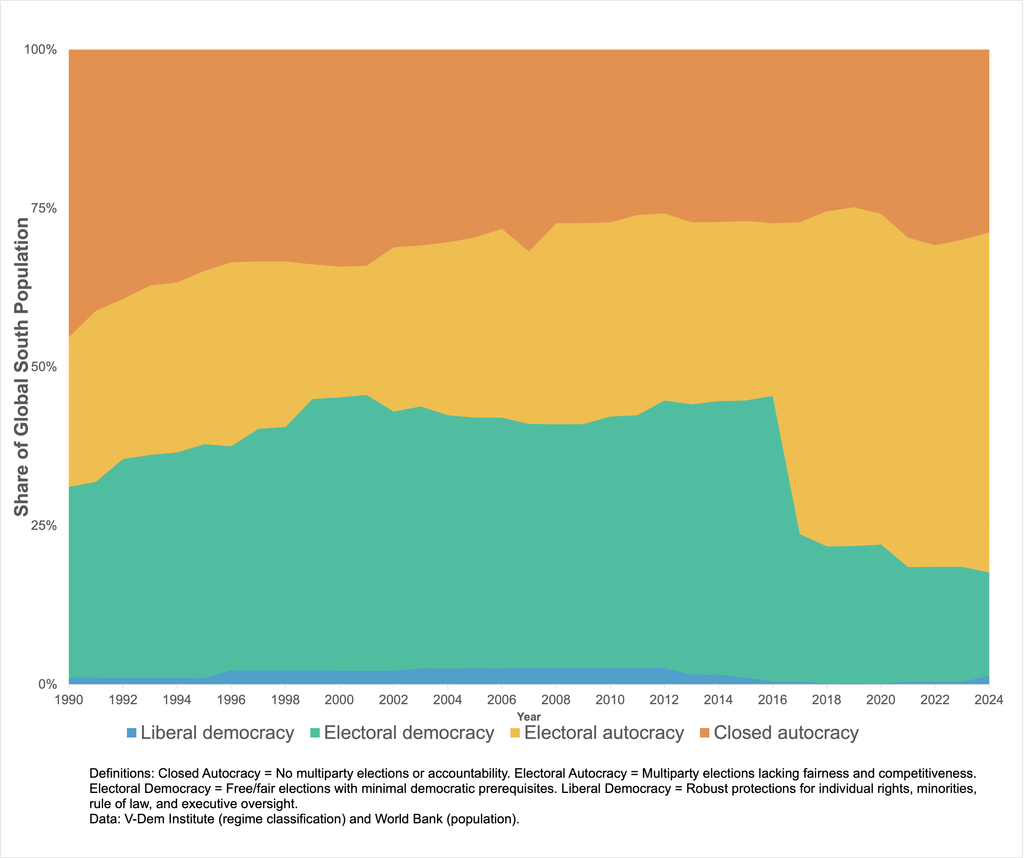
And here’s the rub. This is not hypothetical given half of the population of the South live in ‘electoral autocracies’ where elections are not fully free and competitive and another third live in ‘closed autocracies’ according to data from the V-Dem project at University of Gothenburg (see data in Figure 2). In the North, populist right governments, typically sceptical of aid and international cooperation, have seen their average vote share rise from about 1 in 25 people in 1990 to approaching 1 in 5 people in 2023 across European DAC members (see Figure 3), and that share seems set to continue to rise. In this kind of political context, it is not that surprising that mutual interest is being promoted as a new organising idea for development cooperation.
Figure 2: Share of Global South population (%) living under different political regime types, 1990-2024.
What does this all mean in 2031 for the DAC at 70 years old if one of the four types of mutual interests becomes its organising logic? We outline four plausible futures for the DAC, each based on one type of mutual interest.
Figure 3: Average support for ‘radical right’ authoritarian populist parties in European countries (% of population, unweighted mean), 1990-2023.
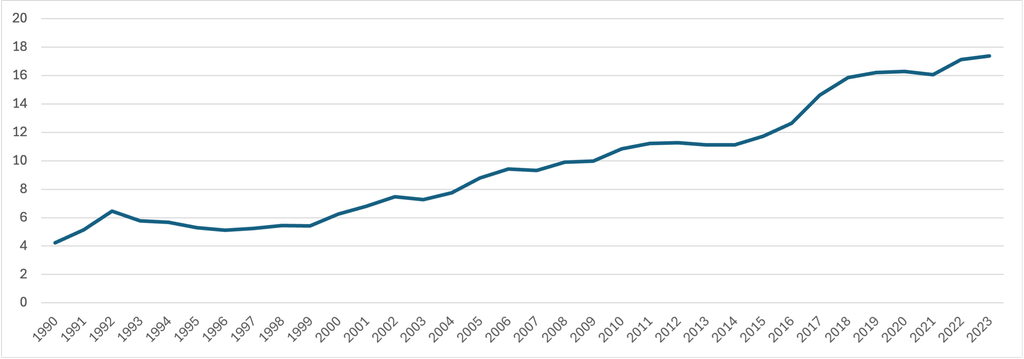
Note: The index classifies a party under two conditions: either it openly advocates populist and/or authoritarian and non-democratic ideologies such as fascism, or Nazism, or it has demonstrated a willingness to abandon democratic principles once in power.
Future 1: the OECD-DAC as a developmental partnership
Imagine: Paris, 2031. In this future world the DAC has done the hardest thing an institution can do. It has changed its mission to adapt to the times. The old name has gone and been replaced with the G-DACC or the Global Development and Cooperation Committee.
What does this look like? The membership has widened past the traditional club. The G-DACC now takes in OECD members that never joined the DAC like Mexico, Turkey, Costa Rica, Chile and Colombia as well as the OECD accession countries (including Brazil, Indonesia, Thailand). It also includes other partners from the Global South (such as the 31 who are members of the OECD Development Centre including India, China and South Africa) and current low-income countries such as Rwanda, Togo and Senegal. All these countries now sit at the new G-DACC table with agenda-setting rights rather than just observer or participant status.
In this future, all providers of development finance including China, the Gulf states and the New Development Bank are recognised as contributors. They are not competitors outside the G-DACC. A repurposed peer review mechanism continues as a mutual accountability instrument for all providers. The 0.7% target is reaffirmed as an obligation for former DAC members even if only a handful of members fully meet it. A less ambitious target (common but differentiated responsibilities) is agreed for other members of the G-DACC. What is new is that development cooperation has been reframed as based on genuinely shared interests.
In this world, the reform that G7 development ministers called for, one that goes ‘beyond cost-cutting’ and extends to DAC’s mandate has happened. The G-DACC is an expanded forum of members with a wide range of financing modes. It is an authoritative node in a wider network offering norms and standards.
In our view, this is the most desirable world for development cooperation because it remains developmental-focused. It is, though, the least likely future because northern publics may remain sceptical and Southern partners may not trust a body that has Northern roots.
Future 2: the OECD-DAC and de-development of development cooperation
Imagine: A different Paris, 2031. In this future the DAC may look healthy but that is only on paper. Aid volumes have partly recovered and several DAC members report figures and the 0.7% target is met by a few countries. However, development cooperation has shifted to tied channels that benefit politically connected contractors in both provider countries and intermediaries in partner countries.
The DAC has a role in this world but it is a diminished one. The DAC’s main functions are statistical authority and ODA reporting. Peer review has become a spending audit of what was disbursed and whether it counts as ODA.
Firms with political connections gain in this world by winning contracts, and politicians or officials who broker them win standing with publics or elites for supporting the national interest. This future is development as business deals. Elites in donor and recipient countries benefit most from this scenario. The pact between North and South holds because those who matter most politically benefit and, as a consequence, they keep things running.
This future looks like the ‘de-development’ of development cooperation. This means that development cooperation is no longer driven by developmental concerns such as raising living standards. Making a deal is what matters. The outcome may be rising incomes, but that is not the core concern of doing the deal. The 0.7% norm survives but has no real purpose. Communiqués continue to be signed, and the DAC certifies that money was mobilised.
Future 3: the OECD-DAC and strategic interests
Imagine: Yet another Paris, 2031. In this third future the DAC no longer claims cooperation is symmetric. Providers now say openly what has been evident for some donors for years: development cooperation is about geopolitical positioning, alliance building, market access and mineral rights. This is not far from where some DAC members have sat for decades. By 2031, this logic has spread: cooperation is now a means of pursuing strategic interests. This entails using development cooperation to choose allies or guarantee resource access. Again, it is the de-development of development cooperation because the core objective is no longer developmental.
This world is evident in the 2020s in migration compacts, security partnerships in fragile regions and critical-minerals deals. Recipient countries do get some economic benefits. However, those benefits have a political cost in terms of country alignment with the provider or their companies.
In this future the DAC is a coordination forum for strategic providers to bargain with global southern actors that have become more assertive because countries can shop around. This potentially gives partner governments room for ratcheting up negotiations. On the provider side, governments can show how development cooperation is, for example, addressing migration. The danger for the DAC is a ratcheting down of social or environmental standards in order that DAC countries can compete with China or Gulf states.
In this future, the DAC’s role could still be to ensure there is a floor of common standards. The support for the 0.7% target weakens, though, because the 0.7 would become a way of measuring the values of deals made.
Future 4: the OECD-DAC and extractive cooperation
Imagine: One more future Paris, 2031. In this world the DAC has been completely bypassed. Development cooperation has become commercially based in, for example, loans for resources, infrastructure for access deals or outright commercial arrangements. This is now-President Rubio’s world of development cooperation as business deals or ‘trade over aid’.
Gains are asymmetric, though they do accrue to elite coalitions on both sides of the commercial relationship. At the DAC, the early-adopter countries who signed up to the US’ ‘trade over aid’ doctrine have promoted and disseminated the idea across enough DAC providers to shift the mission of the committee. However, there is no reason for the DAC to exist in this world because the 0.7% target is meaningless, and deals happen in bilateral compacts outside the DAC. In this future, the poorest countries without minerals or geopolitical salience may struggle to find deals. Even post-ODA countries that are looking for cheap finance may find there is little they are offered unless they have something to offer in return. If Southern actors cannot offer anything else of value, technology companies may obtain access to personal health data in return for providing health support. Global public goods like climate adaptation will become harder to address because there is no bilateral payoff.
This may all seem far-fetched, but it is the world that the 2026 trends most clearly point to. The large fall in aid driven by the US alongside the US walking away from the ODA concept as currently defined is one signal. Other major donors’ cuts and interest in critical minerals, migration management or geopolitical positions are other early signs.
So, what?
The future scenarios above are not forecasts. Instead, their value is in raising questions for the DAC about what future it wants. The term ‘mutual interest’ is largely without meaning if it is not defined. It can be understood in different ways, which implies there are political choices to be made.
Those choices matter for the 0.7% target and for whether development cooperation is symmetric or asymmetric and whether it is shared by broader populations or captured by elites. What governments do about the 0.7% says something about the future they are choosing.
The future of the DAC too is up for grabs. It could become something wider or disappear altogether, and the choice of mutual interest lens taken could play a role in that. The DAC review now underway in Paris is mostly set up as a technical exercise. However, there are also political choices to be made on the mission. The OECD-DAC has to answer the question: which face of mutual interest is the DAC to promote?
Mutual interest should be part of the discussion of whatever comes next, though the danger is that the lack of definition means it drifts towards one future. Only by looking at the types of mutual interest is it possible to see who benefits. For European DAC members, the choice is sharp. The EU and its member states along with the United Kingdom can help decide which face of mutual interest prevails or wait for others to do so and live with the consequences.
For the DAC itself, there is history worth recalling. The DAC was built to serve Western donor coordination in a bipolar world, and it did this well in several areas for decades. The world is now more multipolar. The DAC’s role in 2031, at 70, will depend on whether it can find itself a purpose fit for a multipolar world where a large number of countries are post-ODA (at least in its traditional form), though they sit alongside about 40 countries that are barely better off than at the end of the Cold War.
Which face of mutual interest the DAC takes is not yet decided. It will be settled in the next few years, and Thomas Gass, the DAC’s new chair from January 2027, will be instrumental in that discussion. It will also be shaped by the choices made by DAC members under fiscal pressure and rising populism, by partners with new bargaining power, and by what the DAC review concludes. All four worlds are live worlds now. The DAC could reinvent itself or it could disappear. Which approach to mutual interest the DAC chooses will determine what the DAC becomes.