Introduction
The Government’s ambitious plans for decarbonising electricity will require a massive investment in transmission as new renewable power is located often far from a grid designed in the 1960s for conventional power stations. The National Energy System Operator, NESO, is responsible for planning this expansion. Its Beyond 20301 report recommends around £58 billion in direct investment for offshore and onshore network upgrades. Clearly considerable investment is needed, but it is time to query the very high cost of at least some of the offshore networks. NESO is charged to minimise total system cost – including the cost of investing in and operating generation as well as the transmission to deliver it to market. This Policy Brief argues that better signals to guide new onshore wind investments to lower cost locations and better transmission choices and routes could save £ billions.
It is worth asking why NESO is contemplating such an expensive solution to the problem of exporting wind power from Scotland to England. The plans date back to when National Grid was responsible for planning as well as operating the grid. As a regulated monopoly it could earn the allowed rate of return on all approved new investments, and also on the high cost of the extensive planning and consultation before investing. As such it had an incentive to maximise its amount of investment and planning, provided only it could convince the regulator, Ofgem. Although Ofgem asks engineering consultants to check the plausibility of the submitted costs, and has penalised inefficient delivery, it is less capable of judging whether there are cheaper solutions available. This brief is in part a plea that Ofgem and now NESO (separated from National Grid to remove such conflicts of interest) should reconsider the Beyond 2030 study. The remaining concern is that many of the new staff of NESO may come from National Grid and continue to reflect its culture, particularly if they have been involved in the earlier planning of network expansion.
It is not clear how much of the £58 billion will be to connect offshore windfarms and how much is part of the Transmission Owners’ investment needs, as NESO’s Beyond 2030 report is lamentably silent on individual costs. Offshore windfarms build their own connections that are then auctioned to Offshore Transmission Owners (OFTOs), who then charge the windfarm a per MWh charge for 20 years. That charge is part of the cost to be covered in the Contracts for Difference (CfD) auctions and appears as an energy charge. For example, the 2026 auction round cleared at a price of £91.20/MWh (2024 prices), which includes the cost of delivery to the on-shore main integrated transmission system. Suppose that £30 billion (about half) is offshore links to transport power from Scotland to England, and suppose that operation and maintenance (O&M) costs are 20% of the total,3 so the amount to be amortized is £36 billion. The annual cost of amortizing this amount is roughly £1.8 billion.4 Projected 2030 electricity consumption is 287 TWh5 so this would add over £6/MWh to electricity bills for the next 40 years. This of course assumes that projects are built on time and to budget. The only subsea link commissioned to date, the Western Bootstrap,6 went massively over budget and was eventually fully operational over four years late and after fines imposed by Ofgem.7
Reducing the cost of transmission
There are two ways of reducing transmission costs, and both are needed.
Onshore rather than offshore transmission
The first is to build onshore rather than offshore links between Scotland and England. The relatively incomplete data in Mott MacDonald’s 2025 report on electricity transmission8 suggests that subsea High Voltage Direct Current (HVDC) lines can be more than eight times the cost of onshore High Voltage Alternating Current (HVAC) lines of similar size (2GW), with larger capacity onshore lines considerably cheaper per MWkm (i.e. per MW of capacity per km of length). To take a more relevant example, the subsea Scotland England Green Link 2 (SEGL 2) project, 440 km, 2GW, is projected to cost £4.3 billion9 or £130.29/kWyr (amortized at 5.05% with 20% O&M, at 2024 prices). The current Generation-Transmission Use of System (G-TNUoS) charge, which is intended to measure the long-run marginal cost of expanding the network, is £27.58/kWyr between the entry and exit point of SEGL 2; this is 6.2 times higher than the current use of system (G-TNUoS) charge.
In addition to the initial cost, subsea cables have a high failure rate, and it is often time-consuming and expensive to locate and repair the fault. Repair costs are reported to be £10m-£100m per incident.10 For High Voltage Direct Current (HVDC) subsea interconnectors, the European Network of Transmission System Operators for Electricity (ENTSO-E) reported last year that the “percentage of unavailable technical capacity (EU) of all links in 2024 was 11 %”.11 Again, repairs can be lengthy: the EstLink 2 sea cable was damaged in January 2024 and took seven months to repair. In periods of increasing geopolitical tension security issues may become increasingly important too.
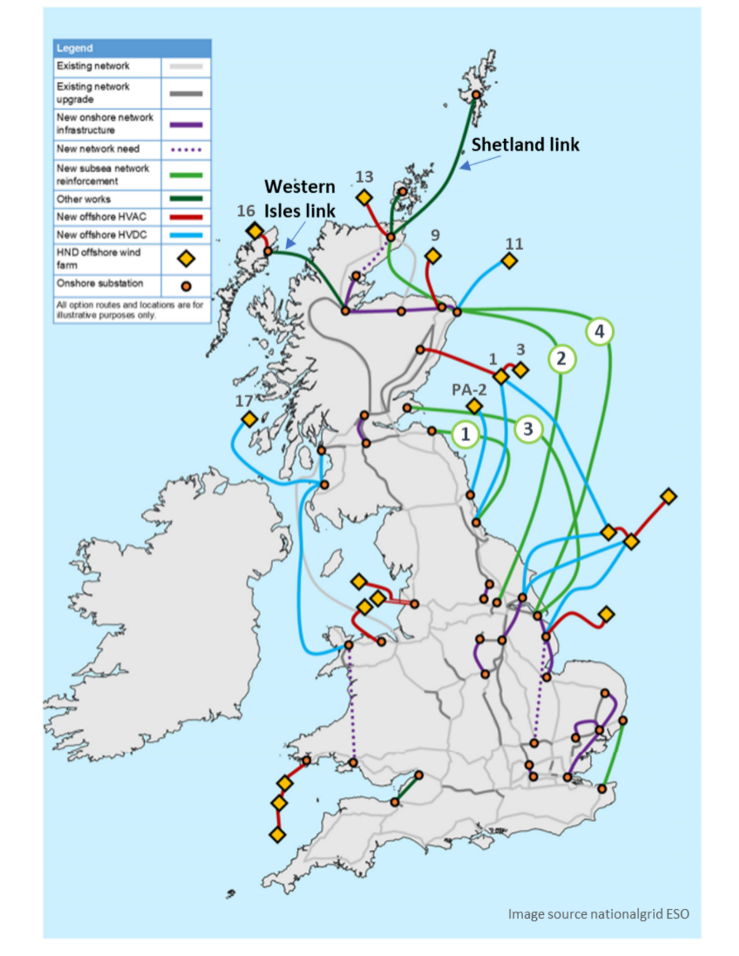
National Grid’s argument for building subsea links to move power from Scotland to England is that overhead lines take years to obtain approval and encounter fierce local opposition. As noted, National Grid had an incentive to argue for asset-heavy solutions, and one would hope that NESO is more sceptical of this argument. There would seem to be two solutions worth exploring. The first is to run an additional double circuit set of pylons along the way-leaves of the current North-South main transmission lines. Indeed, the methodology for setting Generation-Transmission Use of System charges assumes that existing lines can be incrementally expanded each year, demonstrably not happening at present, but clearly worth considering. The visual intrusion of adding a line to one already there would seem to be minimal, and there is little evidence of strong protests against the existing lines.
The second solution is to install HVDC cables from a suitable site in Scotland down to the Midlands. Long distance HVDC is cheaper than conventional alternating current (AC) lines above distances of 500-700 km because of much reduced power losses12. Thus the lifetime cost of a 700km 8GW HVDC cable is 53% of the conventional high voltage alternating current (HVAC) overhead line, a dramatic saving. HVDC lines can be carried on lower pylons, so if following existing way-leaves would be even less intrusive. According to Mott MacDonald, HVDC onshore is “Not currently used in GB but common-place in other countries. Multiple such links are currently under construction in Germany to provide a link between the North of the country which has significant renewable generation, and the South which has high demand.”13
Improving locational signals for new windfarms
At present onshore windfarms pay less than the full Generation-Transmission Use of System charge as they impose less stress on the network. A windfarm with a 34% capacity factor (CF) connected in Argyll in Scotland (a windy location) would pay £23.71/kWyr. (77% of the full charge) while one connected in the Midlands and East Anglia would be paid £0.10/kWyr (if delivering in winter peak hours, otherwise zero). At the assumed 34% capacity factor the difference between the two translates to £7.96/MWh, a substantial incentive to locate wind farms in low charge zones instead of zones distant from demand. To put this figure into context, the February 2026 Auction Round 7a cleared at £72.24/MWh for onshore wind.14 A wind farm in Argyll would earn a gross income of £64.28/MWh, compared to the full £72.24/MWh in East Anglia. The Argyll windfarm would need to have a 38.2% capacity factor to earn the same gross income as a 34% capacity factor East Anglian wind farm. This is hardly a deterrent to locating in Scotland given its better wind conditions.
This assumes that current overhead lines can be immediately expanded at the same cost as existing lines, but the reason for the subsea connections is because this is thought impossible. If new windfarms had to pay the cost of using SEGL 2 the annual charge would be 71%15 of £130.29 or £92.50/kWyr and £21.73/MWh (at 48.6% capacity factor, CF). This would be the CF needed to deliver the same gross income as an East Anglian windfarm with a 34% CF.16
Faced with the correct long-run marginal cost of expanding transmission via subsea links, windfarms would avoid Scotland, forgo the apparently higher capacity factor, and locate nearer to demand with a lower capacity factor but also a lower total system cost. If enough windfarms choose to do this, and until onshore lines can be built, the case for SEGL 2 (and the other subsea links) would disappear.
The reform needed to deliver this lower system cost would be to grandfather all existing connections (i.e. continue to pay according to the published methodology) but offer new connections at the new forward-looking marginal cost (i.e. the cost of the next line). This would be with a contract at that price for e.g. 20 years, like the current offshore transmission owner (OFTO) charges for offshore windfarms. The benefit would be avoiding the very high curtailment rates currently experienced in Scotland as a result of constraints on the transmission system – in recent cases over 50%. If a windfarm is curtailed 50% of its potential output, its costs per unit of output are doubled, confirming that locating in such constrained areas is costly. Existing generators would have no reason to complain if this reform were introduced for all new as yet not consented connections. Almost all revenue for transmission is already connected from load (i.e. consumers), which can readily accommodate this reform without undermining regulated transmission revenue.
If only a limited export capacity at any node on the grid is currently available, a further reform would be to offer only that amount firm (i.e. with compensation for curtailment below this amount), with no compensation if curtailed, and with priority curtailment – last connected first curtailed. This has been proposed for the island of Ireland by Eirgrid17, which offers a non-firm connection until the link is reinforced or after five years, whichever is sooner. The agreement could be attached to a grid contract when the line becomes available that reflects the (suitably shared) amortized deep connection charge.18 A similar contract is offered to variable renewable energy projects (VRE) connecting to GB distribution networks, a result of an innovation competition initiative to accelerate connections.19 Developers are offered either a firm contract at the deep connection cost, or an existing cheaper option but subject to a capped level of curtailment.
Conclusions
Current plans that have their origin with asset-hungry National Grid propose to deal with the massive expansion of renewable electricity in distant location with a massive and unnecessarily costly expansion of subsea transmission links. If NESO is to fulfil its duty to minimise total system cost (as the former vertically integrated and state-owned Central Electricity Generating Board did with its spatial planning) it will need to revisit its Beyond 2030 report while Ofgem will need to ensure that Generation-Transmission Use of System (G-TNUoS) charges reflect the true cost of new connections.
1. ‘Beyond 2030: A national blueprint for a decarbonised electricity system in Great Britain’, NESO, March 2024.
2. NESO, 2024, Figure 1, page 7.
3. ‘A Comparison of Electricity Transmission Technologies: Costs and Characteristics’, Mott MacDonald in conjunction with the IET, 2025, p81.
4. National Grid Electricity Transmission’s 2024 weighted average cost of capital (WACC) is 3.54% – RIIO-2 Annual Iteration Process 2024 for Transmission and Gas Distribution, Ofgem: see spreadsheet ET2 PCFM. Transmission life is taken as 40 years, which may be optimistic for subsea cables, giving an under-estimate of annual costs. This gives an annual rate of 4.48%. Mott Macdonald (2023) uses a factor of 5.05% based on a WACC of 4% and, looking forward, that seems appropriate.
5. NESO, n.d. ‘Clean Power 2030 Annex 1: Electricity demand and supply analysis’, p.4.
6. ScottishPower Energy Networks, Western HVDC Link.
7. Western HVDC Link, Wikipedia.
8. Mott MacDonald, 2025.
9. Go-ahead for UK’s biggest subsea connection project, Scottish and Southern electricity Networks, press release, August 2024.
10. ‘Ship anchor damage remains a leading cause of damage globally, presenting a significant and preventable threat to submarine cables’, International Cable Protection Committee, February 2025.
11. ENTSO-E, 2025. ENTSO‐E HVDC Utilisation and Availability Statistics 2024.
12. Mott MacDonald, 2025, p109 and appendix G2.
13. Mott MacDonald, 2025, p267.
14. Contracts for Difference Allocation Round 7a results
15. Lower than the 77% for a 34% CF because calculated for the 48.6% CF needed to compete
16. Calculated as £72.24*34%/(£72.24-£21.73)
17. Firm Access Methodology: Proposal. Technical Report, Eirgrid, 2022.
18. Newbery, D. and D. Biggar, 2024. ‘Marginal curtailment of wind and solar PV: transmission constraints, pricing and access regimes for efficient investment’. Energy Policy 191, 114206. §2.2 shows pro-rata curtailment with efficient G-TNUoS charging leads to efficient entry.
19. Ofgem financed the Flexible Plug and Play project – see the progress report here.