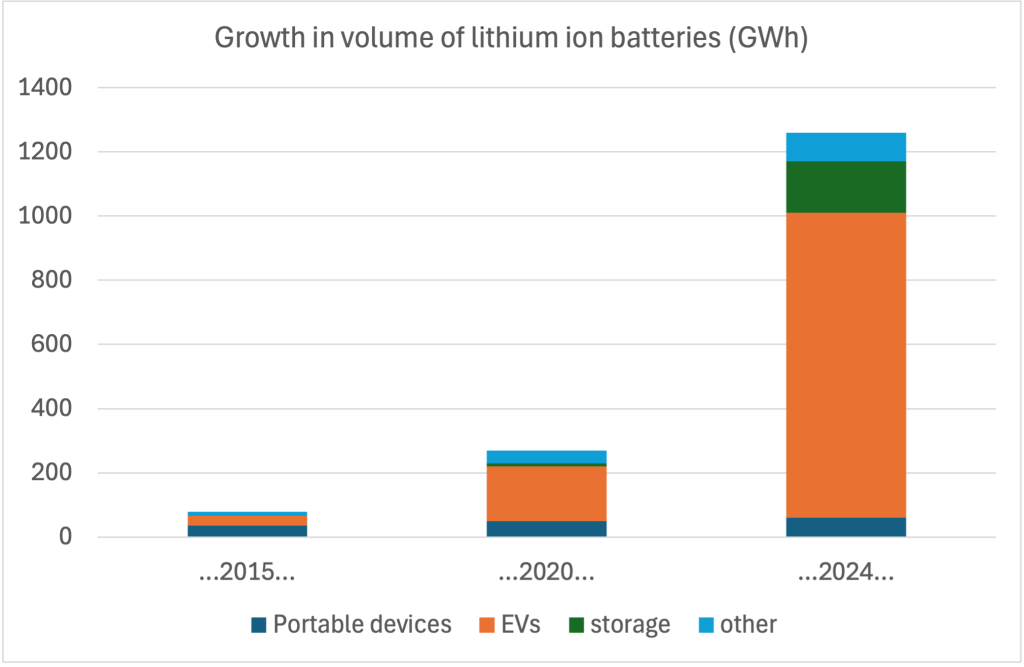
Battery use is exploding around the world as prices crash and battery technologies improve. They are set to become the second most important source of electricity to be beaten only by the increasingly dominant growth of solar power. In fact, as can be seen in Figure 1, the bulk of battery capacity is going into the surging demand for Electric Vehicles (EVs). However stationary storage is rapidly increasing.
In this article I begin by looking at the expansion of lithium battery technology as a whole; then I shall zero in to look more specifically and comprehensively at the impact of the lithium battery revolution on the power sector – in particular its growing impact on electricity markets and the ability of these markets to absorb increasing penetrations of fluctuating renewable energy sources.
Figure 1.
Lithium dominance
Figure 1 shows how production of lithium-based batteries has exploded. It began in the 1990s with the demand for laptops – which required compact, lighter batteries than could be provided by existing battery technology. Then the emergence of mobile phones as consumer devices increased demand for lithium batteries, and from 2010 onwards EVs started to become a major consumer of lithium batteries: by 2020 the demand for lithium batteries was dominated by EVs.
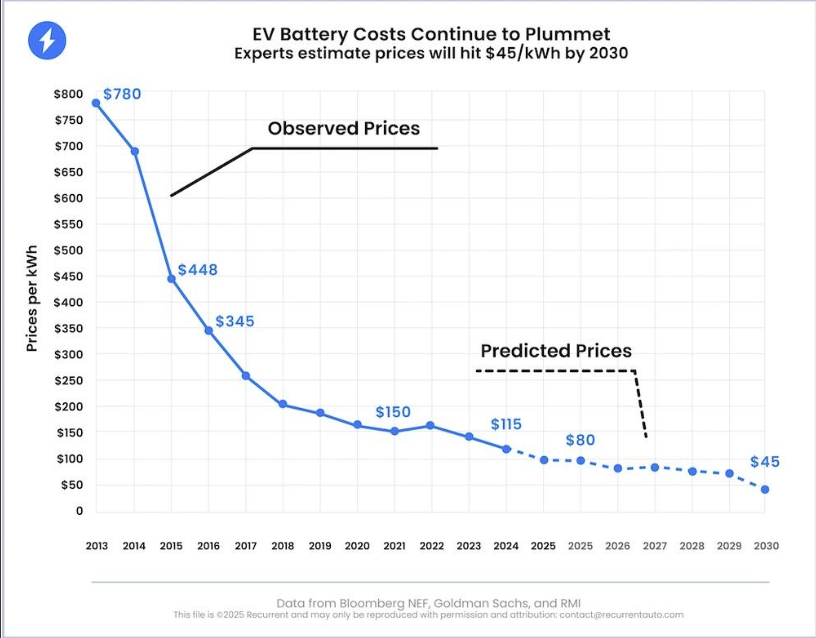
The decreasing costs of stationary batteries used in the power sector is thus driven by the EV market. This can be seen in Figure 2 below. There has been talk of competition between lithium-based batteries and other technologies, e.g. sodium-based batteries, or ‘long duration’ batteries of various types. However, for the moment at least, lithium batteries continue to dominate virtually the entire market for EVs, as well as portable and stationary sources used in the power sector. Indeed, innovations in lithium battery technology, in particular the increasing use of lithium ferrous phosphate (LFP) batteries, has increased lithium’s stranglehold. Lithium is a very common element and its battery technology, via LFP, has been evolving to reduce the use of rare metals such as cobalt and nickel and at the same time reduce fire risks. Lithium prices have edged upwards this year, but even so price rises are still small compared to the Autumn of 2022 when prices peaked at over three times the current world market price. Nevertheless, the dominant Chinese battery company CATL has started producing sodium-based batteries which promise to use more common ingredients for an efficient alternative that is especially suitable for stationary batteries.
Around three quarters of the world’s battery production comes from China. China is leading innovation in new styles of battery production, for example in LFP batteries. China’s dominance in battery manufacturing, gained in particular through robot-controlled factories, is also linked to its dominance of the world market for EVs.
Figure 2.
It is important to understand the two key elements which define the power potential of batteries. One is the power that a given battery can provide, say 5MW; the other is its duration. Duration refers to the length of time that a battery can supply a given level of power. For instance, if a 5MW battery can store 10MWh of electricity in total, then it will have a ‘duration’ of two hours. The longer duration a battery is designed to last, the more expensive it is to produce. Certainly, governments have promoted innovation in alternative, longer duration batteries (i.e. more than, say, eight hours). That is a worthy thing to do. However, there is no technical reason why lithium batteries could not be used in much longer duration batteries that are routinely used today in electricity markets. It is only recently that battery durations for grid purposes have often been longer than two hours. The only reason that they are not is that power markets do not yet demand this. However, as wind and solar penetrations increase, this is likely to change.
There may be economic advantages for developing (non-lithium) battery systems that can deliver power for over a few hours duration. However, the cheapness of non-lithium long duration battery technologies is yet to be demonstrated. Of course, other battery technologies may find niches to which they are better adapted compared to lithium-based ones. This whole discussion should not be confused with a discussion about inter-seasonal or inter-annual storage vectors (e.g. hydrogen). Such a topic is rather different from the intra-day batteries that are the focus of this article.
Absorbing wind and solar generation
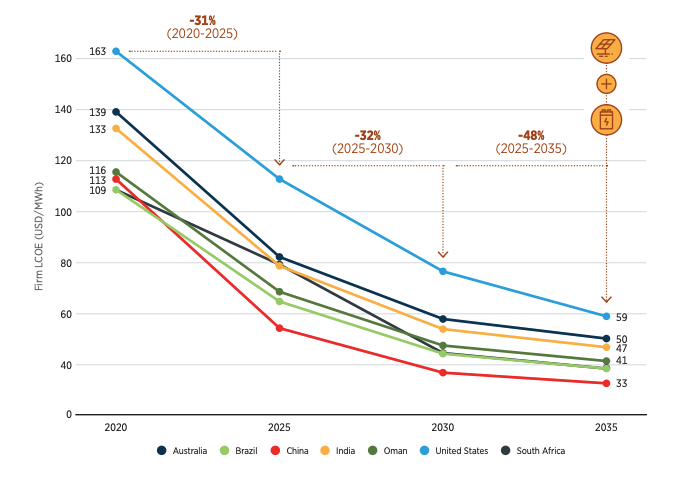
The wind does not blow and the sun does not shine all the time. However, batteries can make up for most – and in some parts of the world all – of this gap. This used to be a crazy idea because solar PV and wind power and batteries were expensive. But now wind and especially solar costs have dropped dramatically – to a small fraction of the cost 30 or 40 years ago. Batteries used to be expensive, short-lived, and based on heavy lead acid technology. Now things have changed radically. In many parts the world, solar plus lithium-based batteries are the cheapest mainstream electricity source. You can see the trajectory in Figure 3 from a recent report from the International Renewable Energy Agency, which charts spectacular reductions in cost in the very recent past, specifically highlighting declines in the US of 31 per cent from 2020-25, with projected declines of a further 32 per cent from 2025 to 2030 and 48 per cent from 2025 to 2035 in the US market.
Figure 3. Firm LCOE trajectory for solar PV and BESS at 95% reliability, 2025-2035.
Solar PV is the cheapest source of electricity even in the UK. It came in as cheaper than its next competitor, onshore wind, in the most recent competition in bidding for UK Government backed contracts for renewable energy (AR7a). In the UK, as elsewhere, batteries allied to renewables are acting as competition for gas fired power plant – competition that will reduce power prices. In Northern states like the UK, wind might still be dominant compared to solar PV because of the need to provide a more even level of electricity production in the winter (when there is in any case more wind production).
As the penetration of fluctuating wind and solar sources increases, gas is used less and less while declining battery prices allow batteries to substitute for gas-fired peak generating capacity. Indeed, in the UK the amount of time that natural gas sets the wholesale electricity price is declining, though gas still sets the price for around three quarters of the time this is down from over 90 per cent of the time just five years ago.
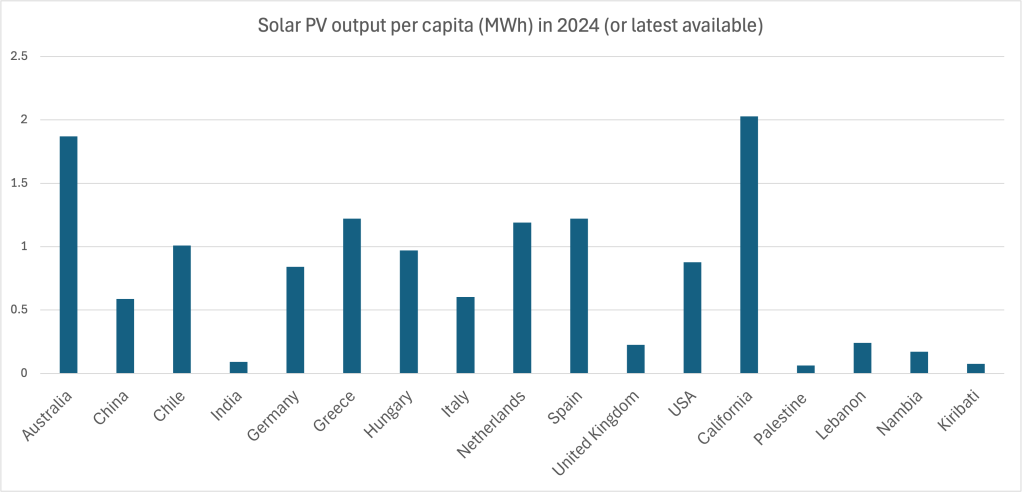
Very large amounts of battery capacity are waiting to be connected to the UK grid. However, we can already see the big impact that batteries are having in balancing solar PV in places like California and Australia. In these places there is a lot of solar PV already installed and an increasing amount of battery capacity. As can be seen in Figure 4, California and Australia have the highest installation rates so far on the basis of capacity per person.
Figure 4.
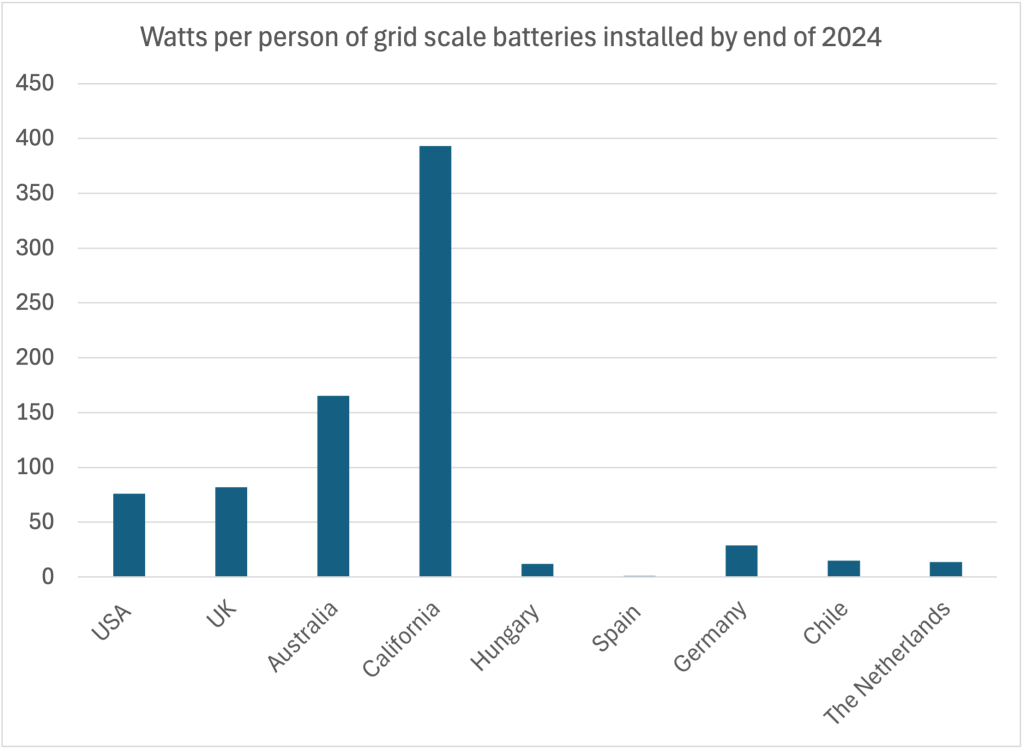
California, and to a lesser extent Australia, are ahead of other countries in developing battery capacity partly because of the tremendous growth in solar PV generation during the daytime. Although this coincides with peak demands for air conditioning it still leaves a problem of excess supply during the daytime compared to demand.
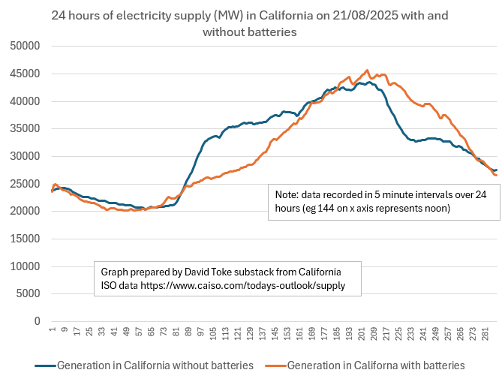
In California the Government, advised by its California Energy Commission, induced the big energy utilities to invest in grid-scale batteries. The impact of increasing levels of batteries can be seen in Figure 5. Two lines are shown: generation with batteries and generation without batteries. The ‘without batteries’ line shows what would have happened without the batteries, i.e. it shows the electricity generation (including large amounts of solar PV) as it occurs. The ‘with batteries’ line shows the power that was sent to consumers. As can be seen, the existence of batteries meant that, in effect, much of the daytime generation was shifted to the evening. The amount of generation being shifted is increasing rapidly and both installed solar PV and battery capacity increases. If it was not for the batteries, increasing amounts of solar PV generation would have to be curtailed.
Indeed, there is an increasing problem in power markets. As solar PV generation increases, focussed as it is on the sunniest parts of the day, more and more is excess to electricity demand. This reduces what are called ‘capture prices’ – the monetary value of the output from solar PV – and the value of solar PV generation declines. The excess generation problem can be ameliorated by utilities installing large batteries and the solar PV generators themselves can capture more value for the otherwise excess (and low-value) generation by co-locating the solar farms with batteries. As solar generation increases as a proportion of total electricity generation, this is becoming the norm in many places.
Figure 5.
It needs to be pointed out, however, that there is a mismatch between the relative proportions of electricity production provided by solar PV and the level of battery installation in different countries. Unlike California and Australia countries, such as Spain and Germany with high proportions of solar PV production are relatively lacking in battery installations. These latter countries will have to increase (and to an extent already are increasing) their battery installations in order to keep down the amount of low value solar generation. This contrast can be seen by comparing Figure 4 shown earlier with Figure 6. The UK is building up its battery capacity by around 2GW a year, with around 7GW in place at the end of 2025. However, this rate of growth is well behind the National Electricity System Operator (NESO) target of 23-27GW of Battery Energy Storage System (BESS) by 2030.
In addition, the UK Government is promoting ‘long duration energy storage’ (LDES) through a cap and floor incentive system. There is a target of 4-7GW of LDES by 2030. There is no shortage of proposed projects – over 60GW of battery projects have planning consent. The big dampener on rapid growth are grid connection bottlenecks. NESO has introduced a method of speeding deployment by shortening grid connection queues so that only ‘ready to go’ projects are at the front of the grid connection queue.
The UK Government says that the reforms are cutting out large proportions of ‘unready’ generation and storage which are acting as connection blockers. However, this reform may not be enough to meet the targets. One measure that will create greater income streams for batteries is simply to increase the roll-out of wind and solar projects. This is because the more the electricity system relies on fluctuating generation the more there will be a difference between wholesale prices. This difference in prices is between the high wholesale prices in those half-hours when there is a shortage of wind and sun and, on the other hand, low (or, even negative) prices when there is an abundance of fluctuating renewables. Hence the opportunities for ‘arbitrage’ will increase as the proportion of electricity from fluctuating renewables increases.
Figure 6.
Markets for batteries
For the most part, batteries in the electricity sector have been developing from market pressures rather than government inducements. That having been said, batteries are taking advantage of incentives that are on offer to provide reserve source of electricity. These ‘capacity markets’ are where companies are given payments to guarantee provision of capacity if called upon to do so. Until recently, capacity markets were entirely taken up by conventional (mostly gas-fired) generation.
The market that has seen the main drive for the initial installation of batteries in the electricity sector is the frequency response market. Traditionally fast response markets have been populated by flexible, usually gas-fired, fossil fuel plant. These can come on stream at a moment’s notice to ensure that frequency of electricity transmission is kept stable within regulated boundaries. The electricity system operators will buy frequency response services (and other ‘ancillary’ services) off generators according to who can supply them cheapest at any given time. However, in recent years batteries have increasingly dominated such markets in the UK because batteries can provide frequency response services very quickly indeed.
A third market that has been a growing market for batteries consists of balancing mechanisms. These are used by system operators to provide supplies of electricity when there are gaps in between registered ‘wholesale’ supplies of electricity and the amount that is being demanded in any half hour in the national electricity system. Balancing mechanisms can become more important as fluctuating electricity supplies become more important for national grids. That is because predictions of fluctuating renewable energy sources are not perfect.
However, an even bigger growing market for batteries is the so-called ‘arbitrage’ market. Arbitrage means that battery owners absorb or buy in power when wholesale power prices are low. Then they sell the power that they have stored in the batteries when wholesale power prices are high.
Opportunities for ‘arbitrage’ trading expand generally as the proportion of electricity produced by wind and solar PV increases. Not only this, but the duration of batteries that are installed also increase since there will be more demand for battery services of a longer duration. As the proportion of generation from wind and solar power increases, then the likelihood that such generation will exceed demand also increases. This implies that there will be more and more excess renewable energy that is available for storage. Hence, ‘arbitrage’ will become the largest market for grid-connected batteries as the proportion of total electricity that is fluctuating increases. Indeed, the ‘duration’ of batteries installed is gradually increasing as the use of batteries shifts from being mainly short-term ‘frequency response’ and ‘balancing’ to longer lasting ‘arbitrage’.
Conclusion
Use of batteries in the power sector is growing very fast. However, this is coming largely on the back of the rapid roll-out of Electric Vehicles which is providing the largest share of manufacturing battery production and driving down the cost of producing each unit of battery power.
The expansion of the use of batteries in the power sector will march forward with the expansion of the proportion of electricity that comes from fluctuating renewable energy sources, mostly wind and solar. Renewable energy sources and batteries are an unbeatable combination that will sweep most other electricity generation off the map across the world. This will allow global energy transition to move forward. Its speed, ultimately, will depend on electrification of energy sectors and the rapid application of technologies such as EVs and heat pumps.
- ‘Global battery markets are growing strongly – and so are the supply risks’, 13 February 2026.
- Joe Romm, ‘EV Battery Costs Keep Plummeting, Goldman Forecasts EV Price Parity With Gas Cars by 2026, Hydrogen Cars Still on a Dead End Street.’, LinkedIn post, 2025.
- ‘24 / 7 Renewables: The Economics of Firm Solar and Wind’, IRENA, page 10, Figure 2, 2026.