Introduction
At the London Early Years Foundation (LEYF), the UK’s largest children’s charitable social enterprise, our role extends far beyond running nurseries. We exist to demonstrate that a different way of delivering early education and childcare is not only possible, but necessary. As an active member of the Early Education and Childcare Coalition (EECC), we advocate for a system that prioritises affordability, accessibility and inclusion while refusing the false choice between financial sustainability and social purpose.
Social enterprises like LEYF show that it is possible to combine commercial acumen, business discipline with social purpose which drives public value. We do not extract profit; we regenerate our income and drive social impact through the business model. Yet, despite decades of evidence, innovation and delivery at scale, social enterprises remain marginal in government contracting and chronically under-recognised as a credible business model for publicly funded services. This neglect is increasingly difficult to justify.
At a time of intense fiscal pressure, the UK continues to tolerate extraordinary waste elsewhere in the system. Large consultancies secured over £1.5 billion in UK government contracts in 2024 alone, up from £1.4 billion in 2023 and £1 billion in 2022, according to Tussell data. This sits uneasily alongside repeated government commitments to cut spending on external advisers, pledges that have yet to translate into meaningful restraint. Meanwhile, social enterprises delivering frontline services with measurable long-term impact struggle to access stable, fair funding. We appear to be willing to accept bureaucratic bloat rather than invest intelligently in services that prevent inequality before it becomes entrenched. Early Childhood Education and Care (ECEC) is a case in point.
The UK’s ECEC system is delivered through a fragmented mixed economy of private, voluntary, charitable, social enterprise and state provision. While this diversity is often presented as a strength, in practice it conceals deep structural weaknesses. Many private providers operate on precarious margins, particularly those serving disadvantaged communities where public funding fails to meet the true cost of delivery. Others, most notably large private-equity-backed chains are able to generate substantial profits, extracting value from a publicly subsidised system and distributing it to shareholders.
This imbalance matters because ECEC is not merely an economic childcare service enabling parental employment. It is also a powerful social justice intervention with proven potential to reduce inequality, improve life chances and support social mobility. Yet public discourse and policy increasingly prioritise the quantity of childcare places over the quality of early education, sidelining the very outcomes that justify public investment in the first place.
The consequences are visible across the sector. Workforce recruitment and retention remain critical challenges, driven by low pay, poor conditions and limited professional development. Evidence from the Education Policy Institute highlights that high-quality provision depends not only on skilled staff, but on fair treatment, ongoing learning and clear career pathways. These conditions are far more likely to be sustained in purpose-led organisations that reinvest in people rather than extract profit.
“Early Childhood Education and Care can reduce inequality, improve life chances and support social mobility. Yet policy increasingly prioritises the quantity of childcare places over the quality of early education, sidelining the very outcomes that justify public investment.”
At the same time, market fragility is intensifying. Provider numbers are declining, childminder capacity is shrinking, and costs associated with SEND, workforce pressures and rising operational expenses fall hardest on settings in disadvantaged areas. Flat funding rates force providers to cross-subsidise through parental fees or withdraw altogether deepening geographical and social inequalities in access to provision. This is not a temporary market correction. It is a structural misalignment between public policy goals and the mechanisms used to deliver them.
Social enterprises offer a credible alternative. They operate with business discipline, transparency and accountability, while remaining anchored to public purpose. They are designed to hold social value at their core, align incentives with outcomes, and deliver long-term impact rather than short-term returns. In a system under strain, this is not an ideological preference; it is a practical solution.
If we are serious about giving every child the best start in life, reducing inequality and spending public money wisely, then social enterprise must move from the margins to the mainstream of government contracting. The question is no longer whether social enterprise works. It is why, in the face of mounting evidence and escalating need, it continues to be overlooked.
What is a Social Enterprise?
Social enterprises are businesses that trade to deliver a social purpose. Unlike profit-extracting models, they operate with asset locks and mission safeguards, ensuring that surplus is reinvested for public benefit rather than distributed to shareholders. Their defining feature is not the absence of profit, but the way profit is used: as a means to achieve social outcomes.
In early education and childcare, this operating logic matters profoundly. Delivering high-quality provision in disadvantaged communities typically involves higher costs and lower financial returns. Conventional market models struggle in these contexts, often leading to under-provision or withdrawal. Social enterprises are explicitly designed to operate where markets fail. They blend public funding with earned income, use deliberate cross-subsidy, and reinvest surplus locally to sustain access, quality and equity.
Social enterprises are financially disciplined organisations. They must be viable, resilient and well governed. However, because they are not driven by shareholder returns, their business decisions are aligned with long-term outcomes rather than short-term extraction. This creates a fundamentally different incentive structure, one that prioritises children, families, staff and communities.
A report on social enterprises and early years1 identifies them as particularly effective in complex public service environments, where outcomes matter more than volume and where prevention delivers long-term value. Their strength lies in their ability to combine commercial acumen with public purpose, operating as partners to the state rather than dependents upon it. In this sense, social enterprises do not replace public services, nor do they privatise them. They offer an alternative delivery model — one that reduces pressure on the state while improving outcomes, especially in areas of entrenched disadvantage. At a time of fiscal constraint, this is not a marginal proposition; it is a pragmatic and value-for-money solution.
What is a Childcare Social Enterprise?
A childcare social enterprise applies this model specifically to early education and childcare, using its business structure to widen access, raise quality and mitigate inequality. These organisations operate nurseries, but their role extends well beyond childcare provision. They exist to support children, families, the workforce and communities as an interconnected system.
At LEYF, for example, approximately 75% of nurseries are located in areas of deprivation, as measured by the IDACI index2. This is not accidental. It is the result of a deliberate strategy to counteract the emergence of “nursery deserts”3 in poorer neighbourhoods, areas where provision becomes scarce because it is deemed financially unviable. Through cross-subsidy and fair fee models, childcare social enterprises ensure that high-quality provision remains available where it is most needed.
The added value of childcare social enterprises lies in their holistic approach. Support for families frequently goes far beyond childcare, encompassing guidance, advocacy and crisis support. Case studies consistently show staff helping families navigate housing insecurity, domestic violence, mental health challenges and engagement with statutory services. For some families, without this relational and open-ended support, the benefits of childcare alone would be significantly diminished.
Childcare social enterprises are also inclusive by design. They are more likely to welcome children with additional needs, invest in workforce training, and maintain flexibility to respond to complex family circumstances. By supporting families early, stabilising provision in disadvantaged areas, and investing in staff quality and retention, childcare social enterprises reduce downstream costs to education, health and social care. They are not a cost to the system — they are part of the solution.
Why the social enterprise model is a credible solution to England’s broken childcare system?
England’s childcare system is failing the communities that need it most. Recent world-first research by Victoria University, International childcare: Mapping the deserts, mapped access for ten million children across nine countries and found England to be among the worst in Europe for childcare accessibility. The study exposes a stark truth: childcare provision follows wealth, not need. In England, childcare accessibility in the most advantaged ten per cent of neighbourhoods is 16 per cent higher than in the most deprived. Providers are incentivised to operate where families can pay higher fees, creating childcare “deserts” in poorer communities and entrenching inequality from the earliest years.
This evidence reinforces a central principle: equity in early years cannot be achieved through uniform funding. It requires differentiated responses that reflect uneven geography, disadvantage and cost. Public support for this approach is strong. Findings from the Early Childhood Education and Care Coalition (2025)4 show that 67 per cent of respondents agree that investing in high-quality, affordable early education benefits the entire nation — supporting parents into work, strengthening local economies, and crucially, giving children from disadvantaged backgrounds a fairer start.
The early years represent one of the most powerful prevention opportunities available to government. Analysis from the Institute for Fiscal Studies (2022)5 shows that by age five, children from disadvantaged backgrounds are already four to five months behind their peers in vocabulary, problem-solving and socio-emotional development. These gaps are highly predictive of later outcomes, including lower attainment, school exclusion, poorer health and reduced lifetime earnings. Once established, they are costly and difficult to close. The IPPR (2015) estimates6 that spending on “late intervention” services—children’s social care, mental health provision, youth justice and crisis responses now exceeds £17 billion per year. Much of this expenditure reflects avoidable failure earlier in the system.
Despite this evidence, early years funding in England remains largely flat and uniform, ignoring the higher costs of delivering quality provision in disadvantaged areas. These settings face greater workforce instability, higher family support needs and increased inclusion demands. Uniform funding undermines prevention by making provision in high-need communities financially fragile and more likely to close. It also restricts providers’ ability to cross-subsidise, increasing dependence on the state and driving up long-term public costs. Experience at LEYF demonstrates this clearly: several local authority nurseries were rescued only to reveal chronic problems of low productivity, limited business expertise and a lack of financial flexibility.
This is where the social enterprise model offers a credible and pragmatic alternative. Social enterprises blend public funding with earned income and reinvest surplus locally, enabling them to absorb higher operating costs without withdrawing from disadvantaged communities. Unlike profit-distributing models, they are structurally designed to prioritise outcomes over extraction. Social enterprises as particularly effective where markets fail, precisely because profit maximisation is not their primary driver7.
“Despite this evidence, early years funding in England remains largely flat and uniform, ignoring the higher costs of delivering quality provision in disadvantaged areas.”
LEYF’s experience illustrates this logic in practice. With approximately 75 per cent of nurseries located in areas of high deprivation, the organisation sustains quality through deliberate cross-subsidy, workforce investment and long-term commitment to place. This reduces the likelihood that children will require costly downstream interventions. It is prevention by design, not remediation after failure.
The fiscal case is compelling. High-quality early education reduces later demand for SEND provision, mental health services and social care. Investment in workforce training and progression improves retention and reduces recruitment and agency costs. Mission-led providers are less likely to exit disadvantaged markets during periods of financial pressure, avoiding disruptive service gaps that the state must later fill at greater expense. As IPPR (2020) has consistently argued8, rebalancing public spending towards prevention improves outcomes while reducing long-term costs. The Adebowale Commission9 found that despite over £600 million of public investment since 2010, the social investment market delivered little structural change. The impact economy, which is being described by the Department for Education as an approach in which public and social investment is judged not only by immediate outputs or cost efficiency but by its ability to improve life chances, reduced inequality, and stronger communities. If it is to gain real traction and be accessible for social businesses then investment supported by government funds must be affordable, patient, and relevant, and free from unnecessary investor demands that undermine mission delivery. Early years social enterprise provision is a mechanism for achieving this shift at scale.
This is not an argument for increased state control or the displacement of private provision. It is an argument for recognising public value within a mixed economy and aligning funding, commissioning and accountability accordingly. If government is serious about narrowing the attainment gap, stabilising childcare provision and reducing long-term expenditure, early years must be treated as essential prevention infrastructure rather than a discretionary market service. Social enterprise models are not a cost to be managed — they are a fiscal asset that enables the state to spend less later by spending more wisely now.
Why Early Childhood Education and Care Needs a New Model of Leadership
If early childhood education and care is to play the transformative role that evidence demands of it, then leadership in the sector must also be transformed. The challenges facing ECEC today including deepening inequality, market fragmentation, workforce attrition, and chronic under-investment cannot be addressed through technical management alone. They require a form of leadership that starts and ends with social purpose.
Social leadership begins with a clear vision of how ECEC contributes to a better, fairer society. There is no social leadership without social purpose. While it is not revolutionary to assert that ECEC has a social purpose, it is striking how rarely this purpose is made explicit in leadership theory or policy discourse. Many people are drawn to the sector precisely because they believe in its potential to improve children’s lives, particularly for those experiencing poverty or disadvantage. High-quality ECEC is consistently associated with improved long-term outcomes, and this relationship is strongest for children whose parents have lower levels of educational qualification. Yet the structures within which ECEC operates often undermine its ability to deliver on this promise. Leadership literature reflects this fragmentation. While a growing body of research addresses equity-related issues such as gendered labour, low pay and workforce conditions, these are rarely connected to deeper questions about the purpose of leadership itself. Social justice is often treated as an adjacent concern rather than a defining principle. As a result, leadership risks becoming disconnected from the very outcomes ECEC exists to achieve.
In developing a model of social leadership, the language of “social purpose” matters. While some scholars frame this work explicitly in terms of social justice, leaders in practice more often describe their motivations in terms of purpose, values and vision. This language creates a more inclusive space one that allows leaders to articulate how they enact fairness, inclusion and equity in ways that are meaningful within their own contexts. Social leadership, then, is not a fixed ideology but a commitment to aligning organisational decisions, pedagogy and relationships with a shared moral purpose.
“High-quality Early Childhood Education and Care is consistently associated with improved long-term outcomes, and this relationship is strongest for children whose parents have lower levels of educational qualification.”
A defining feature of social leadership in ECEC is a different relationship with power. Social leaders are not preoccupied with holding authority; instead, they actively give it away. They invest time and energy in developing the leadership capacities of others, recognising that the sustainability of the sector depends on distributed leadership rather than heroic individuals. This matters deeply in a field experiencing a severe leadership shortage and a lack of systematic leadership development. When leadership is embedded as a shared practice—spoken about openly and inclusively, it becomes part of everyday professional life rather than a distant role reserved for a few.
Powerful conversations sit at the heart of this model. Change in ECEC rarely happens through policy alone; it happens through conversations that shift thinking, practice and relationships. These may be pedagogical conversations that deepen social pedagogy, coaching conversations that grow confidence and agency, reflective professional conversations that embed collaborative innovation, or wider public and network conversations that strengthen the sector’s collective voice. What unites these conversations is their capacity to lead to action. Trust, empathy, challenge and a willingness to take risks are not optional extras; they are the conditions that allow meaningful change to occur.
However, the current policy environment has eroded the sector’s capacity to lead in this way. Chronic under-investment and short-term decision-making have not only constrained ECEC’s ability to enact its social purpose but have also diminished its readiness to lead with purpose at all. Leadership development has been deprioritised at precisely the moment it is most needed. Yet effective leadership is crucial for enabling pedagogy, participation, distributed power, voice, social equity, democracy and achievement to flourish10. In essence, social leadership in ECEC offers a way forward. It reframes leadership as a moral, relational and collective endeavour, grounded in economic, social and environmental sustainability. In a system under strain, it provides not just a critique of what is failing, but a practical framework for rebuilding ECEC as a public good, one capable of delivering lasting benefit for children, families and society.
The Power of a Social Justice Pedagogy
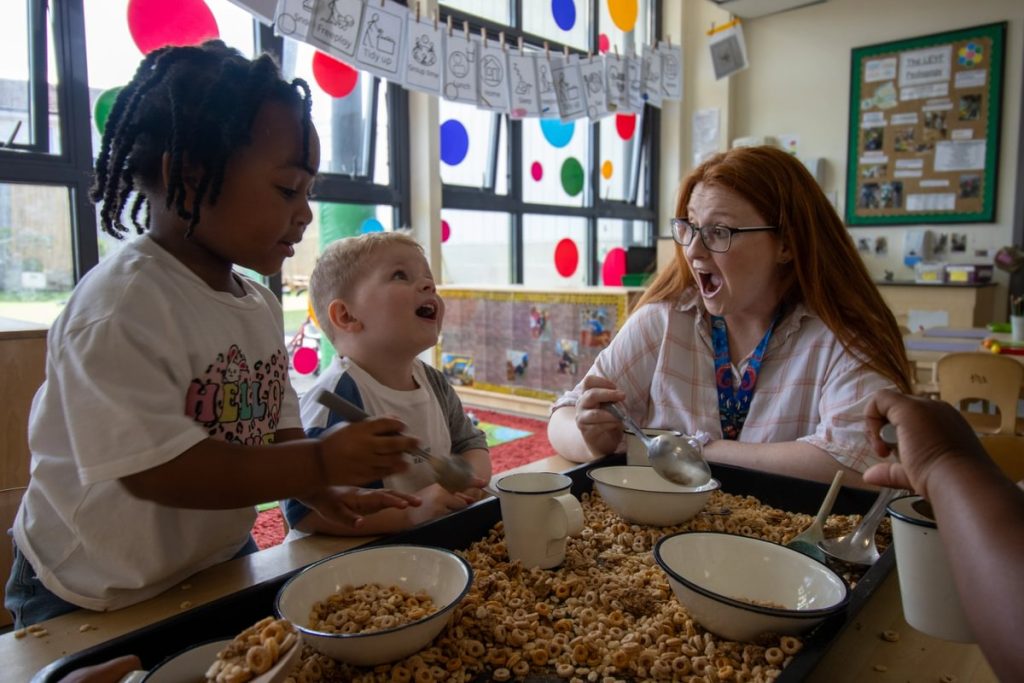
A social justice pedagogy sits at the very heart of social leadership in Early Childhood Education and Care. While leadership, funding and governance structures matter, it is pedagogy that ultimately determines how social purpose is lived, felt and experienced by children, families and staff. Too often, pedagogy remains the “silent partner” in the sector11, overshadowed by operational pressures or reduced to curriculum compliance. Yet if ECEC is to function as a force for social change rather than a transactional childcare service, pedagogy must be made visible, intentional and morally grounded.
A social justice pedagogy acts as the golden thread that connects curriculum, workforce development, leadership and organisational growth. It ensures that social purpose does not remain aspirational or rhetorical, but is enacted daily through interactions, routines, environments and decisions. In this way, pedagogy becomes the means through which policy intent is translated into lived practice. It is what allows early years provision to function as a preventative public service addressing inequality early rather than merely responding to its consequences later.
Social leaders understand that pedagogy is not neutral. Every pedagogical choice reflects values about whose knowledge counts, whose needs are prioritised, and whose voices are heard. A social justice pedagogy therefore begins with a commitment to children’s rights, inclusion and equity. It recognises that children arrive in early years settings with vastly different life experiences, shaped by poverty, racism, disability, housing insecurity, parental mental health and systemic disadvantage. Treating all children “the same” in unequal conditions simply reproduces inequity. Instead, social justice pedagogy is deliberately responsive, adaptive and relational, offering differentiated support grounded in respect and high expectations for every child.
This pedagogy is enacted through everyday practice: how environments are designed to invite movement, exploration and belonging; how language and communication are supported; how families are welcomed and engaged as partners rather than clients; and how children’s identities, cultures and experiences are affirmed. It also shapes workforce practice. Social justice pedagogy requires reflective, critically engaged educators who are supported to examine their assumptions, biases and decision-making. As I highlighted inSocial Leadership12 pedagogy cannot flourish without leadership that invests in professional learning, creates space for dialogue and trusts educators as moral agents rather than technicians.
“Children arrive in early years settings with vastly different life experiences, shaped by poverty, racism, disability, housing insecurity, parental mental health and systemic disadvantage. A social justice pedagogy recognises this and is deliberately responsive, adaptive and relational, offering differentiated support grounded in respect and high expectations for every child.”
Crucially, social pedagogy gives coherence to organisational decision-making. In social enterprises such as LEYF, pedagogy informs business choices about where nurseries are located, how fees are structured, how surplus is reinvested and how staff are supported. If social purpose is the heart of social leadership, then social pedagogy is its heartbeat, animating the organisation and ensuring that values are not compromised under financial or political pressure.
A social justice pedagogy also strengthens sustainability. By aligning leadership, practice and purpose, it builds organisational integrity and resilience. It creates cultures where staff understand not just what they do, but why it matters. In a sector facing workforce crisis and moral fatigue, this coherence is not a luxury; it is essential.
Conclusion: Collaboration, Commitment and Collective Action
The future of early childhood education and care depends on our ability to move beyond fragmented provision and short-term solutions toward models that are ethical, sustainable and grounded in social purpose. Social enterprise approaches such as LEYF demonstrate that it is possible to align high-quality pedagogy, workforce investment and financial viability while prioritising children and communities most affected by disadvantage. When underpinned by social justice pedagogy and social leadership, these models act as preventative public infrastructure improving outcomes now while reducing costs later.
However, no organisation can achieve this transformation alone. If ECEC is to fulfil its role as a public good rather than a market commodity, collaboration must replace competition as the dominant logic of the system. Social change at scale requires shared language, shared values and collective action. This is particularly true in a mixed economy where social enterprises remain largely invisible within policy, funding and data frameworks.
In response to this challenge, colleagues and I have established the Early Years Social Enterprise Collective (EYSE Collective), bringing together social enterprise providers from England, Scotland, Wales, Northern Ireland and Ireland. The Collective is being shaped as a collaborative platform to strengthen voice, share evidence, support leadership development and advocate for policy frameworks that recognise and resource social enterprise as a credible, effective and essential part of the early years system.
Becoming a member of the EYSE Collective is not simply about affiliation. It is a commitment to collaboration over isolation, prevention over crisis, and social purpose over extraction. It is an opportunity to contribute to a growing movement that believes early years provision can and must do better for children, families and society. If we are serious about equity, sustainability and long-term impact, then working together is no longer optional.
Endnotes
1. ‘Social enterprise and the future of Early Years provision’, Jodie Reed, ISOS partnership, July 2025.
2. The Income Deprivation Affecting Children Index (IDACI) measures the proportion of all children aged 0 to 15 living in income deprived families.
3. ‘International childcare: Mapping the deserts’,Hurley, P., Tham, M and Nguyen, H., Mitchell Institute, Victoria University, 2024.
4. ‘Pulse Check 2025: Public attitudes towards early education and childcare’, Early Education and Childcare Coalition (2025)
5. ‘Families and inequalities’, Kiernan, K., Crossman, S. and Phimister, A., IFS Deaton Review of Inequalities, Institute for Fiscal Studies 2022.
6. ‘Spending on late intervention: How we can do better for less’, Chowdry, H and Oppenheim, C, Early Intervention Foundation, 2015.
7. Social Enterprise and the future of Early Years provision in the UK, Jodie Reed, ISOS partnership, July 2025.
8. ‘The whole society approach: Making a giant leap on childhood health’,Hochlaf, D and Thomas, C., Institute for Public Policy Research, 2020.
9. ‘Reclaiming the Future: Reforming social investment for the next decade’, Final Report of the Commission on Social Investment chaired by Lord Adebowale, 2021.
10. ‘Pedagogies for Leading Practice’, Cheesman, S. & Reed, M. eds., Routledge, 2019.
11. ‘Pedagogy: the silent partner in early years learning’, Christine Stephen, in ‘Early Years: an international research journal’, Taylor & Francis, 2010.
12. Social Leadership in Early Childhood Education and Care: An Introduction, June O’Sullivan and Mona Sakr, Bloomsbury Academic 2022.