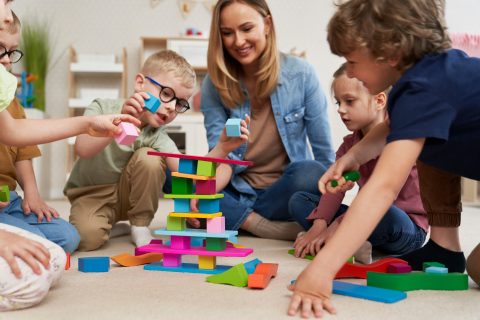
“Nothing comes without a struggle. Strife creates nothing by itself; it only clears the air. New seeds must be planted to germinate and grow, if we will have the tree of humanity blossom . . . We cannot tear the present from the past or from the future. Past, present, and future are the Trinity of time. In the children lies the seed-corn of the future!”1
- Friedrich Froebel (1782-1852)
Context
Over the past two decades children have increasingly spent their time indoors on devices rather than outside in nature2. Whilst fear of children’s safety when playing outside is not new3, there has nevertheless been a significant change in the way children play, driven in part by the availability of screen devices such as iPad, iPhone and gaming consoles. There has also been a wider societal shift away from children having space and time to play in the material world due to changing attitudes about risk4. Trends in parent behaviour confirm their reluctance to allow their children free, autonomous play outside. Research confirms that parents’ perceived risk aversion, including fear of traffic, crime or strangers, is strongly associated with reduced outdoor and unsupervised play for children5. With fewer avenues for outside play coupled with greater availability of a range of electronic devices, children are far more likely to spend time indoors on screens. The shift away from outdoor play has contributed to poor mental health amongst children and young people6, who struggle to adjust to the demands of education. The association of screentime with a raft of mental health problems that include increased anxiety, hyperactivity and inattention, and poorer self-esteem to mention a few has been well documented7.
The impact of poverty
The context described above is even more challenging when we take account of the effects of poverty on children’s over exposure to screens and limited time and space for nature play. Low-income families face acute challenges when attempting to provide play opportunities for their children. In a recent academic report8 low-income mothers expressed strong aspirations for children’s play and future childhoods and found ways to create positive playful opportunities for their children, but support and resources are limited and have diminished due to the cost-of-living crisis in the UK. Raising children in poverty contributes to a situation where “the ‘everydayness of play’ is not adequately facilitated”9. The lack of accessible outdoor space has been identified as a key barrier to nature play10, and limited opportunities for nature play exist in urban locations. The findings confirm the need for government policies that provide opportunities for equitable access to safe, high-quality nature play spaces across all communities, particularly in densely populated urban areas.
“The shift away from outdoor play has contributed to poor mental health amongst children and young people”
Outdoor nature play
The current context has, therefore, seen a shift in children’s opportunity to access nature play and confirms this is an issue for all families, but low-income families are particularly impacted. Access to forms of nature play in, for example, local playgrounds, education settings, parks and nature reserves is mediated by geographical context and proximity to open spaces. Despite the geographical disparities, all children — whether in urban or rural areas — spend far more time indoors than previous generations11. Within this context, the case for an outdoor learning approach in the early years as a counter discourse to staying inside is important. A key strand of Friedrich Froebel’s philosophy is the emphasis on learning in and from nature. Froebel argued that nature is the ‘source of all learning’, firmly positioning outdoor environments as central to children’s holistic development. His approach to ‘outdoor play is about potential — the potential of spaces to engage children’s imagination, curiosity and creativity and foster their health and wellbeing’12. By providing children with opportunities for outdoor play, they can explore freely, develop confidence, and build a deeper understanding of the world around them. Through these connections, they can develop a sense of appreciation for the natural world and their place within it.
The potential of forest schools
Forest Schools represent a reflection of Froebel’s philosophy by providing a space for child-led, experiential learning in woodland settings where children can explore, take risks, and make meaning through self-directed activity. Forest schools recognise the importance of nurturing the whole child, that is intellectually, emotionally, physically, and socially, through hands-on engagement with natural materials and open-ended exploration13. Contemporary research on Forest Schools supports these principles, highlighting gains in confidence, resilience, and problem-solving abilities when children learn in sustained outdoor contexts14. Forest Schools can be understood as a modern extension of Froebel’s vision, translating his nature-centred, play-based pedagogy into a contemporary educational model. A recent study by examining the value of forest schools noted that ‘Froebel emphasised the importance of children’s play… Forest School recognises play as an integral part of learning and development through its learner-centred processes’15. A Froebelian approach provides a powerful theoretical foundation for Forest School practice, emphasising the intrinsic value of play, first-hand experience, and children’s relationship with the natural world.
“By providing children with opportunities for outdoor play, they can explore freely, develop confidence, and build a deeper understanding of the world around them.”
Play in natural environments — the evidence of benefits
There exists a large body of evidence that demonstrates how being and playing in natural environments yields benefits for humans, including — and sometimes especially — young children. Just as Froebel believed in a connected view of development, we find that evidence from multiple scientific disciplines supports a holistic perspective. A recent academic report noted that nature based early childhood education contributed to reduced sedentary time and improved balance, alongside improved socialisation skills16. Other research has noted that Froebel’s principle of unity, which refers to the fundamental interconnectedness of all things, is valuable in nature play because shared experiences outdoors help children build a sense of belonging, collaboration and collective responsibility for the natural world17. Natural England’s research18 notes the value of nature play with 93 per cent of schools agreeing that outdoor learning improves their pupils’ social skills and 92 per cent of schools confirming that it improves pupils’ health and wellbeing and engages them with learning. The evidence consistently highlights that nature-rich experiences support children’s physical, social, emotional and cognitive development in ways that indoor environments cannot fully replicate. Studies across education, psychology and environmental science converge in showing that regular engagement with natural spaces nurtures curiosity, resilience and a sense of ecological responsibility from an early age. Taken together, this growing body of research reinforces the view that nature play is not simply an optional enrichment, but a vital component of high-quality early childhood education grounded in holistic principles.
“The evidence consistently highlights that nature-rich experiences support children’s physical, social, emotional and cognitive development in ways that indoor environments cannot fully replicate.”
Policy recommendations
On the basis of the research reviewed here, the following recommendations to increase children’s engagement with nature play are aimed at policymakers. These recommendations provide practical, value for money policy interventions aimed at increasing children’s engagement with nature:
- Improve emphasis in education policy on outdoor learning to bolster engagement by Early Years settings and schools in the initiatives promoted by the DfE’s Sustainability and Climate Change Strategy19;
- Increase community-based play resources and subsidised access to early years facilities to allow Froebelian-inspired play to flourish. This investment has the potential to improve children’s educational outcomes and their social skills;
- Provide affordable access to indoor facilities, particularly during the winter months when outdoor play is restricted (Ergler et al., 2013). This investment would allow families to overcome seasonal limitations on their children’s play routines;
- Recognise that nature can be brought indoors, seen from indoors, experienced indoors, but children and families also need support to play outdoors in all weathers, providing simple solutions such as clothing for rain / snow etc;
- Develop Community Partnerships: Working with community organisations and collaborating with local councils, early years centres, and other non-profit organisations could extend play-based learning resources to all families, especially those on a low-income. These partnerships are a cost-effective way to reach more families;
- Shift the responsibility for children’s play away from individual parents alone and invest in durable and affordable social infrastructure that incorporates Froebelian principles and enables parents to support their children’s play. This shift would allow parents to reach out and seek support to play with their children, without attaching stigma and blame.
Endnotes
1. ‘Reminiscences of Friedrich Froebel’, 1887, Bertha von Marenholtz‑Bülow, Friedrich Froebel Web.
2. Ofcom (2025, May 7) Children and parents: media use and attitudes report 2025. London: Ofcom; Mullan, K., Hofferth, S.L. (2022) A Comparative Time-Diary Analysis of UK and US Children’s Screen Time and Device Use. Child Ind Res 15, 795–818. https://doi.org/10.1007/s12187-021-09884-3.
3. Valentine, G., McKendrick, J., (1997) Children’s outdoor play: Exploring parental concerns about children’s safety and the changing nature of childhood. Geoforum, 28(2), 205-220.
4. Hoskins, K., Genova, C., & Crowe, N. (Eds.). (2022) Digital Youth Subcultures: Performing ‘Transgressive’ Identities in Digital Social Spaces. Routledge.
5. Kalish M, Banco L, Burke G, Lapidus G. (2010) Outdoor play: A survey of parent’s perceptions of their child’s safety. J Trauma. Doi: 10.1097/TA.0b013e3181f1eaf0. PMID: 20938312;
Faulkner, G., Fagan, M., McKenna, J. et al. (2025) Stranger danger or good Samaritan? A cross-sectional study examining correlates of tolerance of risk in outdoor play among Canadian parents. BMC Public Health 25, 627. https://doi.org/10.1186/s12889-025-21848-8.
6. Xiang, H., Lin, L., Chen, W. et al. (2022) Associations of excessive screen time and early screen exposure with health-related quality of life and behavioural problems among children attending preschools. BMC Public Health 22, 2440. https://doi.org/10.1186/s12889-022-14910-2.
7. Stiglic N, Viner RM. (2019) Effects of screentime on the health and well-being of children and adolescents: a systematic review of reviews. BMJ Open, 3:9(1): 023191. Doi: 10.1136/bmjopen-2018-023191. PMID: 30606703; PMCID: PMC6326346.
8. Hoskins, K., Genova, C., & Crowe, N. (Eds.). (2022) Digital Youth Subcultures: Performing ‘Transgressive’ Identities in Digital Social Spaces. Routledge.
9. Casey, T. and McKendrick, J.H., 2023. Playing through crisis: Lessons from COVID-19 on play as a fundamental right of the child. The International Journal of Human Rights, 27(9-10), pp.1369-1388.
10. Hoskins, K., Genova, C., & Crowe, N. (Eds.). (2022) Digital Youth Subcultures: Performing ‘Transgressive’ Identities in Digital Social Spaces. Routledge.
11. Gray C, Gibbons R, Larouche R, Sandseter EB, Bienenstock A, Brussoni M, Chabot G, Herrington S, Janssen I, Pickett W, Power M, Stanger N, Sampson M, Tremblay MS. (2015) What Is the Relationship between Outdoor Time and Physical Activity, Sedentary Behaviour, and Physical Fitness in Children? A Systematic Review. Int J Environ Res Public Health. 8:12(6): 6455-74. doi: 10.3390/ijerph120606455. PMID: 26062039; PMCID: PMC4483711.
12. Tovey, H. (2017) Outdoor play and exploration. Froebel Trust.
13. Bruce, T. (2012) Early childhood education (4th ed.). Hodder Education.
14. Knight, S. (2016) Forest school in the early years (3rd ed.). SAGE.
15. Menter, H., & Tiplady, L. (2020) Forest School for Wellbeing – Supporting children and young people with social and emotional needs. Scotswood Community Garden / Newcastle University.
16. Johnstone, A., McCrorie, P., Cordovil, R., Fjørtoft, I., Iivonen, S., Jidovtseff, B., Lopes, F., Reilly, J. J., Thomson, H., Wells, V., & Martin, A. (2022) Nature-based early childhood education and children’s physical activity, sedentary behavior, motor competence, and other physical health outcomes: A mixed-methods systematic review. Journal of Physical Activity and Health, 19(6), 456–472
17. Kemp, N., Josephidou, J., & Watts, T. (2022) Developing an ECEC response to the global environmental crisis: The potential of the Froebelian-inspired ‘NENE Pedagogy’ . The Froebel Trust.
18. Natural England (2016) England’s largest outdoor learning project reveals children more motivated to learn when outside GOV.UK.: England’s largest outdoor learning project reveals children more motivated to learn when outside – GOV.UK.
19. DfE (2023) Sustainability and climate change: a strategy for the education and children’s services systems. London: Department for Education. Available online: Sustainability and climate change: a strategy for the education and children’s services systems – GOV.UK