
The golden age of foreign aid
The system that long dominated international development and structured the complex network of partnerships within it endured for nearly seven decades, producing mixed but significant development outcomes and, despite periodic fluctuations, maintained a relative degree of stability until recent years. The premises on which the global architecture of international development was built have been profoundly undermined by the emergence of different development models and a growing political narrative among donor countries pushing for a reduced commitment to providing foreign aid assistance. The reason why this established system remained mostly uncontested within donor countries from the global north throughout this time is that the development cooperation framework had been framed as an effective mechanism for addressing development targets and priorities that benefited all parties.
These premises inspired the launch of the Marshall Plan (officially called the European Recovery Program), the first large-scale post-conflict reconstruction programme. Originally proposed by Secretary of State George Marshall in his Harvard address of 5 June 1947, the plan was approved by Congress in April 1948 with an overwhelming majority, reflecting the bipartisan foreign‑policy consensus of the early Cold War1. The Marshall Plan extended $13.3bn of financial aid, approximately $150bn in 2024 dollars, to Western European nations between 1948 and 1951 for economic reconstruction.
To pre-empt any possible hesitation and secure the support of Congress and the public, the Truman administration needed strong arguments to frame the plan as a presidential priority. The initiative was presented as serving multiple, interrelated objectives: it offered aid to all European countries, including Eastern Europe and the Soviets in order to reinforce diplomatic relationships, promote the image of the US as a force for peacebuilding, and secure economic and political stability across Europe. Investment in European stability won domestic support by assuring the US public that a recovered Europe would keep buying American goods, staving off the risk of a post-war domestic downturn.
In exchange, it required that recipients adopt democratic and capitalist practices – the American economic and political model. The Marshall Plan was designed to function simultaneously as a recovery effort and as a mechanism for securing American market expansion and policy influence within the newly-reconstructed European economies. From its inception the plan was not purely altruistic but strongly characterized by an element of transactionality: economic and financial support was dependent on the promotion of geopolitical objectives and the interests of the donor country and the willingness of the recipient(s) to satisfy donor interests. Because the US administration set out a clear purpose for such a substantial expenditure — serving domestic interests as well as geopolitical stability for its European allies — it secured bipartisan political support and public endorsement, establishing the plan as the model for foreign aid. As European empires dissolved and mandates were relinquished, Western countries repurposed this template — large-scale financing bound up with conditionalities and policy influence — as “development” aid for newly-independent countries. This aid frequently reproduced hierarchical relationships in new post-colonial forms: donors – often including the previous colonial power – provided financial support under strict conditionalities, leveraging their position as recipients’ main source of capital. That leverage rested on a widely shared economic premise: without domestic savings or capital markets able to attract private investment, foreign aid was seen as the only realistic way for developing countries to finance economic growth.
Without domestic savings or capital markets able to attract private investment, foreign aid was seen as the only realistic way for developing countries to finance economic growth.
In the decades that followed, foreign aid became part of the broader global architecture of bilateral and multilateral relationships. Following these phases of foreign aid, the “golden age of foreign aid” paradoxically coincided with the first signals of its future crisis around the beginning of the 21st century. For instance, efforts by the international community to strengthen multilateral cooperation produced a number of important institutional developments, including the creation and consolidation of organizations and forums central to global and regional governance, such as the African Union and the G20. At the same time, persistent poverty and hunger in many low- and middle-income countries, together with growing concern over environmental degradation, prompted the United Nations to adopt the Millennium Development Goals (MDGs) at the Millennium Summit in 2000. These established a shared, time-bound framework for monitoring progress towards internationally agreed development targets. Following the review of the MDGs at the end of their implementation period in 2015, UN member states adopted the 2030 Agenda for Sustainable Development, comprising 17 broader and more integrated Sustainable Development Goals (SDGs). Yet, despite the optimism surrounding these ambitious initiatives and the renewed momentum for international cooperation, early signs of growing scepticism towards foreign aid had already begun to emerge and would gradually start undermining global aid architecture.
The European public’s aversion to aid policies
As the international community committed itself to these new joint proposals for action and cooperation, new critiques emerged of the effectiveness of foreign aid allocations in supporting the development of recipient countries in the Global South. In ‘The White Man’s Burden’ (2006), William Easterly provided a compelling critique, arguing that much of foreign aid was ineffective due to its top-down, central planning approach that failed to address local contexts and incentivized dependency rather than sustainable development. In his core argument, Easterly makes a distinction between Planners and Searchers. Planners announce grand expectations but take no responsibility for meeting them. They determine what to supply recipients based on their own theories and ideologies, whereas Searchers find things that work and get rewarded for success2. The tragedy, according to Easterly, is that much of development aid has been delivered by Planners: international institutions such as the World Bank, the IMF and several development agencies took an approach that impaired rather than supported the growth of markets in developing countries, and in some cases even worsened bad governance by condoning corrupt regimes like Duvalier’s Haiti, Mobutu’s Zaire and the Hutu regime in Rwanda3.
Similar critiques were raised by the economist Dambisa Moyo in ‘Dead Aid’ (2009). In her critique, Moyo explained that Marshall Plan aid to Europe amounted to a maximum of 2.5% of recipients’ GDP and was disbursed for a finite period. Crucially, it went to countries that had already experienced liberal-democratic government and whose economies were already on the path to recovery. By contrast, post-colonial nations typically received higher percentages of their GDP in aid – up to 15% in Africa – without limitations on the time frame4. In her argument, this model perpetuated a cycle of dependency, caused the absence of solid long term financial planning, and fostered corruption rather than facilitating a market-based approach that could stimulate the growth of an African middle-class capable of mobilizing domestic resources and raise domestic savings to foster self-sufficient economic growth5.
The critiques raised by Easterly and Moyo are merely two prominent examples among a broader academic and policy discourse that emerged and challenged the impacts of traditional foreign aid; these were countered by arguments from proponents of foreign aid that questioned their claims and the methodologies behind their reasonings. For example, the statistics published by the African Development Bank Group in 2011 challenge Moyo’s claim about the lack of an African middle class and acknowledged that by 2010 the middle class had risen to 34% of Africa’s population, representing a growth rate of 3.1% in the middle-class population between 1980 and 20106.
The emergence of a lively debate around the effectiveness of foreign aid demonstrates how the consensus around the premises supporting the international system of development cooperation was starting to come under threat. Part of the reason that critiques gained traction lies in the sustained economic crisis experienced by developed countries. The 2008 global financial crisis and its aftermath in many donor countries was expected to generate a sharp decrease in foreign aid assistance as a consequence of the increased pressure of unemployment, wage stagnation and fiscal consolidation at home. Surprisingly, however, Official Development Assistance (ODA) remained relatively stable. After a decline in 2011-2012 of around -6% it recovered fairly quickly – at least for a while7.
This initial resilience was met at home by growing scepticism among much of the public increasingly unwilling to accept the allocation of foreign aid while domestically suffering the consequences of austerity measures. This contributed to a growing trend of more critical academic and policy arguments which attracted more media coverage and greater sympathy across countries in the Global North.
The emergence of a lively debate around the effectiveness of foreign aid demonstrates how the consensus around the premises supporting the international system of development cooperation was starting to come under threat.
Simultaneously, several other factors contributed to this perception that public expenditure on foreign aid assistance should have been reduced. Amongst them, the economic growth in gross national income (GNI) terms of competitor countries like the BRICS members – especially China – was a key element. The emergence of China as a major non-Western donor country through ambitious projects like the Belt and Road Initiative – a massive infrastructure investment strategy aiming to enhance China’s trade and financial connections with Asia, Africa and Europe – offered developing countries an alternative development paradigm, one increasingly perceived in the West as geopolitical competition.
At the same time, another key issue that strongly influenced public opinion was the migrant crisis that affected Europe and which reached its peak in 2015 following geopolitical instability and conflicts in countries like Syria, Iraq and Afghanistan. A significant and increasing portion of the European population began to perceive the refugee crisis as an exacerbating domestic social and economic pressure. What aggravated public opinion was the lack of genuine partnership and coordination between European countries in addressing the influx, with countries of first arrival bearing a disproportionate burden that they were not always financially or institutionally able to manage while countries of secondary arrival blamed the former for failing to adequately control their borders and meet their responsibilities under the EU’s Dublin Regulation. This helped fuel the spread across the continent of an increasingly strong sense of victimisation, fear and resentment which were exploited by populist parties.
The UK’s disillusionment with the international architecture
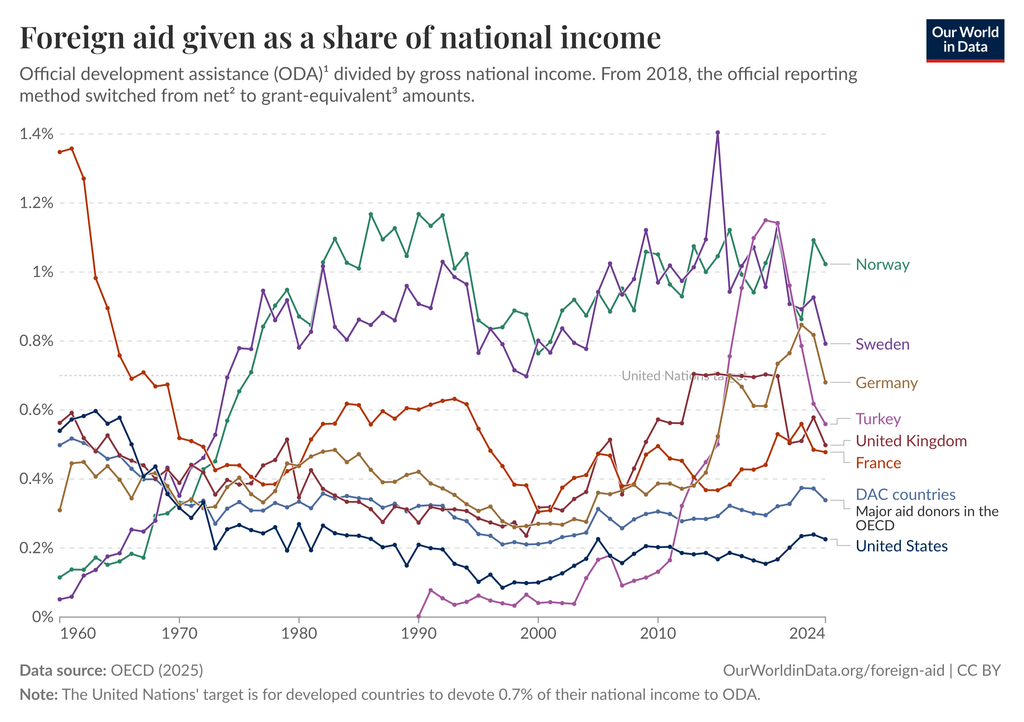
In the United Kingdom, the departure from a firm commitment to overseas aid was marked by the 2020 merger of DfID with the Foreign Office under Boris Johnson. In just a few years the UK found itself experiencing an extraordinary shift in its foreign aid policy: it went from being a leader in international development –between 2013 and 2020 it was the only G7 country to achieve the 0.7% ODA/GNI target8 – to hollowing out its ODA following the Covid-19 pandemic temporary budget cut to 0.5% and then further budget cuts to fund first asylum seekers and later defence. This trend is similarly visible in Figure 19 (below) depicting UK, EU, DAC, and US foreign aid spending over time, which shows the UK’s transition from a leading donor position to a level of expenditure increasingly convergent with the EU/DAC average.
Clare Short, reflecting on this period, argues that the UK’s shift away from internationalism was not accidental but rather ideological. She describes the destruction of DfID as “pure vandalism”, emphasising that Boris Johnson “had no commitment to development or helping the poorest countries”. At the same time, she argues that Labour’s subsequent choices were equally damaging and that “despite extensive consultations and vague promises to re-establish DfID”, the Starmer government “did nothing even to establish a separate part of the Foreign Office dedicated to development” and instead cut the aid budget further “in order to spend money on defence”. By contrast, Anna Schuesterl, Director of Communications at ODI Global, highlights that the effectiveness of development policy depends less on political theatrics and more on institutional design. She notes that evidence from countries such as Australia and Canada shows that development programmes are most effective when they have “clear objectives, long‑term horizons and strong technical expertise”. Integrating development and foreign policy, she argues, can enhance coherence where diplomacy, security and development overlap but it also carries the risk that short‑term political priorities crowd out longer‑term development goals.
Anna Schuesterl interprets the reduction in UK ODA not as a temporary fiscal adjustment but as “a more structural shift in the UK’s approach”. She notes that while the UK remains an important development actor, its influence now does not depend solely on aid volume but rather on “how these assets are used strategically in a period of more contained resources”, including diplomacy, development finance, research and convening power.
Figure 2. Survey Data on Attitudes Towards Foreign Aid & Development in France, Germany, Great Britain, and the US.
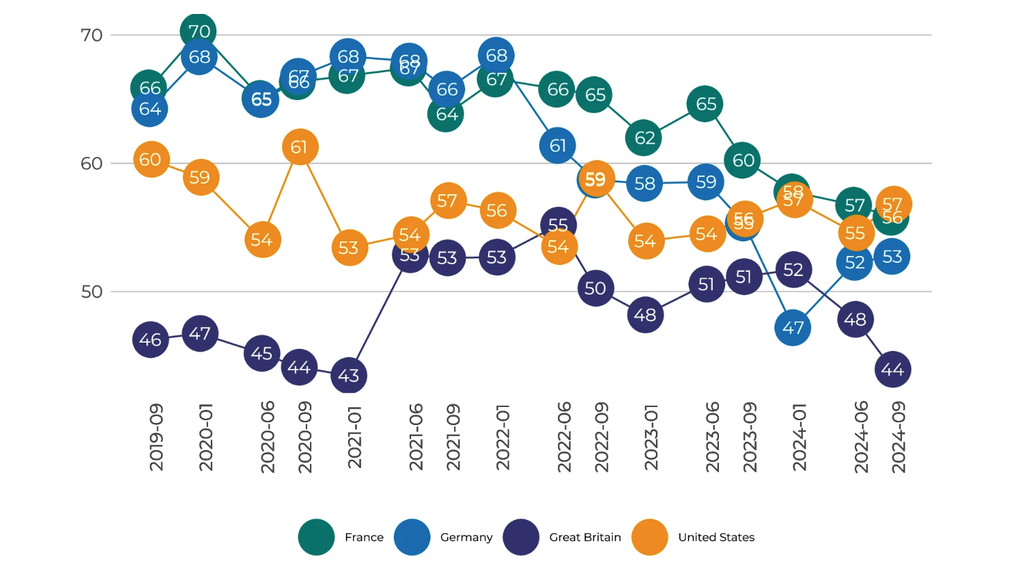
Question: % who thinks we should keep or increase current expenditure levels | Base: DE/GB/FR/US adults | Data are weighted to be nationally representative10.
Nonetheless, over most of the period covered in Figure 2, it is clear that public attitudes toward aid across the UK, France, Germany and the United States converged, with UK support gradually rising to meet the levels observed in the other three countries before declining again in the second and third quarters of 2024. Notably, it is France that shows the steadiest decline in support and Germany the sharpest, indicating that the recent downturn in public backing for development assistance is not uniquely British but part of a broader European trend. Schuesterl further observes, however, that while many European countries continue to emphasise multilateralism and long-term development partnerships, “post‑Brexit, the UK has placed greater emphasis on strategic partnerships, trade, investment and geopolitical engagement,” integrating development more tightly with foreign policy objectives. This was a key driver for folding DfID into the FCO under Boris Johnson.
With the war in Ukraine persisting, and new armed confrontations erupting, Western governments – including the UK – that have been diverting public expenditure from development assistance to fund domestic priorities are now cutting aid budgets to fund increases in defence expenditure.
In the 2025 calendar year, the UK spent £13,036 million on ODA – 0.43% of GNI – a further decrease from previous years;11 that cut was justified to help fund an increase in defence spending to £60.2 billion in 2024/25. ODA is currently planned to reduce to 0.3% by 2027, largely to fund further defence increases. What was set out as a temporary post-Covid cut has become permanent.
With a defence budget 4.6 times higher than ODA and rising, advocates of development assistance should reframe their arguments, extending the debate on foreign aid beyond moral questions to matters of national interest and international cooperation. As Anna Schuesterl rightly points out “It’s not that there is no narrative. In recent years, there has been a growing emphasis on partnerships, mobilising finance, and working with others to achieve greater impact. However, it remains an open question whether that narrative is sufficiently clear or persuasive beyond the development community itself. A successful narrative needs to speak both to values and interests.”
Similarly, Clare Short argues that the erosion of the UK’s commitment to international development was made possible precisely because “there had been no public discourse about its purpose and effectiveness,” leaving the ground to “right‑wing newspapers and their representatives constantly attacking all aid and suggesting it was all corrupt”. She recalls that public attitudes research during her tenure showed that while people disliked “handing over big sums of money,” they consistently supported tangible objectives such as ensuring that “all girls [are] given the opportunity to go to school”. For Short, this demonstrates that the public does care about development when it is framed in a way that “speaks to people’s values – heart and head – about a sustainable future for all of us in a more just world order.” She argues that the disappearance of such framing reflects “how big a shift to the right there has been in politics in OECD countries in the last 15 to 20 years”.
Advocates of development assistance should reframe their arguments, extending the debate on foreign aid beyond moral questions to matters of national interest and international cooperation.
As the contrast between funding for ODA and defence widens, proponents of development assistance confront a dual task: they should demonstrate that shifting resources entirely to defence spending in times of crisis could worsen the very problems that need to be addressed – such as migration flows, economic instability, and weak governance in fragile states. There also needs to be a recognition that involvement in the global architecture provides more benefits and greater agency for influencing reform than withdrawal. However, as Schuesterl cautions, this strategic reframing must avoid reducing development assistance to a mere security instrument. She argues that “there is a balance to strike”. When effective, ODA undoubtedly “contributes to stability and resilience”, generating benefits for both the UK and the wider international community, but “aid should not be viewed solely through a security lens” as doing so risks distorting its fundamental purpose and undermining long‑term development outcomes.
A more pragmatic and beneficial approach would openly acknowledge that development assistance involves mutual interests and that, instead of obscuring transactionality, it would be better to recognize that both parties seek benefits from cooperation. To be successful, advocates of ODA should highlight how leveraging the power of development assistance secures more domestic interests than isolationist and defensive policies. In particular, they should demonstrate how, properly managed, ODA can secure the interests of developing partners by improving their economic growth and political stability; this in turn benefits donor countries through greater geopolitical and economic stability, reduced migratory pressures, and stronger economic partnerships. The objective is to secure public support through a narrative that once again transcends political ideologies and demonstrates the benefits of using ODA to advance common interests, moving from a discourse of charitable duty to a narrative of strategic investment.
Advocates need to demonstrate how countries like the UK can better secure their domestic interests by leveraging the beneficial effects of well-managed, clearly targeted ODA, and how they gain more agency in shaping and reforming global governance systems by remaining active participants rather than stepping back. The current trajectory suggests Western countries face a fundamental policy question about the balance between defence expenditure and international development engagement. Whether continued participation in global governance systems through development assistance offers greater returns than alternative approaches remains central to ongoing debates about how best to secure national interests in an increasingly interconnected and volatile international landscape.
Note to the reader
The author would like to take this opportunity to express sincere gratitude to the Rt Hon Clare Short, former UK Secretary of State for International Development, and Anna Schuesterl, Director of Communications at ODI Global for their time, willingness to participate, and valuable contribution to this publication.
1. Achenui, N., The US Marshall Plan and the post-World War II reconstruction of Europe, 1947-1970: economic and diplomatic study, American Journal of International Relations, 6(1), 2021, pp. 82-83.
2. Easterly W., The White Man’s Burden: Why the West’s Efforts to Aid the Rest Have Done So Much Ill and So Little Good, Penguin Press, 2006, 16-31.
3. Ivi, pp.152-158.
4. Moyo D., Dead Aid: Why Aid Is Not Working and How There Is Another Way for Africa, New York, Penguin Books, 2009, pp. 44-45.
5. Ivi, p.61.
6. African Development Bank Group, Market Brief – The Middle of the Pyramid: dynamics of the Middle Class in Africa, 2011.
7. Aza O., British Official Development Assistance (ODA) and the 2008 Financial Crisis: a Noteworthy Commitment or a Self-interested Strategy?, French Journal of British Studies, 2016, p. 2.
8. Aza O., British Official Development Assistance (ODA) and the 2008 Financial Crisis: a Noteworthy Commitment or a Self-interested Strategy?, French Journal of British Studies, 2016, p. 4-5.
9. Figure 1 from OECD (2025) – with minor processing by Our World in Data. “Foreign aid given as a share of national income – Official estimate” [dataset]. OECD, “OECD Official Development Assistance (ODA) – DAC1: Flows by provider (ODA+OOF+Private)” [original data]. Retrieved May 1, 2026.
10. Figure 2 from Torres-Raposo F., Oh S., Morini P., Hudson J., Hudson D., Survey Data on Attitudes Towards Foreign Aid & Development in France, Germany, Great Britain, and the U.S., Scientific Data 12, Article number 1122, 2025.
11. FCDO, Statistics on International Development: Provisional UK ODA Spend 2025, April 2026.


