
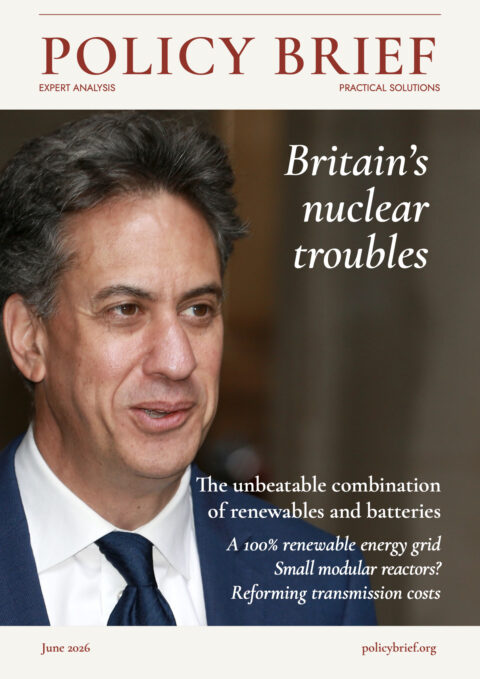
Britain’s nuclear programme has stalled, and the Government is blaming the wrong culprit. Emeritus Professor Stephen Thomas shows that the projects launched since 2006 failed for want of finance, not because of planning or regulation, and that the UK’s record matches that of Finland, France and the US. He also finds the case for small modular reactors thin: few have been built, and those operating perform poorly.
The alternative is here. David Toke shows how collapsing battery costs are making renewables plus storage cheaper than gas across much of the world, but in Britain grid connection queues risk holding it back. Pete Roche argues that long-duration storage, from pumped hydro and liquid air to sodium-ion and iron-air batteries, is the key to a 100% renewable grid, and that the government’s 4–6GW ambition is too timid.
Then there is the grid. Emeritus Professor David Newbery argues that plans inherited from an asset-hungry National Grid favour costly subsea links to carry Scottish wind south. Onshore HVDC cables and charges that reflect the true cost of new connections could save consumers billions.
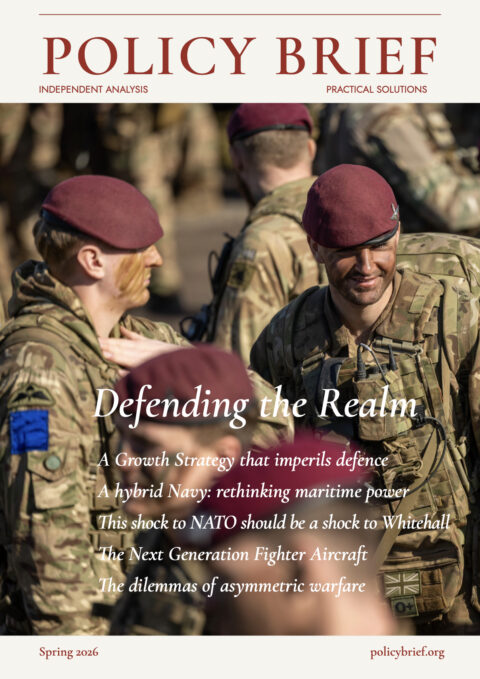
Britain faces its most dangerous security environment in decades, yet its armed forces are hollowed out and its Defence Investment Plan is reported to be £28bn short. Defending the Realm asks what it will take to close the gap between threat and resources. The Editor opens by arguing that the Greenland shock to NATO should prompt the UK to lead Arctic security, backed by serious investment.
On money and industry, Emeritus Professor Ron Smith argues that the Defence Industrial Strategy has let growth targets crowd out the primary task of buying the weapons we need, and explains why procurement reviews keep making the same unheeded recommendations. Keith Hartley weighs the economics of merging the UK-led Tempest fighter with Europe’s rival FCAS into a single European combat aircraft.
Peter Spayne makes the case for a hybrid Navy of crewed and uncrewed systems. He also examines the dilemma that cheap drone swarms pose for billion-pound warships. James Prichett warns that closing the Royal Navy Strategic Studies Centre blunts the service’s intellectual edge just when it is most needed.

The UK starts formal schooling earlier than nearly nine in ten countries, and our youngest children are paying the price. Rescuing Early Years Education brings together leading practitioners and researchers to make the evidence-based case for change. Sue Palmer shows why the world’s top-performing education systems protect play and delay formal learning until six or seven, citing the gains in Estonia and Ireland.
In the classroom, Dr Sue Allingham traces how the “school readiness” agenda has pushed top-down pressures and rigid commercial schemes into Reception. Kym Scott draws on Lewisham’s record to show that high-quality play raises outcomes, especially for disadvantaged children, and warns that new Good Level of Development targets risk squeezing it out.
On the workforce, Professor Verity Campbell-Barr warns that three of the four UK nations still allow unqualified staff to work with young children. She sets out a strategy for a graduate-led profession with structured mentoring. Phil Armstrong asks whether headteachers have the early years knowledge the new targets demand, and how school leaders can be equipped to lead this crucial phase well.
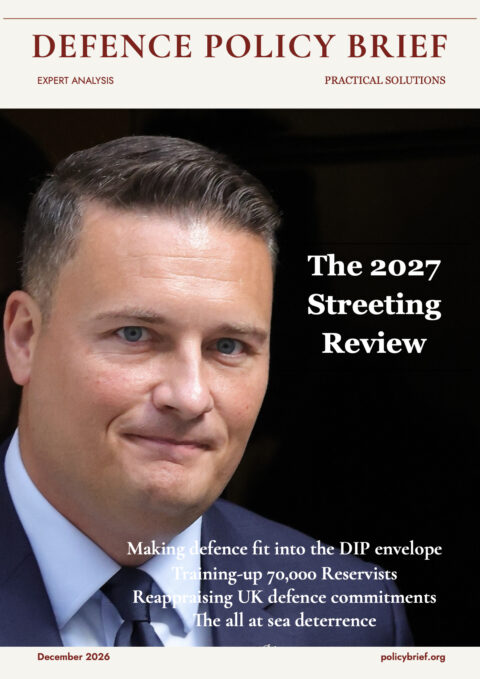
Britain has a defence plan it cannot afford. The 2025 Strategic Defence Review was a necessary wish list, but no efficiency drive will fund it, and the promised 3.5 per cent of GDP will not arrive. The Streeting Review argues that the Defence Secretary must own a review that starts from a realistic budget, around 2.7 per cent, and shapes Britain’s commitments to fit it.
That means hard political choices. Ministers must face down vested interests and tell allies what Britain can and cannot do. They must also accept that the ring-fenced cost of renewing the nuclear deterrent will squeeze the rest of the budget. As Sir Michael Quinlan warned, defence planning is not a shopping list sent to the Treasury. One fighting division that can be sustained and reinforced is worth more than two on paper.
It also means getting more from every pound. Doubling the reserves would add deterrent capability at modest cost, drawing on the programme that trained tens of thousands of Ukrainian recruits. So would ships cheap enough to deploy and risk, rather than too precious to lose.

Clean power can also be cheap power, if policy keeps pace with technology. Green, Cheap and Smart Energy opens with the human cost of getting it wrong: David Reiner (Judge Business School, Cambridge) confronts the scandal of avoidable winter deaths in the UK.
On storage, Pete Roche welcomes Ofgem’s first round of long-duration storage support, which backs 16 projects and nearly triples Britain’s storable electricity. He warns, though, that the round leans heavily on pumped hydro and lithium-ion, leaving little room for cheaper emerging technologies. A swift second round should back sodium-ion and iron-air batteries, alongside a plan for hydrogen to cover long windless spells.
On nuclear, Emeritus Professor Stephen Thomas traces two decades of stop-go policy and concludes there is little prospect of new nuclear power before 2040. By then, the UK will have run on less nuclear power than today for over a decade, while renewables deliver several times as much at lower cost. He questions whether the staggering cost of Sizewell C, falling on consumers and taxpayers, can be justified.