Overview
- Since the global financial crisis, the UK has been locked into a low-investment, low-productivity equilibrium, marked by weak capital investment, woeful wage growth, but remarkably strong employment outcomes. This pattern has persisted across different macroeconomic, political and policy environments.
- Post-2008 growth, such as it is, has been driven primarily by labour supply expansion: higher participation, immigration, and rising workforce quality. This has restrained real wage growth and encouraged labour- rather than capital-intensive production.
- The composition of investment has been unfavourable: intangible investment has held up but has not been backed up by complementary investment in equipment. This has limited commercialisation and productivity.
- Recent developments, notably increasing confidence, buoyant capital & banking markets and tighter labour markets, suggest that these conditions are now shifting. Changes in the relative costs of capital and labour are now turning in favour of capital investment and deepening.
- The exigencies of fiscal policy have spurred policies that strongly reinforce these relative cost effects. Inadvertently or not, George Osborne’s increases in the minimum wage, Rishi Sunak’s super-deduction and more recently Rachel Reeve’s increase in employer NICs, have helped to shift relative costs in favour of investment, opening a pathway towards a more benign equilibrium.
- Buttressing fiscal discipline with active labour market, energy and industrial policies can now help ensure that any short-term adjustment costs are followed by the longer-term gains of a more productive and resilient economy.
UK economic performance since the financial crisis
The UK’s economic performance since the global financial crisis has been characterised by weak productivity growth and low business investment, despite the accommodative monetary policy1 and periods of relatively favourable global conditions.2 Despite very strong employment growth, real wage growth has been poor.3 In 2008, the UK shifted abruptly from the so-called non-inflationary continuous expansion (NICE) economy to a low-growth equilibrium. This low-growth equilibrium has proved resilient across different political and macroeconomic environments, suggesting that it reflects a deeper structural shift rather than being a product of a series of temporary shocks.
These outcomes are widely recognised and well documented.4 Much of the commentary has focused on the uncertainty that followed the financial crisis, the weakness of capital markets, and more recently the effects of Brexit and the Covid epidemic. While each of these factors has played a role, they are not sufficient to explain the persistence of weak investment and productivity growth over such a long period, nor the coexistence of these weaknesses with historically high employment rates. A more complete explanation lies in the interaction between labour & capital markets, relative costs, and investment & employment.
A low-investment, high-employment equilibrium
Productivity and real wages are closely correlated in any well-functioning market economy (see figure 1). They move in lock step, but the key question is: which way does the causality run? In the more usual benign equilibrium of a market economy, trade, technological innovation and other influences clearly drive output expansion, which, given land, demographic and other constraints, drive high rates of investment, productivity and pay. High levels of confidence, learning by doing, technology transfer and other informational externalities sustain this benign equilibrium.
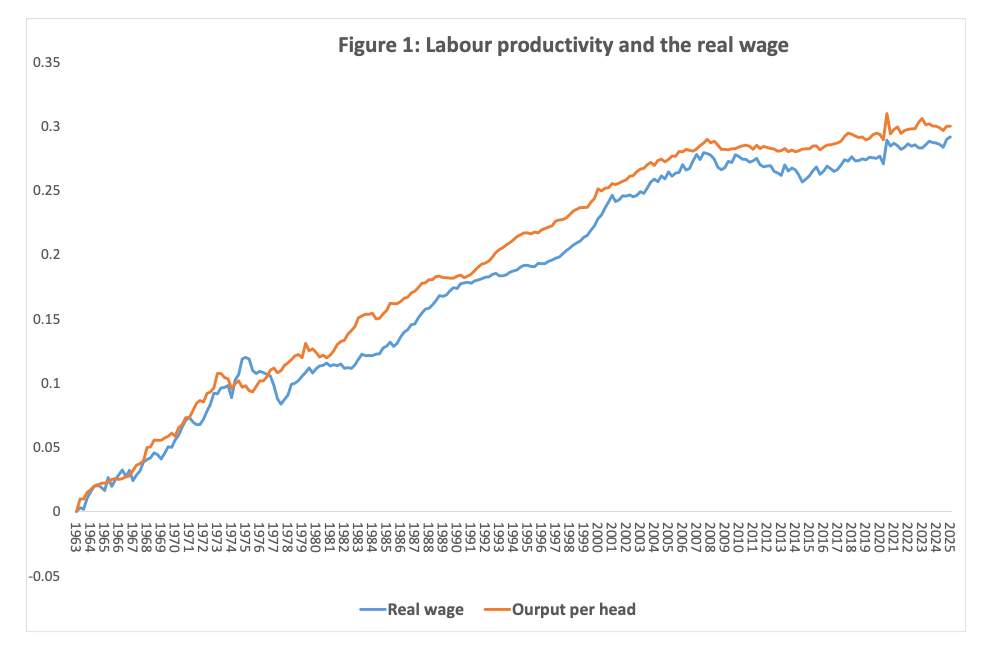
However, since the 2008 financial crisis, anaemic productivity and wage growth have gone hand in hand with buoyant employment growth, suggesting that in this case, an increase in the supply of labour has been an important driving force. Growth came from the expansion of the labour force rather than increasing productivity. The labour force was swollen by increased participation of women and older workers, as well as immigration5. Migrants also mitigated the paucity of domestic technical skills6 This remains the subject of some debate, but there is evidence that immigration restrained wages in particular sectors. For example, HMRC pay and payroll data7 indicates that workers in construction, which enjoyed remuneration 25% above the UK average in 2014 saw this premium fall to just 7% by 2025.
Moreover, investment in human capital has been as important in boosting the effective supply of labour as the increase in the labour force. Studies of UK growth by the Office of National Statistics8 show that, although hours worked in the UK have increased by 15% since 2008, the quality-adjusted labour force has increased by 29% over this period. Analysis of this difference reveals that this was largely due to the increasing share of more qualified people, and in particular graduates, in the workforce9. This effect alone has contributed 10% to the effective labour force and 7% to UK growth since 2008 — a bright spot in an otherwise dismal scenario. The increased share of older workers and migration to relatively high productivity jobs in London and the South East have also contributed.
These developments have been highly beneficial, for both the participants and the wider economy. However, they have had important implications for the structure of growth. The plentiful supply of labour arguably restrained real wage growth and reduced the incentive for firms to invest in labour-saving capital. This resulted in ‘capital shallowing’: a decline, or very weak growth, in capital per worker.10 Business investment remained subdued, particularly in equipment and machinery11, even as employment expanded. The result was an economy capable of generating jobs, but increasingly reliant on low capital intensity as well as wage restraint.
These trends have reinforced the natural shift in the economy from manufacturing to services, so that the most rapid growth in the labour force has been in low-wage, low-value added sectors like retail and hospitality rather than high value-added areas like business and financial services12.
“Investment in human capital has contributed 10% to the effective labour force and 7% to UK growth since 2008 — a bright spot in an otherwise dismal scenario.”
These dynamics help explain why weak productivity and wage growth have gone hand in hand. Rather than high productivity growth boosting wages, the causality arguably ran in the opposite direction: the increased availability of labour across a wide spectrum, repressed wage growth and reduced the pressure to invest, reinforcing low productivity growth. The economy settled into a self-reinforcing equilibrium, characterised by high employment, low investment and weak productivity leading to growth in output per head being even weaker than the growth in output.
Investment composition and commercialisation
While the composition of the labour force has on balance supported the growth of productivity, this is not true of the composition of investment and the stock of capital. A long-standing criticism is that UK investment has been concentrated in structures, which are easy to offer as collateral. Investment in intangibles, including R&D, software, design and organisational capital, has admittedly held up well, but investment in equipment has not. This unfavourable composition reflects deliberate policy choices as well as the changing nature of production. While successive governments have expanded support for intangible investment through R&D tax credits and the Patent Box, incentives for investment in plant and machinery have weakened over time. The reduction in investment allowances for plant and machinery following the 1984 reform of corporation tax had long-lasting effects on the composition of investment13. Recent Budgets have reversed this, starting with Rishi Sunak’s ‘Super deduction’ in 202114. This scheme was designed to counter the incentive to delay investment in order to claim this against the higher 25% tax rate announced for April 1, 2023.
Modern economies increasingly rely on intangible capital15. The UK has been relatively successful at generating ideas, research, and high-value intellectual property. However, intangible investment does not stand in splendid isolation. In many sectors, particularly advanced manufacturing and life sciences, it requires complementary investment in specialised equipment, facilities, and production capacity for it to be commercialised at scale. Where incentives for such complementary investment are weak, firms are more likely to conduct research domestically but locate capital-intensive production elsewhere. Over time, this has contributed to a pattern in which the UK captures the early stages of the value chain but loses the downstream investment and associated productivity gains. This is evident in sectors such as advanced engineering and poses growing risks for parts of the pharmaceutical and life sciences industry. This pattern reinforces weak aggregate productivity growth; employment expands in lower-capital-intensity activities, while high-productivity, capital-deep sectors grow more slowly or locate abroad.
The latest literature on economic growth suggests that the effect of industrial investment on productivity has been seriously underestimated16. That is because the conventional analysis focuses on the return on investment for the individual firm and neglects the benefits for the wider economy, in particular the gains from knowledge spillovers. These spillovers largely stem from the way that new ideas and practices spread from organisations that invest and innovate to others. These effects are particularly strong in the case of industrial investment in plant and machinery. Research has found that for a range of developed economies these externalities make the social return to this type of investment up to three times larger than the private return to the investor17. This synergy means that supporting capital investment can have the same effect on the technological trends that drive long-term productivity growth as subsidizing R&D does.
The role of relative costs
In sum, relative costs sit at the centre of this equilibrium. Firms make investment decisions based on the relative cost of capital or labour. When labour is abundant and relatively cheap, and when adjustment through employment is easier than adjustment through investment, firms rationally choose labour-intensive production techniques. Understanding this is critical because it implies that improving productivity requires more than isolated interventions. Investment incentives, labour market conditions, tax policy, and capital market functioning all interact through relative costs. Changing outcomes requires shifting these relative prices in a coherent and durable way, one that stimulates investment and output per head.
“Firms make investment decisions based on the relative cost of capital or labour. When labour is abundant and relatively cheap, and when adjustment through employment is easier than adjustment through investment, firms rationally choose labour-intensive production techniques.”
Signs of a shift in the growth equilibrium
Although the UK economy has been locked into a low-investment, low-productivity equilibrium for much of the period since the financial crisis, there are now signs that some of the conditions sustaining that equilibrium are changing. The relative prices and incentives that shaped firms’ behaviour over the past decade are shifting in ways that could support higher investment and capital deepening, especially if policy responds coherently.
Lower uncertainty and better investment incentives
A first, relatively short-term, factor is the gradual easing of economic and political uncertainty. Over the past decade, successive shocks, notably the financial crisis, Brexit, the pandemic and geopolitical instability, have repeatedly undermined private investment and large household spending decisions. Uncertainty around fiscal policy has also been a recurring feature of recent years. That at least should now abate. The pursuit of a more stable fiscal regime, combined with additional headroom in the public finances in the 2025 Budget, should reduce speculation about tax increases. Signalling this improvement, 10-year UK government bond yields, the benchmark for the cost of long-term borrowing, fell to 4.34% early in the New Year, the lowest rate for over a year. As these uncertainties ease, pent-up demand is likely to be released, initially through consumption and subsequently through business investment.
Recent Budgets have also strengthened incentives for business investment. The introduction of the ‘Super-deduction’ for investment expenditure18 in the 2021 Budget, followed by the move towards full expensing, represented a significant shift in the tax treatment of capital expenditure, particularly on plant and machinery. These measures addressed the bias in the UK tax system identified earlier in this article. So far, the impact of these reforms on aggregate investment has been limited. This should not be surprising; in an environment characterised by weak demand, abundant labour and high uncertainty, the effect of such incentives is necessarily muted. Nevertheless, they improve the post-tax return on investment and lower the threshold at which projects become viable. On their own, these fiscal and other improvements would not be sufficient to transform growth prospects, however, they provide a supportive environment for investment and other important spending decisions.
The effect of a rising equity market
Against this background, recent developments in UK capital markets are illuminating. The equity market is often dismissed in policy debate as little more than a casino or betting shop, generating paper gains and losses with limited relevance for the real economy. However, security prices reflect economic, industrial and corporate information and act as important signals to decision takers right across the economy, guiding executive remuneration, investment & employment decisions as well as the decisions of policymakers like those on the Monetary Policy Committee. Thus, capital markets are not merely a reflection of economic prospects but are also a driver of the economy.
For much of the time since the financial crisis, UK equities underperformed their international peers. Valuations remained subdued, particularly in domestically focused sectors, and the UK market became increasingly dominated by mature, dividend-paying firms rather than high-growth companies. This reflected weak expectations of domestic growth and returns on investment. This effect was particularly evident in the case of bank shares. It reinforced cautious corporate and banking behaviour and weak capital formation. It provided an additional mechanism through which pessimistic growth expectations became self-fulfilling.
“Security prices reflect economic, industrial and corporate information and act as important signals to decision takers right across the economy, guiding executive remuneration, investment & employment decisions as well as the decisions of policymakers like those on the Monetary Policy Committee. Thus, capital markets are not merely a reflection of economic prospects but are also a driver of the economy.”
In contrast, the UK equity market has performed well over the last two years. The FTSE 100 share index rose by 6.0% in 2024 and another 19.8% in 2025, outpacing the US and many other world markets. This partly reflects problems elsewhere, and the inclusion of mining and other global stocks, but also signals a better outlook for the UK and in particular banks and other large UK companies.
Besides its signalling role, a rising stock market reduces the cost of capital and risk aversion, spurring business investment — as we are seeing in the current boom in investment by the US tech sector. We have already seen a recovery in Initial Public Offerings (IPOs) and large rights issues in the UK energy sector. A rising market lifts all boats, with wealth effects that ripple well beyond the options held by corporate executives and other decision takers, boosting the value of ISAs and defined contribution pension plans, for example. They ward off the albatross of defined benefit pension liabilities, turning deficits into surpluses, easing the drag on corporate valuations, enterprise and investment. Many companies have already used this as an opportunity to divest themselves of these liabilities.
Banks and the broader economy
Bank shares have performed particularly well over the last two years. The FTSE 350 banking index increased by 53% during 2024 and another 50% in 2025 after subsiding over the previous 12 years. Initially, rising interest rates allowed bank earnings to recover, but last year has seen a re-rating, a valuation effect that pushes up share values relative to earnings. Importantly, this lowers the cost of capital. Regulation, a two-sided sword, is also easing.
These developments might simply boost bonuses and dividends or lead to excessive risk-taking. But they should also boost bank lending, not just to homeowners. Lending to industrial and commercial companies rose by 6.1% in 2025 after showing no growth over the previous three years. Bankers need to step up to the plate now, for the first time since the financial crisis.
While performance remains uneven and valuations are still low by historical and international standards, the recovery of equity prices aligns nicely with favourable fiscal developments and eases some of the constraints that have been holding us back.
The cost of labour
However, the most significant change has surely been in the labour market. After a prolonged period of abundant labour supply and weak wage growth, vacancy rates rose in the wake of the Covid epidemic and real wages have more recently begun to increase in many sectors. This shifts the choice between labour-intensive and capital-intensive production methods and creates the necessary incentive for a move back towards capital deepening. Where labour costs rise relative to the cost of capital, investment in equipment, automation, and process improvement becomes more attractive. However, firms do not respond to temporary wage pressures with immediate investment. What matters is that decision takers perceive higher labour costs as economically viable and sustainable. Policy instruments that appeared ineffective in the past, may become effective when relative price shifts are seen as persistent.
“Recent increases in real wages are shifting the choice between labour-intensive and capital-intensive production methods and creates the necessary incentive for a move back towards capital deepening.”
Are these straws in the wind?
It is worth examining the influences now at work in the labour market and in particular the impact of government policy in some detail. Media attention has focussed on the effect of the increase in employer National Insurance Contributions (NICs) in the 2024 Budget and the sustained increase in the living wage on job losses in sectors such as hospitality and retail. These activities are important because they provide crucial entry-level jobs, support tourism, and anchor many rural communities. However, they are exposed to these policies because they are low-wage and low-margin activities. This means that although the immediate human consequences are regrettable, the macroeconomic impact is commensurately small.19 From this perspective, the loss of jobs in ICT over the last two years, which has been on a similar scale but has escaped attention, is much more worrying. Unfortunately, it is almost certainly the leading edge of wave of job losses in activities like computer programming, at which AI has proved remarkably adept.
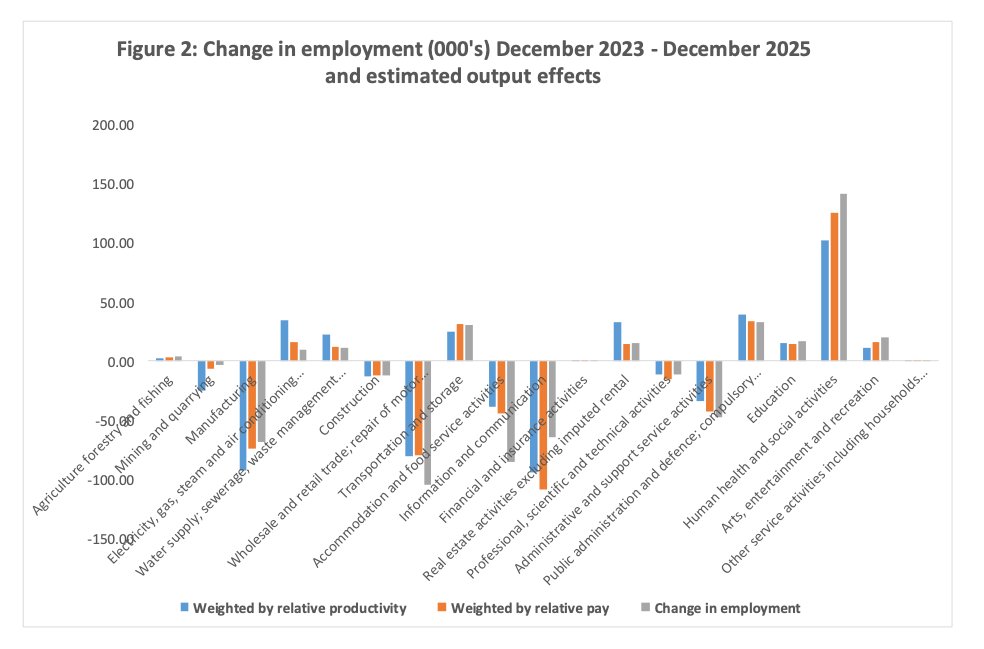
Figure 2 shows what happens if we give jobs in these sectors weights that depend upon (a) their average productivity and (b) their relative wage, used by economists as a measure of marginal productivity. Over the last two years, employment in hospitality has fallen by 3.9%, 0.28% of the UK workforce, but my calculations suggest that that this has reduced UK labour inputs by just 0.15% and GDP by less than 0.1%20. In contrast, employment in ICT has as fallen by 5.0%. This is just 0.2% of the UK workforce, since employment in this industry is relatively small. However, because of the high productivity of ICT workers, this has reduced labour inputs by 0.36% and GDP by more than 0.2%.
These displaced workers have increased unemployment, but the UK’s flexible labour market will help them to price themselves back into jobs, as happened after the financial crisis. This labour market adjustment will be helped by the boost to the economy from lower inflation and interest rates. However, the government needs to put retraining and other policies in place to ensure that they find higher value-added jobs than the ones that they have left. It has rightly placed increasing emphasis on training, education and skills as part of its growth strategy, including the expansion of apprenticeships, reforms to technical education, greater use of skills boot camps, and a stated ambition to improve lifelong learning and workforce adaptability. These initiatives should also facilitate the labour market adjustment and improve productivity over time. Their effectiveness will depend on how well they facilitate the transition towards higher-value activity, particularly as rising labour costs and new technologies, notably the use of artificial intelligence in the workplace, reshape demand for skills. However, the risk is that job losses lead to inactivity rather than re-employment, as happened during the 1980s. Productivity increased then because we increased the team average by sacking the tail-end batsmen, as they were called. They remained idle onlookers in the pavilion; we cannot allow that to happen again.
“These policies will support the growth of output per head by encouraging reallocation towards higher-value activities and greater investment in skills and capital. However, they need to be sustained.”
Other policies are also likely to increase the cost of hiring workers, especially those on low pay and low hours. The Employment Rights Act is designed to tighten up on abuses like fire and rehire and involuntary zero hours and although it could reduce recruitment in the short-term it should work to improve productivity as employers take a less casual approach to the workforce. Tightening the criteria for work visas will act in a similar way, but without the risk of higher unemployment costs. In the year to June 2025, long-term net migration to the UK fell to about 204,000, sharply down from 649,000 in the preceding year21 This is well below the peaks recorded in 2022–23 as well as recent projections of the OBR: some commentators even envisage zero net migration. The fall in immigration will reduce output growth but will surely increase output per head and ease the pressure on public services and infrastructure.
Whether by accident or design, these policies seem remarkably coherent. They will support the growth of output per head by encouraging reallocation towards higher-value activities and greater investment in skills and capital. However, they need to be sustained. Their synergies need to be recognised, and they need to be welded into a coherent growth strategy and ultimately a vision for the future.
Conclusion
For much of the period since the financial crisis, the UK economy has been trapped in a low-investment, low-productivity equilibrium characterised by strong employment growth, weak capital deepening and subdued real wage growth. Relative costs lie at the centre of this equilibrium. An abundant supply of labour, supported by migration, rising participation and improvements in workforce quality, restrained wage growth and weakened incentives for firms to invest in equipment and other productivity-enhancing capital. At the same time, weaknesses in the composition of investment, particularly the long-standing bias against plant and machinery, limited the UK’s ability to translate strengths in research and intangible capital into higher productivity.
Recent Budgets, however, have opened up a pathway towards a more benign equilibrium. The need to repair the fiscal arithmetic by increasing levies on the corporate sector, notably through corporation tax under Rishi Sunak in 2021 and NICs under Rachel Reeves in 2024, have pushed up the cost of labour relative to capital. Increases in the minimum wage, notably those enacted by George Osborne to curb rising in-work welfare payments, have had the same effect. Tighter criteria for work visas, a more encouraging stance towards large-scale investment in energy and infrastructure, early steps towards planning reform, and a renewed emphasis on skills, training and the deployment of AI in both the private and public sector are all acting in the same direction. Taken together, these policies encourage firms to respond through reallocation towards higher-value activities and through greater investment in skills, equipment and other forms of productive capital. If executed and promoted in a coherent way, this combination of policies could rekindle productivity growth and reduce the need for further tax increases in the run-up to the next election.
The central challenge for policymakers is therefore to follow the logic of recent policy choices through to their conclusion — welding labour and capital market policies into a coherent growth strategy, and ultimately a vision for the future. If this challenge is met, the recent straws in the wind may yet herald a lasting improvement in the UK’s economic performance. Buttressing fiscal discipline with active labour market, energy and industrial policies can help ensure that any short-term adjustment costs are followed by the longer-term gains of a more productive and resilient economy.
Endnotes
1. In response to the Global Financial Crisis, the Bank of England aggressively lowered interest rates, reducing Bank Rate from 4.50% in late 2008 to 0.50% by March 2009, and ultimately to 0.10% during the COVID-19 pandemic. Alongside this, the Bank deployed large-scale asset purchases, with the stock of bonds acquired through quantitative easing peaking at £895 billion by end-2021.
2. Global GDP growth has fluctuated significantly since the 2008 financial crisis. After a steep downturn in 2009, growth averaged approximately 2.7-3.5% annually through much of the 2010s, well below the pre-crisis 4%+ pace. The COVID-19 pandemic caused a drastic contraction in 2020, but the subsequent rebound was followed by more moderate rates in the early 2020s (~3.0–3.2%), with IMF forecasts projecting around 3.1–3.2% for 2025–26.
3. The 2010s saw rapid growth in employment, which reached a record high working-age employment rate of 76.2 per cent at the start of 2020, up from 70.3 per cent in 2010. Average wages were only £16 a week, or 2.5 per cent, higher in real terms in early 2024 than they were at the time of the 2010 election. (Resolution Foundation (2024), Job done? Assessing the labour market since 2010 and the challenges for the next government.
4. ‘Real wage and productivity stagnation’, Stephen Machin, Oxford Review of Economic Policy, 2025, 41, 105–119.
5. Capitalism Without Capital: The Rise of the Intangible Economy, Haskel, J. & Westlake, S. Princeton University Press, 2018.
6. Migration Advisory Committee (MAC) Annual Report 2024.
7. ‘Earnings and employment from Pay As You Earn Real Time Information, UK’, HMRC 2026.
8. ‘Multi-factor productivity’, ONS, 2025.
9. ‘Labour force composition and UK productivity’, University of York, Department of Economics Discussion Paper 26/02, Spencer, P, 2026.
10. ONS calculations suggest that capital shallowing reduced output per hour by 0.2% between 2009 and 2024. (ONS: Annual multi-factor productivity, UK.)
11. Real UK business investment in plant and machinery from £74 bn in 2008 to £57 bn in 2010. During the 2010s, it fluctuated within a relatively narrow range (£64–75 bn). It declined again around the Brexit referendum and again during the COVID-19 epidemic, before recovering modestly in the early 2020s. By the mid-2020s, real plant and machinery investment was only marginally higher than its pre-crisis level, (ONS, Gross Fixed Capital Formation, plant and machinery.)
12. Ibid; ‘Government support for hospitality’, House of Commons Library, 2025).
13. ‘How to better align the U.K’s corporate tax structure with national objectives’, Paulo Santos Monteiro, Peter Smith, and Peter Spencer, University of York, Department of Economics Discussion Paper 20/02, 2020.
14. Rishi Sunak, as Chancellor of the Exchequer, announced the ‘super deduction’ capital allowance in the 2021 Budget. It allowed companies to claim 130% of the cost of expenditure on plant and machinery investments incurred from April 1, 2021, until March 31, 2023against their taxable profits. It was then replaced by ‘full expensing’, which expensing allows companies to deduct 100% of the cost of such expenditure from taxable profits.
15. Capitalism Without Capital: The Rise of the Intangible Economy, Haskel, J. & Westlake, S. Princeton University Press, 2018.
16. ‘How to better align the U.K’s corporate tax structure with national objectives’, Paulo Santos Monteiro, Peter Smith, and Peter Spencer, University of York, Department of Economics Discussion Paper 20/02, 2020.
17. ‘Equipment Investment and Economic Growth’, DeLong, J., B. and Summers, L.H., Quarterly Journal of Economics 106: 2, pp. 445-502, 1991.
18. The October 2004 Budget raised employer NICs from 13.8% to 15% and lowered the secondary threshold at which contributions are levied from £9,100 to £5,000 per year, effective from April 6, 2025. At the same time, the statutory minimum wage rose by 6.7% for workers aged 21 and over, and by even more for younger groups. It will increase by another 4.1% in April 2026. Importantly, employers do not pay NICs for under-21s or apprentices.
19. A recent report on the hospitality industry by the House of Commons Library noted that it employs around 7% of the workforce but contributes less than 3% of output, implying output per head of only 40% of the national average. Retail shows a similar imbalance.
20. ‘Labour force composition and UK productivity, University of York, Department of Economics Discussion Paper’, Peter Spencer, 2026.
21. ‘International Migration: People moving into and out of the UK’, ONS, 2025.