The history of dealing with the past in Northern Ireland is really a history of the present. It is for that reason that the latest ‘legacy’ proposals are really a reheated version of ideas that were articulated over a decade ago. The reprise, has, arguably, occurred to offset pressure from Irish nationalist politicians and academic activists, North and South of the border. The result may appease some within that broad constituency – for a while – but will, I suggest, inevitably worsen community relations in the longer term. The desire to avoid such a scenario was the impulse behind the first legacy report by Sir Kenneth Bloomfield in 1998, which, I argue, ought to be revisited in substance and ethos.
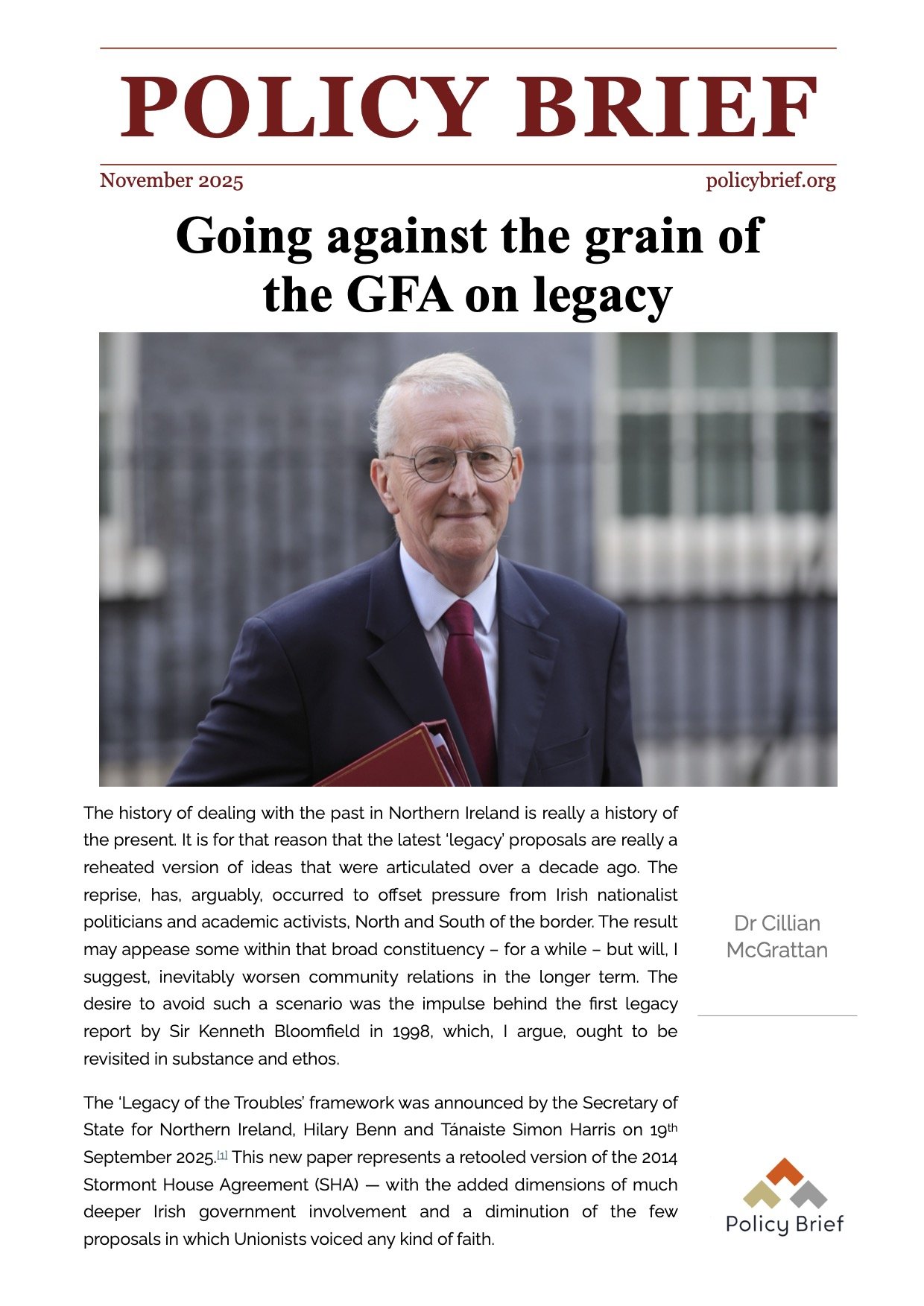
The ‘Legacy of the Troubles’ framework was announced by the Secretary of State for Northern Ireland, Hilary Benn and Tánaiste Simon Harris on 19th September 2025.1 This new paper represents a retooled version of the 2014 Stormont House Agreement (SHA) — with the added dimensions of much deeper Irish government involvement and a diminution of the few proposals in which Unionists voiced any kind of faith.
Labour’s promises
A significant factor in this outcome is the promise Labour made in its election manifesto to change radically the 2020-24 Conservative approach (in particular, the Northern Ireland Troubles (Legacy and Reconciliation) Act of September 2024):
“The Legacy Act denies justice to the families and victims of the Troubles. Labour will repeal and replace it, by returning to the principles of the Stormont House Agreement, and seeking support from all communities in Northern Ireland.”2
Strangely, this pledge is followed immediately by a highlighted soundbite “Labour will end the chaos of sleaze and division, turn the page, and reset politics to put it back in the service of working people”. It is left to the reader to decide whether this is a typo or a reflection of Labour’s perception of the Conservative Party’s approach to Northern Ireland. The latter might be fairly assumed given that the manifesto also promises to reestablish good relations with the Irish government, which had soured over Dublin’s anti-UK positioning during the Brexit negotiations. Thus, Labour promised specifically to “work with the Irish Government to strengthen the relationship between our two countries”.3
Labour’s manifesto also reflects promises made by Mr Benn when he was Shadow Secretary of State for Northern Ireland. In his first visit to the province in October 2023, for instance, Mr Benn articulated his discomfort with the idea that limited immunity would be granted for disclosures about killings:
“For the families and people we met yesterday morning and to listen to their stories and what happened to their loved ones, the thing they said most forcefully to us is: ‘We feel with the Legacy Act, that the death of our loved one somehow doesn’t count.’ We cannot be in a situation where people in Northern Ireland feel that, because coming to terms with what had happened is really important.”4
Whereas the purported amnesty provisions entailed a political judgment to draw a line under the past — in effect, guillotining the ‘lawfare’ of the seemingly endless series of inquests and civil cases against security service personnel — Mr Benn’s approach is one of psychology and therapy.
“Each family deal with it in their own way, but we have to have a mechanism, a means to enable people to find what they are looking for, so that society can progress, overcoming what has been a terrible collective trauma.”
Given that Northern Ireland has experienced a post-conflict period that has lasted around as long as the conflict (if we date the latter from 1969-1994/1998) and that Northern Ireland’s median age is just over 40, it is unclear as to how far collective trauma goes. Whereas intergenerational or post-trauma are ill-defined certainly political outworkings of the conflict in the form segregation, sectarianism and single-identity education are self-evident.5
Policy without Politics in 2025
Psychology and wishful thinking drive the ‘new’ approach. It is difficult to see how reprising the Stormont House Agreement’s approach to legacy with an added Irish dimension will meet Mr Benn’s criteria of gaining support ”from all communities”.
Labour’s new proposals don’t just aim to end immunity, they will end the ‘prohibition on new civil actions’ relating to the conflict. The Independent Commission for Reconciliation and Information Recovery (that has been headed up by the respected former Lord Chief Justice, Sir Declan Morgan) is to be “fundamentally reform[ed]”. While the Conservatives initially hoped to end the litany of inquests that targeted the state, the new framework will establish a “judge-led Inquisitorial Mechanism”. It is uncertain as to how this is not just inquests by a different name.
The Irish government, meanwhile, has pledged to reaffirm “its commitment to the investigation by An Garda Síochána [the Irish police] of all unresolved Troubles-related incidents within its jurisdiction and to ensuring that any potential new investigative opportunities are proactively pursued”. This is undoubtedly welcome but given that a virtual amnesty or amnesia has existed in the Republic as regards Troubles-related crimes since the early 2000s, it is difficult to be optimistic that the role of the Irish state in enabling the violent campaign of republicans will gain much purchase.6
The underlying social psychology is, again, revealed in the rationale — the rather jarring use of ‘holistic’ in a policy paper drawing attention to the impulse:
“the two Governments acknowledge the important role that substantive and unequivocal statements of acknowledgement can play in a holistic legacy process that seeks to address past harms and facilitate societal reconciliation.”
In short, in return for an improved Anglo-Irish relationship, the reopening of lawfare and the reinstating of civil actions against the British state, the Irish government has promised to set up a ‘unit’ within its police force to facilitate investigations in Northern Ireland. Although ‘societal reconciliation’ is not defined, should Unionists complain, they will be arguing against compromise. An alternative, but complementary, argument is that this joint framework demonstrates just why it is inappropriate for the UK government to design its policy on legacy issues with a view to satisfying the Irish government, as opposed to straightforwardly pursuing what it genuinely considers to be the best approach to securing reconciliation and truth in Northern Ireland.7
“in return for an improved Anglo-Irish relationship, the reopening of lawfare and the reinstating of civil actions against the British state, the Irish government has promised to set up a ‘unit’ within its police force to facilitate investigations in Northern Ireland”
Prior to disclosure to the Inquiry all Irish State Materials will be subjected to review and redaction of the material by the Minister or other Irish State Agency, as necessary, including to meet requirements under Irish law, the Irish Constitution, European Union law and the ECHR. In other words, disclosure is subject to raison d’état — in a similar way as nationalists complain that the British government will use national security to redact and withhold documentation. Whereas UK personnel can be subpoenaed, however, there is no quid pro quo in the Republic’s commitments. Thus, as the head of the South-East Fermanagh Foundation victims’ group, Kenny Donaldson, pointed out in regards the inter-governmental discussions: there appears to be no certainty that there would be participation and full engagement from key people formerly employed by the Irish establishment, e.g. those who were handling agents within the Real IRA and Continuity IRA”8.
Yet because the new process cannot guarantee cooperation, it is clearly all carrot and no stick. There is no reason why terrorists — who have not been sent down for their crimes –—would risk implicating themselves or leaving their erstwhile comrades open to being impugned by giving evidence. As veterans’ lawyer Philip Barden has recently argued, the track record on security force personnel offering assistance to inquiries is not good — individuals who have cooperated have been frequently subjected to criminal and civil suits. For Barden, the Joint Framework offers only more of the same state-centred lawfare:
“The 30 or so outstanding inquests will continue and I would estimate they will take three to five years to conclude. The new legacy body will investigate other cases. One legal right that will apply is that those who are subject to investigation will have a right not to answer any questions which may incriminate them. This privilege applies not only where the person believes an answer will incriminate them, but where someone else may assert the answer is incriminatory. It is a very wide privilege. For example, where a person has fired a weapon, they may be accused by someone of murder, so they can refuse to answer questions relating to the weapon and the shooting. Why would you refuse to answer questions? Because you don’t want to spend the next five or more years of your life involved in litigation, which takes over your life, which is what has happened to people who have cooperated in the search for the truth.”9
The new framework process is, therefore, reminiscent of the ending of An Inspector Calls — we already know how things are going to work (or not as the case may be), but there is a commitment to pushing forward on the basis of the promises of Benn as a Shadow Secretary of State and the desire by Labour to begin a post-Conservative, post-Brexit rapprochement with Dublin. These political choices are understandable. What is not is the rewriting of the fact that the Stormont House arrangements did not work. As the late Neil Faris, a solicitor, consistently argued, the elevation of victimhood above evidentiary legal practices – a running theme throughout the Stormont House Agreement – corrupted the law and would lead to the abuse of the rights of accused individuals to a fair hearing.10 The arrangements would not work legally, Faris demonstrated. They would ignore many aspects of criminality and injustice and retrospectively apply contemporary prejudices to historic decisions. His verdict was damning – the Stormont House Agreement “can only lead to an enduring sense of injustice on the part of those who have suffered in all other aspects of the Troubles but who will feel ignored in the entire legacy process”.11
Neither could Stormont House work politically given that Unionist parties quickly realised the potential to rewrite the history of the Troubles in favour of terrorists. However, the resulting impasse was also problematic. For instance, earlier this year, Sandra Peake, the head of the WAVE victims group told the Northern Ireland Affairs Committee that “[t]he process to date is welcome but deeply frustrating. In 2020, the last Government departed from the Stormont House agreement and the process that was suggested. The period in between has been very damaging for victims and survivors’”12
“These political choices are understandable. What is not is the rewriting of the fact that the Stormont House arrangements did not work.”
Dr Peake’s main concern was the fact that victims and survivors from the Troubles “are getting older”. This presents a situation where justice delayed is justice denied. As she goes on to argue, victims and survivors “need to know that their loved one mattered, what happened to them mattered, and there is a process that will meet their needs”. Yet, it is far from certain that the Stormont House arrangements would have achieved this. As I and others argued at the time, the Stormont House approach valorised testimony at the expense of the historical record, it did not require full disclosure from the Republic and kept the focus on the state. The Ulster Unionist Party voiced its rejection of the proposals immediately, and, after a longer period of debate, the Democratic Unionists also declared the deal unworkable. Veterans have voiced similar concerns with the new framework, arguing that oversight, cooperation and transparency as regards the Republic’s role in enabling terror remain within the gift of the Irish government.13 Just as politically, legally, and historically 2014’s Stormont House did not work, as Mr Barden and others have pointed out, 2025’s Stormont House-Plus simply recapitulates and deepens the problems.
Amnesty and Amnesia
The amnesia about the recent past inherent in the new Joint Framework is not only an elision of policy and policy mistakes, it is an erasure of the political desire to adhere to the historical record that it was not state forces but republicans who were responsible for initiating the violence (amidst a period of reforms) and for perpetrating the vast majority of deaths and terror. Irish republicans were responsible for just under 60% of the 3,600 deaths across the three decades of the conflict; loyalist terrorists accounted for around 30%; and state forces were responsible for around 10% of deaths — around nine out of ten of which were as a result of the lawful discharge of duties. The historical context in which 98.98% of illegal killings are not subject to lawfare and are pushed into the background, whilst 1.01% of illegal killings are put under the spotlight, retelling the Troubles through a narrative of state oppression, not as acts of war by terrorists on society and the state.
In this way amnesia is indeed, as the late French philosopher of memory, truth and interpretation, Paul Ricoeur, argued, the antithesis of justice.14 The displacement of memory and history in favour of a framework that foregrounds the state is not just about policy design or implementation. It is not just a diagnosis of consultation or policy articulation gone wrong. It is a prognosis for a particularly problematic model for dealing with the past — one based on well-meaning psychological sentiments about societal healing but that will bring with it the kind of single-identity rewriting of the past that has been the hallmark of the post-1998 period.
Ricoeur was on less sure ground, I suggest, when he tried to draw links between amnesia and amnesty and argued that ‘[a]mnesty prevents both forgiveness and justice’.15 This seems too strong a formulation.16 Certainly, in the Northern Irish context, the 2023 resort to amnesty was nothing new. The peace process period alone has seen
- Immunity from prosecution in respect to the decommissioning of arms (1997)
- An early release of prisoners (1998);
- Immunity from prosecution for the provision of evidence leading to the recovery of the remains of the ‘disappeared’ (1999);
- The non-admissibility of evidence given to the Bloody Sunday Inquiry to future prosecutions (1998-2010);
- The secret letters to the ‘On-the-Runs’ terror suspects promising non-prosecution (2000).
The last example was, arguably, the most notorious. That offer of immunity was made to 187 republicans (out of 228 applications) between 2000 and 2014 in a secret deal between the Blair administration and Sinn Féin – at the request of the Irish government.17 This promise only came to light when a court case against John Downey (associated with the Hyde Park bombing and accused of killing two soldiers in 1972) collapsed in 2013 when a judge ruled that he had been unlawfully arrested because of the letters.18 As the lawyer Austen Morgan has noted, the focus on the state security personnel will continue as ‘Hilary Benn is not going to flood the courts with prosecutions, because that would undermine the … comfort letters’.19
Unionist politicians could not be seen to support the 2023 amnesty provisions as it would appear to deny victims their right to a day in Court. But contrary to Mr Benn’s assessment, that was not the same as stopping people from finding “out exactly what happened to their loved one” or for them — or society — to “come to terms with what had happened”.20 The Secretary of State has downplayed the idea that convictions of service personnel will occur.21 But by leaving the prosecution option open he has, arguably, shut down the possibility of achieving his stated goal of reconciliation.
While Mr Benn’s vision can be explained as being based on the best of intentions, it is likely to result in the continued disarticulation of Unionist collective memory. Unionism perceived the Troubles as being an unjustified attack on the forces of law and order, and which began at precisely the period where radical reforms were being implemented to raise the political and civil rights of the non-unionist, minority and nationalist population. The state-centric focus of the new Joint Framework will not only invert that narrative but will work to further alienate the Unionist community in general. This trajectory has been summed up by the historian, Professor Ian McBride who has argued that there is ‘no uncertainty about who is winning the culture wars [in Northern Ireland]. The overriding pattern since the mid-1980s has been the social and cultural empowerment of the Catholic population and the corresponding alienation and bewilderment of the Protestants who find it increasingly difficult to articulate their Britishness in a remotely positive or credible manner’.22 There is nothing to suggest that the Joint Framework will ameliorate, let alone reverse, that dynamic.
“By leaving the prosecution option open Hilary Benn has, arguably, shut down the possibility of achieving his stated goal of reconciliation.”
This alienation is not just perceptual or psychological or ideological. It is all of those things, but it is also rooted in the very real experience of Unionists during the conflict and its aftermath. It is rooted, for example, in the types of ‘signal killings’ that Ken Funston and I detail in our book on Protestant memory in the border region. We demonstrate that republican terrorists deliberately targeted Protestants in isolated villages and on remote farms to signal to the rest of the Protestant community and tradition that they and their families were vulnerable. Businesses were rendered unprofitable or destroyed; farms were rendered untenable when the sons of the family were killed; people unable to migrate were forced to ‘keep their heads down’.
We conclude that republicans pursued a dedicated campaign of removing Protestants from the border area. The extent and persistence of this tactic is enough to prove intent before one gets to testimony such as that of Colm Murphy, an IRA man who, in 2016, revealed the ‘uncomfortable truth’ that republicans wanted to ethnically cleanse the border area.[i] Protestant outmigration has not been fully mapped and our book is among the first efforts to begin to try to understand it. A recent report, for instance, has shown, enrolment in the Controlled (Protestant sector) schools in Newry declined by 60% between 1971 and 2001; echoing the general decline of Church membership — the congregation of St Patrick’s Church of Ireland in Newry falling by almost 50% in the same time frame.[ii] It is difficult to see how Mr Benn’s policy goal of societal reconciliation will gain traction on that rough ground.
If dealing with the past is reflective of contemporary political realities, then it is not ludicrous to suggest that the new framework approach is driven by Labour’s need to differentiate itself from the Conservatives in appearance and purpose. Labour believed that the amnesty provision breached international human rights agreements and has pledged to uphold those. The need for better optics regarding the London-Dublin relationship and the need to provide something in place of the Conservative legislation has, therefore, culminated in the excising of amnesty and the creation of a new role for the Irish Republic. These political realities would seem to undercut the legal arguments that the Northern Ireland Office has misunderstood the EHCR and judgements by the UK’s Supreme Court.
Mr Benn, however, has also repeatedly mentioned victims and reconciliation in his defence of this position. I have suggested that these are not compelling arguments and, in fact, by continuing the attempted disarticulation of Unionist collective memory, Mr Benn and his Irish counterparts are clearly ruling out agreement, let alone rapprochement.
Reconciliation is both a noun and a (transitive) verb; it cannot be both at the same time. The trouble with Mr Benn’s good intentions is that they confuse this and mistake the verbized form — reconciliation as a process — with it being a noun — reconciliation as a goal. The endpoint in the noun understanding is that Unionists will be required to reconcile themselves to a rewritten version of the past — one that has little to do with the historical reality of republican terror and nationalist irredentism.
By focusing on victims and psychological healing, the new Joint Framework not only confuses what reconciliation means, it also replaces the idea of reconciliation as a common good with reconciliation as an individuated practice. In other words, it is the responsibility of individuals to recognize the new political dispensation that it was the state that was at fault. The disarticulation of Unionist collective memory therefore works to affirm the nationalist contempt for the British state.
“Mr Benn and his Irish counterparts, by continuing the attempted disarticulation of Unionist collective memory, are clearly ruling out agreement, let alone rapprochement.”
Recognition of the ‘Wider Civic Environment’
The replacement of the common or societal good with that of the single (ethnic) identity one means that the new Joint Framework comes from a completely different worldview and stands contrary to the work of the first victims’ commissioner — Sir Kenneth Bloomfield’s 1997 recommendations, entitled We Will Remember Them.25 Sir Ken, who passed away earlier this year, had devoted his life to public service and his report foregrounds the public good as the point of departure for policy. Whereas the latest proposals have emerged from a twenty-plus year campaign against the state, Sir Ken’s report begins with commonalities and is decidedly minimalist in its recommendations.
Sir Ken’s report was commissioned by Secretary of State Mo Mowlam at the end of 1997 and was published on 29 April 1998. Contrary to hopes for societal reconciliation, the brief was narrow — raising victims’ profile, highlighting vision, amplifying voice were the core ideas. Recognition was the order of the day, not reconciliation.
This is demonstrated in Sir Ken’s reflections on the question of having a memorial to the victims of the conflict. Writing before the controversies over the definition of victimhood and, indeed, before the signing of the Belfast/Good Friday Agreement, Sir Ken’s considerations (published shortly after the agreement), nonetheless merit interest and stand in contrast to the maximalism of societal reconciliation. A central memorial is often erected at the end of conflicts to represent and inspire respect and remembrance for the dead but also to act as a kind of punctuation marker, drawing a line under an era of bloodshed and terror. His report makes clear that not only is this often the case in other countries but has been going on at grassroots levels in Northern Ireland. However, as Sir Ken acknowledged
“A difficulty… is that our conflict may not have a tidy end, as may be achieved through an Armistice when nation states call a halt to military activity. The prospect of continuing action by irreconcilables, even in the face of a settlement widely acceptable to the population as a whole, cannot be ruled out. Nevertheless such a settlement would, as in South Africa, represent, if not an absolute end to violence, at least a defining stage in the relationship between communities.”26
Sir Ken organizes these reflections under the idea of the ‘wider civic environment’ — and it is that idea that provides the impulse for his recommendations, which he groups as a three-stranded approach: Trauma care, including counselling, the rationalization of existing processes for compensation and the provision of an office to channel victims’ concerns — audibility and a lack of voice being one of the key lessons Sir Ken discerned from his consultations. The second strand was physical — a memorial or a place of remembrance; a memorial with no names or a wall with all the names of victims; a ”small unobtrusive stone cairn on Slemish, St Patrick’s hill”. Tellingly, the report also suggested a “monument made from wood which would eventually fade as would, hopefully, the memories of the troubles”. Thirdly, the report recommended non-physical schemes including the establishment of an archive and pedagogical projects for young people in Northern Ireland and across the rest of the UK27. Universities are not mentioned at all in Sir Kenneth Bloomfield’s 1998 report.
“An alternative is possible, one that promotes the common good rather than pursuing sctional interests. It was sketched out in 1998 by Sir Ken Bloomfield in We Will Remember Them.”

Curbing the Activism
We Will Remember Them warrants rereading for if a Priestly-esque time slip can occur that returns 2025 to 2014 and materializes a Stormont House-Plus arrangement then maybe there is a chance for a less maximalist, less activist policy framework. Of course, the facts on the ground are substantively different almost thirty years on from Sir Ken’s report and tackling the anti-state hydra that is the lawfare lobby will, it would seem, eventually necessitate government intervention in some form of guillotining mechanism.
The Joint Framework promises to perpetuate the lawfare industry — driven by academics and lawyers who draw on historic grievances to pursue an anti-state agenda. This agenda stands in contradiction to the declared principles of balance and proportionality. Instead of proportionality, it negates the historical record; in place of balance, it works to marginalize Unionism. As such the aim of societal reconciliation represents a policy agenda based on party politics and a clear, but misplaced, belief in the application of therapeutic ideas to the level of an ethno-nationalist divided polity. It places governmental policy at the hands of political, legal, and academic activists while excluding the large section of the population who do not subscribe to the anti-state agenda. By pandering to sectional activists, the Joint Framework itself must become activist; ignoring the historical realities, emotional sensitivities and political possibilities it becomes policy divorced from politics.
Opinion surveys reveal that most people want legacy removed from the political agenda: The most recent survey (2022) from the University of Liverpool shows that legacy was the most important issue for 0.3% of Unionists and 0.4% of Nationalists. The economy and health remain people’s major concerns.28
Mr Benn has stated that he has consulted ‘widely’ on the issue. Differentiating himself in one reading or trying to score party political points in a more cynical reading, he stated that ”I know that many victims, survivors and families felt ignored by the previous government’s approach to legacy. Indeed that is part of the reason why the Legacy Act was so widely opposed”.29 He did not meet the Malone House Group,30 which has dissented from the views of, for instance, the 21 groups and individuals who gave evidence to the Northern Ireland Affairs Committee (NIAC) at the beginning of 2025 by arguing that the lawfare industry ought to be wound down and that amnesties may be the only just way to do that. That view is supported by opinion data and it is clear that Mr Benn’s activist policy diverts significantly from the political reality that almost 40% of Unionists support conditional amnesty as a way of getting ‘truth for victims and survivors’. Given that 53.5% of nationalists are also of that opinion,31 it would appear that the activist spokespeople that Mr Benn is clearly listening to are also out of step. An alternative is possible. It was sketched out almost thirty years ago by Sir Ken Bloomfield. Returning to a vision of the civic environment and turning from the voices of nationalist activists would work to remove the past from the Overton Window. Bringing political realities back into policy articulation would allow Mr Benn – and the two governments – to be able to pursue a balanced and proportionate legacy agenda. Bringing politics back in means taking not only criticisms of the policy framework but also the exclusion of unionism seriously. Replacing reconciliation with a politics of the civic means the pursuit of the common good rather than the pursuit of sectional interests. As Sir Ken pointed out in his letter of introduction to the then Secretary of State, the avoidance of division precedes any process of reconciliation.
Endnotes
1. Labour Party, ‘Change: Labour Party Manifesto, 2024’. Available at https://labour.org.uk/wp-content/uploads/2024/06/Labour-Party-manifesto-2024.pdf; accessed on 31 October 2025; p. 113.
2. Ibid.
3. Rebecca Black, Legacy Act ‘must have a replacement’ to help NI overcome ‘collective trauma’, Independent, 3 October 2023.Available at https://www.independent.co.uk/news/uk/hilary-benn-labour-stormont-irish-rebecca-black-b2423330.html; accessed on 31 October 2025.
4. Around 94% of children are educated in schools run on what is effectively a single identity model – Catholic schools denoted by the ‘Controlled’ sector while Protestant ones are run in the ‘Maintained’ sector. Most of the remaining ‘integrated’ sector schools are required to recruit pupils on a 40-40 Catholic/Protestant background split, with the remain 20% given to ‘Others’. See Cillian McGrattan, Anti-Sectarianism and Reconciliation in Northern Ireland: Peace Building Beyond Ethnicity (Abingdon: Palgrave, 2024).
5. The Northern Ireland Office, ‘Policy paper: The Legacy of the Troubles’, 19 September 2025. Available at https://assets.publishing.service.gov.uk/media/68cd3c16b6d7ea468dbea6d6/157535_NIO_Joint_Framework_Online_Single_Pages.pdf; accessed on 31 October 2025.
6. As Michael McDowell, the former Irish Attorney General pointed out in 2021, ‘as far as the [Irish] state was concerned, a line was drawn across the page of historic Provisional IRA criminality in Northern Ireland’. Cited in Ken Funston, ‘Dublin connived with London to ignore victims’ human rights’, Newsletter, 23 October 2025, p. 19.
7. Conor Casey, Richard Ekins and Sir Stephen Laws, ‘The UK Government’s New Approach to Legacy Cases: A Policy Exchange Research Note’, September 2025. Available at https://policyexchange.org.uk/wp-content/uploads/PROVIDING-FOR-THE-FUTURE-OF-NORTHERN-IRELANDS-PAST.pdf; accessed on 31 October 2025, p. 27.
8. Liam Tunney, Agreement reached between Irish Government and Omagh Bombing Inquiry falls well short of what’s needed, unionist leaders say’, Belfast Telegraph, 15 April 2025; available at https://www.belfasttelegraph.co.uk/news/politics/agreement-reached-between-irish-government-and-omagh-bombing-inquiry-falls-well-short-of-whats-needed-unionist-leaders-say/a2030355159.html; accessed on 1 November 2025.
9. Philip Barden, ‘Hilary Benn is repeating a failed approach to The Troubles’, The Critic, 15 October 2025; available at https://thecritic.co.uk/hilary-benn-is-repeating-a-failed-approach-to-the-troubles/; accessed on 1 November 2025.
10. See, for instance, Neil Faris, ‘Misconceptions on “Truth & Justice” – an Overview’, in ‘Legacy: What To Do About The Past in Northern Ireland?’, edited by Jeffrey Dudgeon (Belfast: The Belfast Press, 2018), pp. 7-41.
11. Ibid, p. 9.
12. Northern Ireland Affairs Committee Oral evidence: The Government’s new approach to addressing the legacy of the past in Northern Ireland, HC 586, 19 March 2025; available at https://committees.parliament.uk/oralevidence/15581/pdf/; accessed on 1 November 2025.
13. Adam Kula, ‘Commissioner under fire from Dublin’, Newsletter, 8 November 2025, p. 4.
14. Paul Ricoeur, Memory, History, Forgetting, translated by Kathleen Blamey and David Pellauer (Chicago: University of Chicago Press, 2004).
15. Sorin Antohi, ‘Memory, History, Forgiveness: A Dialogue Between Paul Ricoeur and Sorin Antohi’, translated by Gil Anidjar; available at http://janushead.org/wp-content/uploads/2020/07/Ricoeur.pdf; accessed on 1 November 2025.
16. For a more nuanced treatment of the theme see Jon Elster, Closing the Books: Transitional Justice in Historical Perspective (Cambridge: Cambridge University Press, 2004).
17. See Funston, ‘Dublin’.
18. Downey was subsequently brought before a civil case in relation to the 1982 bombing and is facing charges relating to the 1972 murders; see Henry McDonald, ‘IRA man John Downey participated in Hyde Park bombing, judge rules’, The Guardian, 18 December 2019; available at https://www.theguardian.com/uk-news/2019/dec/18/ira-man-john-downey-participated-in-hyde-park-bombing-judge-rules, accessed on 31 October 2025; see also John Downey returned for trial over soldier murders almost five years after extradition, Irish News, 5 September 2024; available at https://www.irishnews.com/news/northern-ireland/john-downey-returned-for-trial-over-soldier-murders-almost-five-years-after-extradition-WZCRCN76OZH33PKKYGGZGKDKEU/, accessed on 31 October 2025.
19. Austen Morgan, ‘The Irish government continues to cheerlead on legacy for northern nationalists, as they progress from one grievance to the next’, Newsletter, 30 September 2025; available at https://www.newsletter.co.uk/news/opinion/austen-morgan-the-irish-government-continues-to-cheerlead-on-legacy-for-northern-nationalists-as-they-progress-from-one-grievance-to-the-next-5339042; accessed on 31 October 2025.
20. Benn cited in Black, ‘Legacy Act’.
21. See Dan Sabbagh, ‘Benn says ‘no choice’ but to repeal NI legacy act as veterans stage protest’, Guardian 14 July 2025; available at https://www.theguardian.com/uk-news/2025/jul/14/benn-says-no-choice-but-to-repeal-ni-legacy-act-as-veterans-stage-protest; accessed on 1 November 2025.
22. Ian McBride, ‘Provisional Truths: IRA Memoirs and the Peace Process’, in Uncertain Futures: Essays About the Irish Past for Roy Foster, edited by Senia Paseta (Oxford: Oxford University Press, 2016), p. 235.
23. Cited in Kenneth Funston and Cillian McGrattan, The Northern Ireland Conflict on the Margins of History: Protestant Memory on the Border (New York: Berghahn, 2025), pp. 213-14.
24. Billy Mitchell, ‘Newry and a Border: Between “Truth and Justice” (N.P. 2025).
25. Sir Kenneth Bloomfield, We Will Remember Them; available at https://cain.ulster.ac.uk/issues/violence/victims.htm; accessed on 1 November 2025.
26. ‘We Will Remember Them’, Report of the Northern Ireland Victims Commissioner, Sir Kenneth Bloomfield KCB, 29 April 1998, page 24.
27. Ibid. page 54.
28. The Institute of Irish Studies, University of Liverpool, ‘Opinion Poll, April 2022’; available at https://www.liverpool.ac.uk/media/livacuk/humanitiesampsocialsciences/documents/Institute,of,Irish,Studies,Irish,News,Poll,March,2022.pdf; accessed on 2 November 2025.
29. Northern Ireland Office, ‘Statement from the Secretary of State on consulting with victims, survivors and families on the Legacy Act’, 29 August 2024; available at https://www.gov.uk/government/news/statement-from-the-secretary-of-state-on-consulting-with-victims-survivors-and-families-on-the-legacy-act; accessed on 2 November 2025.
30. Of which I am a member, though I am writing in a personal capacity.
31. See Institute of Irish Studies, ‘Opinion Poll’.